
King Air 350 Limitations Practice Test
$69.00
- Buy to unlock unlimited access to all Quiz questions and Answers in this Quiz.
- After purchase you can print a PDF of the whole quiz at any point. The PDF will contain the questions and the correct answers.
About this Exam
The King Air 350 is a powerful, complex twin-turboprop
aircraft that demands precise operational knowledge from its pilots. The King
Air 350 Limitations Practice Test is a crucial preparatory tool for any
aviator undertaking an initial or recurrent King Air 350 (BE-300) type rating.
This test isn't for novices; it's designed specifically for current
multi-engine, instrument-rated pilots who are aiming for pilot-in-command (PIC)
or second-in-command (SIC) qualifications. It focuses on isolating and
mastering the essential "by heart" memory items: the aircraft's
critical structural, speed, weight, engine, and environmental limitations, all
of which are paramount to flight safety.
Ready to test your knowledge?
Buy Now to Access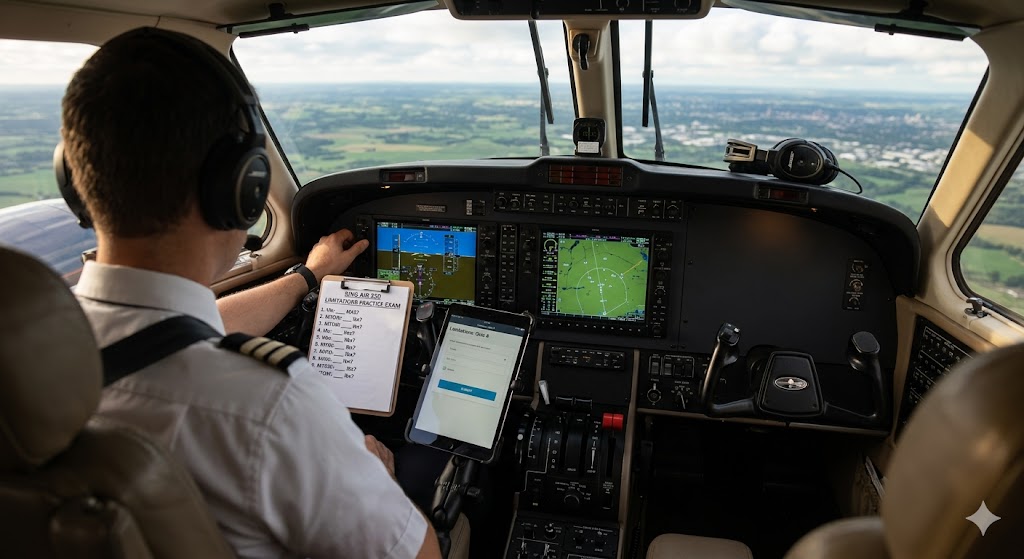
Additional Information
What the Course Entails and Exam Details
This practice test is an focused subset of the comprehensive
King Air 350 Type Rating Course, which usually involves a rigorous 10 to 17-day
ground school and simulator program. While the broader course covers complex
aircraft systems, aerodynamics, multi-crew cooperation, and emergency
procedures, this practice test specifically measures a student's instant recall
of the material found in the "Operating Limitations" section of the
Pilot Operating Handbook (POH). Key topics covered include:
- V-Speeds:
Correct and instant recall of critical airspeeds, including VMO (Maximum
Operating), Va (Maneuvering), Vfe (Flap Extended), Vlo (Landing Gear
Operating), and Vle (Landing Gear Extended).
- Engine
and Powerplant: Limitations related to Interstage Turbine Temperature
(ITT), Torque, Torque/ITT Transient limits, N1, and propeller speed (RPM).
- Weight
and Balance: Maximum Takeoff Weight (MTOW), Maximum Landing Weight
(MLW), Maximum Zero Fuel Weight (MZFW), and structural load factors.
- System
Limitations: Minimum and maximum fuel quantities, fuel balancing,
electrical system limitations, pressurization limits, and autopilot
engagement limits.
- Environmental
and Operations: Icing condition minimums, maximum demonstrated
crosswinds, turbulent air penetration speed, and RVSM (Reduced Vertical
Separation Minimums) operation constraints.
The actual limitations "test" within the type
rating checkride is usually an oral evaluation, but this practice test
is a digital tool, often featuring multiple-choice, select-all-that-apply, and
scenario-based questions, challenging students to recall and apply these
figures correctly under time pressure.
What to Expect in
the Final Exam
While you can take this practice test as a standalone
assessment, the ultimate "Final Exam" is the official FAA (or other
regulatory body) BE-300 type rating checkride. This high-stakes event, often
lasting a full day, is conducted by a designated pilot examiner (DPE) or a Part
142 training center examiner. The checkride is structured into two main
components:
The Oral Examination: This is where the
limitations knowledge is critically tested. Expect a 1 to 2-hour scenario-based
discussion where you must answer, largely from memory, questions about
V-speeds, engine limits, system parameters, and weight-and-balance. A "by
heart" recall of all major limits is non-negotiable.
The Practical Test: Following a successful
oral exam, you'll perform a multi-hour simulator session. You must demonstrate
proficiency in all normal, abnormal, and emergency maneuvers, including
single-engine approaches, engine failures at V1, and emergency descents. A failure
in the oral exam usually prevents you from taking the practical, making
limitations mastery a critical prerequisite. A passing score of 75% or higher
is typically required on all written or formal exams, though the oral exam is
more a pass/fail assessment based on your thoroughness.
How to Study and
Exam Centers
Preparation is the absolute key to success on both this
practice test and the final checkride. Focus on these actionable study
strategies:
- Use
the Practice Test as a Training Tool: Don't just take it once. Retake
it to identify weak areas and reinforce instant recall.
- Flashcards
and Mnemonics: Convert all limitations into digital or physical
flashcards. Use mnemonics for groups of related V-speeds to make recall
instinctive.
- Deep
POH Study: The source of all limitations is Section 2 of the Pilot
Operating Handbook (POH). Read it iteratively.
- Integrate
to Ground School: Take this test in conjunction with a formal King Air
350 type rating course.
- Scenario-Based
Application: Instead of just memorizing "Vfe Approach is 202
knots," imagine you are on a bumpy, visual approach at 210 knots—at
what moment can you legally select the first notch of flaps?
Official King Air 350 training and checkrides are conducted
at FAA-authorized FAR Part 142 flight simulation centers, such as FlightSafety
International, CAE, SIMCOM, and other qualified facilities like FlyRight. These
centers house the full-motion Level D simulators required for initial and
recurrent type ratings. The final examination results are appended to your
existing FAA commercial or ATP certificate.
Job Opportunities
from the Course
A King Air 350 Type Rating (BE-300) is one of the most
versatile and valuable ratings in utility aviation, opening doors to highly
rewarding and stable career paths. Pilots with a King Air 350 rating are in
high demand for numerous roles, including:
- Corporate
Pilot: Fly executives, business teams, or private individuals to
regional and short-field destinations not served by airlines, operating
under Part 91.
- Charter
Pilot: Operate the aircraft for on-demand air charter companies,
transporting groups, cargo, or government personnel under Part 135
regulations.
- Air
Medical Evacuation (Medevac) Pilot: Fly critical missions,
transporting patients and medical teams, sometimes single-pilot, in a
highly optimized medical interior.
- Fractional
Ownership Pilot: Work for fractional operators, providing aircraft
access to a pre-defined set of owners, similar to high-end charter work.
- Special
Operations / Government Contract Pilot: Fly specialized missions such
as aerial surveillance, flight inspection, or personnel transport for
government agencies or private contractors.
- Regional
Cargo Pilot: Fly high-priority, time-sensitive feeder routes for
regional and global cargo companies.
- Flight
Instructor: Teach other experienced multi-engine pilots how to fly the
King Air 350 at advanced flight schools or Part 142 centers.
Frequently Asked Questions
Reviews
5.0
Based on 0 reviews
Leave a Review
No reviews yet. Be the first to review!