
KMK Mnemonics Practice Test
$69.00
- Buy to unlock unlimited access to all Quiz questions and Answers in this Quiz.
- After purchase you can print a PDF of the whole quiz at any point. The PDF will contain the questions and the correct answers.
About this Exam
The KMK Mnemonics Practice Test is an indispensable study tool specifically designed for optometry students preparing for the National Board of Examiners in Optometry (NBEO) board examinations.
This specialized test serves as a bridge between vast volumes of medical information and quick, reliable recall during high-stakes testing.
By utilizing proven memory devices, acronyms, and visual associations, the KMK methodology takes the overwhelming amount of basic science and clinical data required for optometry boards and compresses it into an easily digestible format.
Whether you are a third-year optometry student gearing up for NBEO Part 1 (Applied Basic Science) or entering your final year to tackle Part 2 (Patient Assessment and Management), this preparation pathway is built to help you succeed with confidence.
Ready to test your knowledge?
Buy Now to Access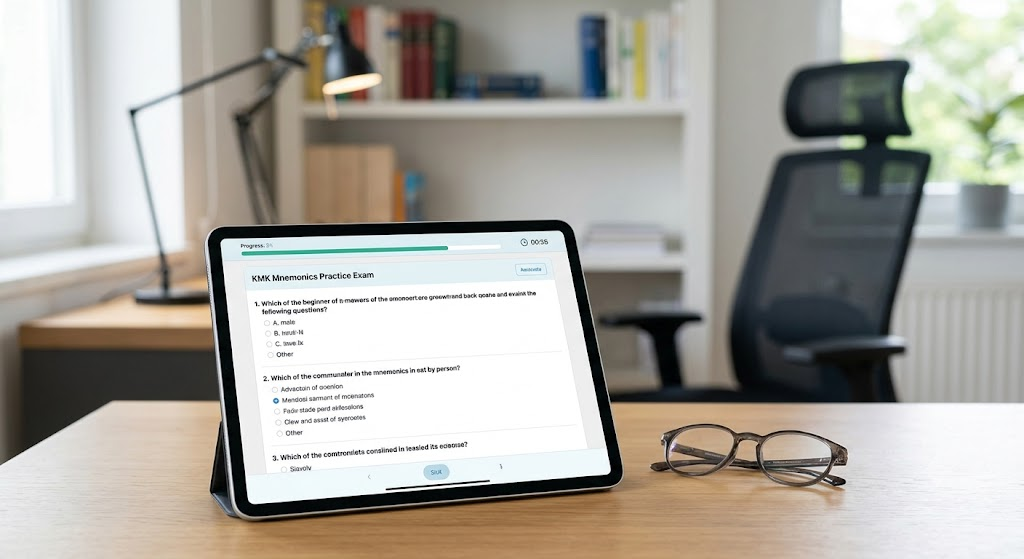
Additional Information
What the Course Entails and Exam Details
The KMK Mnemonics curriculum deeply integrates core optometric sciences with advanced recall strategies.
Students will cover a comprehensive syllabus that includes ocular anatomy, systemic diseases, neuro-anatomy, pharmacology, optics, and visual science.
Instead of simple rote memorization, the course entails learning highly specific memory hooks—mnemonics—that group related ocular side effects, drug mechanisms, and disease symptoms together.
The accompanying practice exams are detailed simulations designed to test your retention of these mnemonics under pressure.
You will be challenged to recall complex drug interactions, decipher systemic conditions presenting with ocular signs, and quickly identify the correct physiological pathways using the shortcuts you have learned.
What to Expect in the Final Exam
When you sit for the actual NBEO exams that these practice tests prepare you for, you can expect a rigorous, multi-day testing experience.
For NBEO Part 1, the exam format consists entirely of multiple-choice questions delivered over two sessions in a single day, with each session lasting three and a half hours.
You will face intricate questions that require not just recall, but application of basic science principles to clinical scenarios.
The passing score requirement is determined by a scaled score, generally standardized to a 300 passing mark.
Strict rules apply during the examination, including prohibited access to outside resources, mandatory identification checks, and closely monitored, timed blocks where efficient recall—powered by your mnemonics practice—becomes your greatest asset.
How to Study and Exam Centers
To study effectively for this monumental exam, active recall and spaced repetition must become your primary strategies.
Begin by memorizing the core KMK mnemonics using physical or digital flashcards, reviewing them daily until they become second nature.
Transition into taking timed practice tests to build your stamina and simulate the intense pacing of the actual board exams.
When you encounter a question you answer incorrectly, revisit the specific mnemonic associated with that topic and write it out multiple times to reinforce the neural pathway.
When it comes to the official NBEO examination, tests are administered globally through authorized Pearson VUE testing centers.
You must register online through the NBEO portal, select an available Pearson VUE center near your location, and ensure you arrive early on test day with your approved identification documents.
Job Opportunities from the Course
Successfully passing the NBEO board exams using the KMK Mnemonics preparation unlocks the door to a rewarding career in eye care and medicine. Acquiring your medical license opens up numerous specialized career paths, including:
Licensed Optometrist (OD): Work in private practice, retail settings, or hospitals diagnosing and treating visual and systemic ocular disorders.
Clinical Director of Optometry: Oversee the clinical operations, staff training, and patient care standards within a multi-doctor practice or healthcare network.
Medical Science Liaison (Ophthalmics): Bridge the gap between pharmaceutical companies and medical professionals by educating peers on new ophthalmic drugs and treatments.
Pediatric Optometrist: Specialize in vision care for children, focusing on developmental vision, binocular vision disorders, and myopia management.
Ophthalmic Consultant: Provide expert advice to surgical centers, specialty clinics, or healthcare technology companies developing new optical devices.
Private Practice Owner: Build and manage your own independent optometry clinic, combining clinical patient care with medical entrepreneurship.
Frequently Asked Questions
Reviews
5.0
Based on 0 reviews
Leave a Review
No reviews yet. Be the first to review!