
LADOTD PCC Plant Inspection Practice Exam
$69.00
- Buy to unlock unlimited access to all Quiz questions and Answers in this Quiz.
- After purchase you can print a PDF of the whole quiz at any point. The PDF will contain the questions and the correct answers.
About this Exam
The LADOTD PCC Plant Inspection certification is designed
for professionals involved in the production, inspection, quality control, and
acceptance of portland cement concrete for LADOTD projects in Louisiana. This
designation signifies expertise in concrete materials, plant operations,
testing procedures, and adherence to LADOTD specifications. It is highly
valuable for quality control technicians, concrete plant employees, materials
testing specialists, and prospective LADOTD inspectors, ensuring that the
critical infrastructure components of Louisiana meet quality and durability
standards. Achieving this certification demonstrates your competency and
commitment to quality and safety in state construction. The LADOTD PCC Plant
Inspection Practice Exam is an essential tool for your preparation journey.
Ready to test your knowledge?
Buy Now to Access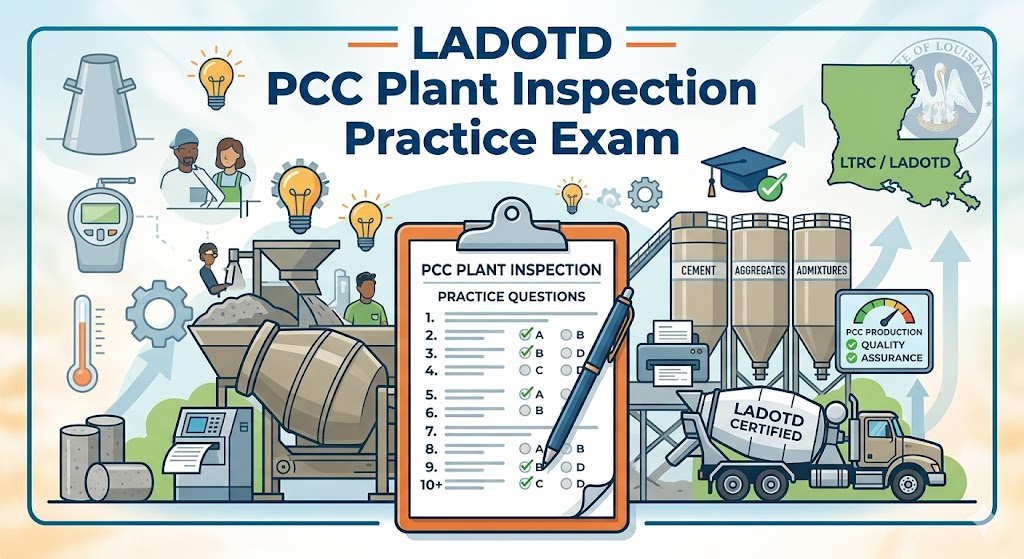
Additional Information
What the Course
Entails and Exam Details
The comprehensive curriculum for this certification covers
the theoretical knowledge and practical understanding required for effective
concrete plant inspection. While the exact structure of a course (if required
for initial certification) can vary, the final exam tests proficiency across
several key areas, typically based on LADOTD Standard Specifications and
related test procedures. Core topics include:
- LADOTD
Standard Specifications: Deep understanding of the specific sections
relevant to concrete production, materials, quality control, and
acceptance (e.g., sections concerning materials, design, and operations).
- Concrete
Materials: Detailed knowledge of cement types, aggregate properties
(gradation, quality, soundness), water requirements, and the purpose and
effect of common admixtures (e.g., air-entrained agents, water reducers,
retarders).
- Concrete
Mix Design: Familiarity with the principles of mix design and
understanding LADOTD's classification and requirements for specific
concrete applications.
- Plant
Operations: Knowledge of concrete batch plant components, operations,
calibration, batching procedures, and quality monitoring.
- Fresh
Concrete Testing Procedures: Proficiency in the requirements and
correct procedures for key fresh concrete tests, such as slump, air
content, temperature, and fresh unit weight.
- Hardened
Concrete Properties: Basic understanding of the factors affecting and
methods for testing hardened concrete properties, including compressive
and flexural strength.
- Quality
Control & Assurance: Knowledge of quality control chart
application, sampling procedures, and required documentation (forms, batch
tickets).
- Safety
& Compliance: Understanding safety regulations within a concrete
plant environment and ensuring all operations and testing are compliant
with established standards.
Exam Details: The final examination typically
requires you to demonstrate competency through a set of comprehensive questions
designed to evaluate your knowledge across the entire curriculum. It's crucial
to confirm the current details, such as the number of questions, time limit,
and passing score with the official certification body (LTRC/LADOTD).
What to Expect in
the Final Exam
While the specific details are subject to change, the final
official exam generally involves several components:
- Theoretical
Examination: A significant portion of the assessment often consists of
multiple-choice and perhaps some true/false or short answer questions.
This part will test your theoretical understanding of specifications,
material properties, mix design, testing procedures, and overall plant
inspection concepts. Expect questions detailing LADOTD requirements and
common inspection scenarios.
- Time
Constraints: The exam will likely have a specified time limit,
requiring you to answer questions efficiently and manage your time
effectively during the test.
- Passing
Score: There is typically a minimum required passing percentage (e.g.,
70% or higher). You will be notified of the specific requirement and your
score upon completion or through official channels.
- Allowed
Materials: Clarify in advance whether the exam is closed-book,
open-book (with limited materials such as official LADOTD specifications),
or requires specific documentation. Ensure you understand what resources
are permitted.
- Authorized
Center Rules: The exam will be administered at official authorized
locations and will adhere to specific code-of-conduct and proctoring
rules. Be prepared with valid identification and follow all instructions
provided by the testing staff.
How to Study and
Exam Centers
Preparation is key to succeeding on the PCC Plant Inspection
Exam. Here are effective strategies to optimize your study:
- Use
the LADOTD PCC Plant Inspection Practice Exam: This resource is
invaluable for familiarizing yourself with the types of questions and
concepts you will encounter, identifying your strengths and weaknesses,
and gaining confidence. Use it as a diagnostic tool early in your
preparation and for simulated test runs.
- Study
Official Manuals and Specifications: Obtain and thoroughly review the
current LADOTD standard specifications, manuals (like the Quality
Assurance Manual), related test procedures, and any official study guides
or manuals provided for the certification. This content is the ultimate
source of knowledge for the exam.
- Focus
on Key Topics: Dedicate focused study time to concrete materials,
LADOTD specifics, testing procedures, quality control, and plant
operations. Create summaries, flashcards, or mind maps for complex areas.
- Understand
Testing Standards: Ensure you are deeply familiar with the standards
(e.g., ASTM standards referenced by LADOTD) for key fresh concrete tests
and understand the nuances of correct procedure and acceptable result
ranges.
- Practice
with Real Scenarios: Try to apply your knowledge to real-world plant
scenarios. Think about how specifications would be implemented and how
quality control would be maintained in a practical setting. If possible,
shadow a certified inspector or spend time in a concrete plant to gain
practical context.
- Review
Documentation: Understand the types of forms, reports, and
documentation required for plant inspection and acceptance, and the
importance of accurate record-keeping.
Exam Centers & Registration:
- Authorized
Testing Locations: The exams are typically administered through the
Louisiana Transportation Research Center (LTRC) in coordination with
LADOTD. Testing locations can include LTRC’s main facilities, authorized
technical colleges across Louisiana, or other officially designated sites.
Check the official LTRC certification website for the most up-to-date
information on exam locations.
- Application
Process: To take the exam, you must complete the required application
forms and fulfill any prerequisites (such as specific course attendance or
work experience, especially for initial certification). Application
details and forms are available through the LTRC website.
- Fees:
Certification exams and related courses (if applicable) involve associated
fees. The exact fee schedule is detailed on the application materials and
LTRC website.
- Scheduling:
Once your application is accepted and fees are paid, you will need to
schedule your exam date and location according to the provided
instructions. Be aware of registration deadlines and any requirements for
rescheduling.
Job Opportunities
from the Course
Achieving your LADOTD PCC Plant Inspection Certification can
unlock numerous rewarding career paths in the construction and quality
assurance sectors within Louisiana. Key job opportunities include:
- Concrete
Plant Inspector (Government/LTRC/LADOTD): Working directly for the
state department of transportation or related agencies to inspect concrete
plants, monitor production, and ensure concrete meets specification
requirements for public projects.
- Quality
Control (QC) Technician/Manager (Concrete Plants): Employed by
concrete production companies to manage and perform all required quality
control tests, develop mix designs, maintain quality charts, and ensure
concrete meets all customer and regulatory specifications.
- Construction
Materials Testing (CMT) Specialist (Private Labs): Working for
independent material testing laboratories to perform a range of tests on
concrete, aggregates, and other construction materials, providing
inspection services for both public and private clients.
- Asphalt/Concrete
Field Inspector: Often, certifications for plant and field inspection
are related or build upon each other. Your knowledge of concrete
properties and specifications will be valuable in field roles monitoring
the placement and paving of concrete on construction sites.
- Production
Supervisor/Manager (Concrete Batch Plants): The comprehensive
understanding of concrete materials and plant operations gained through
certification can lead to management roles overseeing the safe and
efficient operation of concrete production plants.
- Materials
Engineer (Entry-Level/Technician): For those with a relevant
engineering background, this technician-level certification serves as a
valuable practical credential on the path to becoming a professional
materials engineer, offering insights into spec application and quality
control.
- Consultant
in Concrete Quality & Durability: Leverage your expertise and
certification to provide consulting services related to concrete mix
design, production, and quality issues for various clients.
Frequently Asked Questions
Reviews
5.0
Based on 0 reviews
Leave a Review
No reviews yet. Be the first to review!