
Lake Ontario License Practice Test
$69.00
- Buy to unlock unlimited access to all Quiz questions and Answers in this Quiz.
- After purchase you can print a PDF of the whole quiz at any point. The PDF will contain the questions and the correct answers.
About this Exam
The Lake Ontario License represents a crucial step for
professionals aiming to work on the waters of this Great Lake, which straddles
the border between the United States (New York) and Canada (Ontario). Depending
on the nature of your proposed activities, this certification path is designed
for individuals seeking to operate commercial vessels, lead paid fishing
charters, conduct guided tours, or engage in commercial fishing. It is for the
aspiring professional who wants to transform their passion for the water into a
career, ensuring they possess the safety, legal, and operational knowledge
required to responsible serve clients and navigate this complex and dynamic
freshwater environment. Whether you are aiming for a Master license to captain
large vessels or a specialized guide license for an intimate fishing
experience, understanding the regional and international regulations is key,
and preparing for the exams is your first port of call.
Ready to test your knowledge?
Buy Now to Access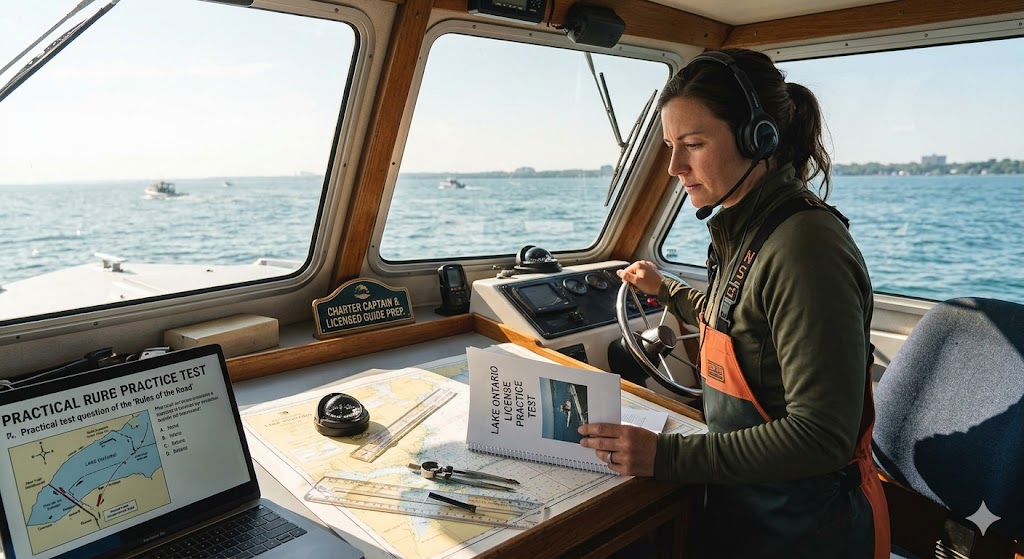
Additional Information
What the Course Entails and Exam Details
The path to a Lake Ontario commercial or guiding license is
multi-faceted, with your specific training and examination detailed by the
authority under which you seek to operate. The core topics generally divide
into two main pathways: the Charter Captain's License and the State
or Provincial Licensed Guide Program. A comprehensive prep course will
entail mastery in the following areas:
- Maritime
Rules of the Road (International and Inland): This is the foundation
of all vessel operation. You must learn the complex system of lights,
shapes, and sound signals that dictate right-of-way and safe interaction
with other vessels to prevent collisions.
- Navigation
and Chart Plotting: The ability to accurately read a nautical chart,
use a compass, plot a course, and account for variables like variation,
deviation, set, and drift is tested extensively. This includes both
traditional and electronic navigation.
- Safety
and Seamanship: Comprehensive knowledge of safety protocols is
paramount. Topics cover fire-fighting, marlinspike seamanship (knots and
line handling), boat handling in heavy weather, anchoring, vessel
stability, and emergency procedures, including man-overboard drills.
- Deck
General and Safety: This covers practical vessel knowledge, such as
standard deck equipment, pollution regulations (MARPOL), vessel documents,
and legal responsibilities.
- State
and Provincial Regulations (Guiding-Specific): For guide licenses
(such as New York's Licensed Guide Program), you must master specific
environmental conservation laws, fish and game limits, client care
guidelines, and small business requirements. You must often hold valid
certifications in First Aid, CPR, and Water Safety.
What to Expect in the Final Exam
While the exact nature of your final exam depends on the
regulatory body (US Coast Guard, Transport Canada, NY DEC, or Ontario MNRF),
you can expect a rigorous testing environment. Generally, the exams are
multi-part, primarily multiple-choice, and conducted in a secure, proctored
setting.
- Multiple-Choice
Format: The vast majority of written questions are multiple-choice,
designed to test both factual knowledge and its application to theoretical
scenarios.
- High
Passing Scores: The standards are high, especially for the maritime
components. For instance, the USCG "Rules of the Road" exam
requires a score of 90%, while other sections (Deck, Navigation) often
require 70-80%. Guide program exams typically set their bar at 70% or
higher.
- Time
Limits: You should expect to work under strict time constraints for
each section. Navigational charting sections are particularly
time-sensitive, as you are expected to complete multi-step plots
accurately and efficiently.
- Chart
Plotting and Calculation: You will be required to physically plot
courses and perform calculations on a specified chart, using tools like
dividers and parallel rules. Accuracy is non-negotiable.
- No
Practical Component: While you must possess and often document
practical skills (like sea time, First Aid, or a Physician's statement),
the licensing bodies themselves usually do not conduct a hands-on "on
the water" test. Your knowledge and sea service serve as the proof of
competency.
Frequently Asked Questions
Reviews
5.0
Based on 0 reviews
Leave a Review
No reviews yet. Be the first to review!