
Lake Ontario Local Knowledge Practice Test
$69.00
- Buy to unlock unlimited access to all Quiz questions and Answers in this Quiz.
- After purchase you can print a PDF of the whole quiz at any point. The PDF will contain the questions and the correct answers.
About this Exam
The Lake Ontario Local Knowledge Practice Exam is an essential tool for all mariners seeking to navigate North America's easternmost Great Lake safely and with confidence. This guide is expertly designed to assist both commercial vessel operators requiring specific localized certifications and dedicated recreational boaters looking to deepen their understanding. Preparing for this assessment ensures you have a thorough grasp of the unique challenges, regulations, and features specific to Lake Ontario. Gaining this mastery is key to ensuring passenger safety, protecting your vessel, and navigating efficiently across these vast and varied waters
Ready to test your knowledge?
Buy Now to Access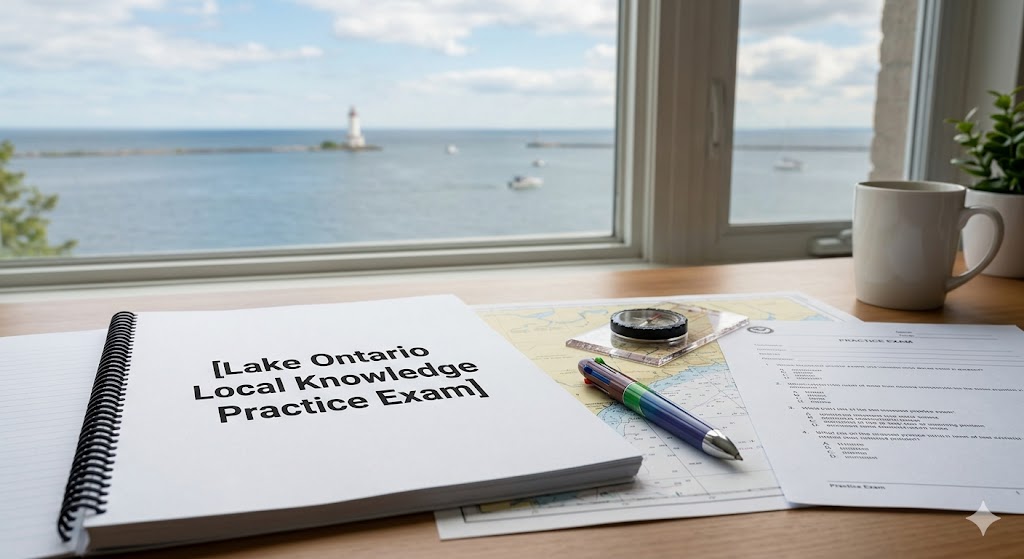
Additional Information
What the Course Entails and Exam Details
The path to a Lake Ontario commercial or guiding license is
multi-faceted, with your specific training and examination detailed by the
authority under which you seek to operate. The core topics generally divide
into two main pathways: the Charter Captain's License and the State
or Provincial Licensed Guide Program. A comprehensive prep course will
entail mastery in the following areas:
- Maritime
Rules of the Road (International and Inland): This is the foundation
of all vessel operation. You must learn the complex system of lights,
shapes, and sound signals that dictate right-of-way and safe interaction
with other vessels to prevent collisions.
- Navigation
and Chart Plotting: The ability to accurately read a nautical chart,
use a compass, plot a course, and account for variables like variation,
deviation, set, and drift is tested extensively. This includes both
traditional and electronic navigation.
- Safety
and Seamanship: Comprehensive knowledge of safety protocols is
paramount. Topics cover fire-fighting, marlinspike seamanship (knots and
line handling), boat handling in heavy weather, anchoring, vessel
stability, and emergency procedures, including man-overboard drills.
- Deck
General and Safety: This covers practical vessel knowledge, such as
standard deck equipment, pollution regulations (MARPOL), vessel documents,
and legal responsibilities.
- State
and Provincial Regulations (Guiding-Specific): For guide licenses
(such as New York's Licensed Guide Program), you must master specific
environmental conservation laws, fish and game limits, client care
guidelines, and small business requirements. You must often hold valid
certifications in First Aid, CPR, and Water Safety.
What to Expect in the Final Exam
While the exact nature of your final exam depends on the
regulatory body (US Coast Guard, Transport Canada, NY DEC, or Ontario MNRF),
you can expect a rigorous testing environment. Generally, the exams are
multi-part, primarily multiple-choice, and conducted in a secure, proctored
setting.
- Multiple-Choice
Format: The vast majority of written questions are multiple-choice,
designed to test both factual knowledge and its application to theoretical
scenarios.
- High
Passing Scores: The standards are high, especially for the maritime
components. For instance, the USCG "Rules of the Road" exam
requires a score of 90%, while other sections (Deck, Navigation) often
require 70-80%. Guide program exams typically set their bar at 70% or
higher.
- Time
Limits: You should expect to work under strict time constraints for
each section. Navigational charting sections are particularly
time-sensitive, as you are expected to complete multi-step plots
accurately and efficiently.
- Chart
Plotting and Calculation: You will be required to physically plot
courses and perform calculations on a specified chart, using tools like
dividers and parallel rules. Accuracy is non-negotiable.
- No
Practical Component: While you must possess and often document
practical skills (like sea time, First Aid, or a Physician's statement),
the licensing bodies themselves usually do not conduct a hands-on "on
the water" test. Your knowledge and sea service serve as the proof of
competency.
How to Study and
Exam Centers
Preparation is the key to passing these challenging exams. A
blended approach is most effective for long-term retention and examination
success:
Actionable Study Strategies
- Take
Multiple Practice Exams: This is your best tool. Use practice tests
early to identify weaknesses and later to build speed and accuracy. Mimic
exam conditions (time, no distractions). Focus on understanding why
an answer is correct, not just memorizing.
- Utilize
Official Study Guides: Regulatory bodies (like the NY DEC) often
provide detailed study syllabi or PDF guides that outline the exact
material to be covered. Make this your primary resource.
- Enroll
in an Accredited Course: For the Charter Captain path (USCG or
Transport Canada), enrolling in an approved, accredited captain's school
is highly recommended. These courses provide expert instruction,
structured learning, and often allow you to take the final proctored exam
with them, simplifying the logistics.
- Master
the Rules of the Road: This is often the biggest hurdle. Devote
significant time to memorizing all lights, shapes, and signals. Use
flashcards and interactive apps to drill.
Where and How to Take the Exam
- US
Coast Guard Regional Exam Centers (RECs): US candidates must schedule
and take their comprehensive exams at one of the several REC locations.
- Transport
Canada Accredited Schools: Canadian candidates can often take their
written and practical assessments through Transport Canada-approved
training institutions.
- New
York State DEC Offices: For the NY Licensed Guide Program, you
register and take the specific category exams (Basic, Fishing, Boats &
Canoes) at designated NY DEC regional offices.
- Pearson
VUE / Pearson Professional Assessments: Some knowledge-based
certifications are beginning to utilize third-party testing partners.
While not typical for comprehensive USCG captain's exams, check if any
components of your guide license can be proctored through a Pearson
Professional Assessment center.
Job Opportunities
from the Course
A Lake Ontario License is not just a certificate; it's a key
that unlocks a variety of career paths in the marine industry. Your license
level will dictate your specific job titles, but here is a clear list of
potential roles:
- Charter
Boat Captain: Lead paying customers on personalized fishing charters
for Lake Ontario's famous trout, salmon, and smallmouth bass.
- Fishing
Guide: Provide expert guiding services, either on your own vessel or
for a resort, focusing on an instructional or immersive angling
experience.
- Tour
Boat Captain / Sightseeing Operator: Operate vessels for sightseeing,
historical, or sunset cruises, serving the tourism industry.
- Commercial
Fisherman: Engage in commercial fishing operations, a vital but highly
regulated sector on Lake Ontario.
- Water
Taxi or Launch Operator: Provide transportation services between
marinas, islands, or to larger anchored vessels.
- Commercial
Diver Vessel Operator: Captain a boat designed to support professional
diving operations for underwater construction, inspection, or salvage.
Frequently Asked Questions
Reviews
5.0
Based on 0 reviews
Leave a Review
No reviews yet. Be the first to review!