
Law Enforcement Aptitude Battery (LEAB) Practice Exam
$69.00
- Buy to unlock unlimited access to all Quiz questions and Answers in this Quiz.
- After purchase you can print a PDF of the whole quiz at any point. The PDF will contain the questions and the correct answers.
About this Exam
The Law Enforcement Aptitude Battery (LEAB) is a
comprehensive, entry-level selection exam designed to evaluate the critical
skills, cognitive abilities, and personal characteristics necessary for success
in a law enforcement career. This assessment is used by a growing number of
police departments, state agencies, and other law enforcement bodies across the
United States to screen applicants. The LEAB goes beyond mere academic
knowledge, assessing how potential candidates think, make decisions, and
interact with the world under the varied conditions of police work. It is
designed to identify individuals who possess not only the required aptitude but
also the resilience and ethical mindset to serve their communities effectively.
For applicants, a strong performance on the LEAB is often a critical early step
in securing a place in a law enforcement academy.
Ready to test your knowledge?
Buy Now to Access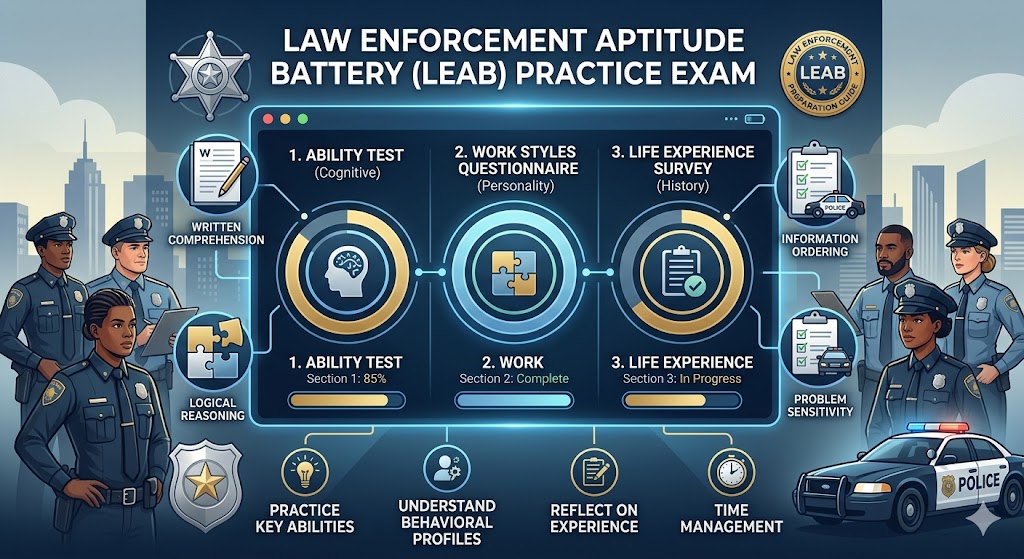
Additional Information
What the Course Entails and Exam Details
The LEAB is a multi-faceted assessment composed of three
primary, distinct sections that contribute to a candidate’s overall profile:
- Part
I: The Ability Test: This section is a 2-hour, multiple-choice
cognitive assessment that evaluates six core mental abilities identified
as essential for effective police performance:
- Written
Comprehension: The ability to understand and interpret written
information.
- Written
Expression: The ability to communicate ideas clearly in writing,
focusing on vocabulary, grammar, and clarity.
- Problem
Sensitivity: The ability to recognize when something is wrong or
likely to go wrong.
- Deductive
Reasoning: The ability to apply general rules to specific problems to
find a logical answer.
- Inductive
Reasoning: The ability to combine pieces of information to form
general rules or conclusions.
- Information
Ordering: The ability to follow a given rule or set of rules in the
correct order.
- Part
II: The Work Styles Questionnaire (WSQ): This section assesses a
candidate’s personality traits, behavioral preferences, and attitudinal
characteristics. It is not about right or wrong answers, but rather
matching an individual's personal style to the demands of the law
enforcement role, evaluating factors like conscientiousness, emotional
stability, and teamwork.
- Part
III: The Life Experience Survey (LES): This section gathers structured
information about a candidate’s past history, including educational, work,
and personal experiences, to predict future performance and ethical
behavior. It helps paint a holistic picture of the applicant's background
and suitability for public service.
The entire LEAB examination process typically takes
approximately 2.5 to 3 hours to complete, with candidates moving sequentially
through the three components.
What to Expect in
the Final Exam
When taking the actual LEAB, candidates should expect a
structured, professional environment. All three sections are usually
administered in a single session, often in a computer-based format at an
agency-specified testing location or online portal. While the Ability Test has
a recommended time of 2 hours for the 48 questions, the exam may be proctored
as a whole, requiring applicants to manage their time across all sections.
Regarding scores, the LEAB does not have a universal
"passing" grade. Instead, responses from all three parts are combined
to create a comprehensive score profile. Candidates often receive a
standardized score, such as a T-score, which allows a candidate’s performance
to be compared to a representative group of entry-level law enforcement
applicants. Individual law enforcement agencies establish their own cut-off
scores based on their hiring needs and standards. For example, a T-score of 50
might be considered average, and agencies may require scores above that level.
Retake policies vary, but many agencies allow candidates to
retest after a specific period, such as 30 or 90 days, if they do not meet the
initial hiring benchmark.
How to Study and
Exam Centers
To succeed on the LEAB, preparation must address all three
components of the exam. The most effective study strategy involves using
official preparation materials, such as the candidate guides provided by the
testing agency (like EB Jacobs, now a PSI business) or detailed guides from
individual departments.
For the Ability Test, practice is essential. Use
sample questions to understand the format of each of the six cognitive
categories. Focus on developing your speed and accuracy by timing yourself
during practice sessions. Improve Written Comprehension by reading
varied texts, and Written Expression by reviewing basic grammar rules
and report-writing principles. For the reasoning sections, break down scenarios
to practice logical deduction and identifying patterns.
For the Work Styles Questionnaire and Life
Experience Survey, the key is to be honest, consistent, and to answer from
a professional perspective. Researching the "core competencies" of
the specific law enforcement agency you are applying to can help you understand
the qualities they value. Avoid trying to answer how you think they want you
to; instead, be truthful while presenting your best self.
Regarding exam centers, there is no central "LEAB test
center." Candidates must apply directly to a specific law enforcement
agency to begin the selection process. If the agency uses the LEAB, they will
provide information on when and where to take the test. This can include:
- Online
portals, allowing candidates to test remotely with a secure system.
- Physical
testing locations managed directly by the state police, sheriff's office,
or police department.
- Regional
assessment centers that facilitate testing for multiple local agencies.
Always confirm details with your hiring agency well in
advance.
Job Opportunities from the Course
Achieving a competitive score on the LEAB opens the door to
numerous vital and rewarding careers within the public safety sector. It is a
mandatory requirement for hundreds of agencies across the country, primarily
leading to the following roles:
- State
Trooper
- Highway
Patrol Officer
- Police
Officer (Municipal/City)
- Deputy
Sheriff
- Conservation
Officer/Game Warden
- University
Police Officer
- Correctional
Officer (in certain state systems)
- Port
Authority Police Officer
Frequently Asked Questions
Reviews
5.0
Based on 0 reviews
Leave a Review
No reviews yet. Be the first to review!