
Law Enforcement Communication and Information System Practice Test
$69.00
- Buy to unlock unlimited access to all Quiz questions and Answers in this Quiz.
- After purchase you can print a PDF of the whole quiz at any point. The PDF will contain the questions and the correct answers.
About this Exam
This Law Enforcement Communication and Information System (LE CIS) practice exam is a crucial preparatory tool for professionals aiming to excel in the critical world of public safety information exchange. It is specifically designed for aspiring and current law enforcement personnel, telecommunicators, and support staff who rely daily on complex national and state databases. Whether you are aiming for a role as a police officer, a 911 dispatcher, or a data systems analyst, mastering these systems is non-negotiable. This study guide ensures you possess the technical knowledge, regulatory understanding, and operational speed required to maintain public safety and officer welfare through effective data management
Ready to test your knowledge?
Buy Now to Access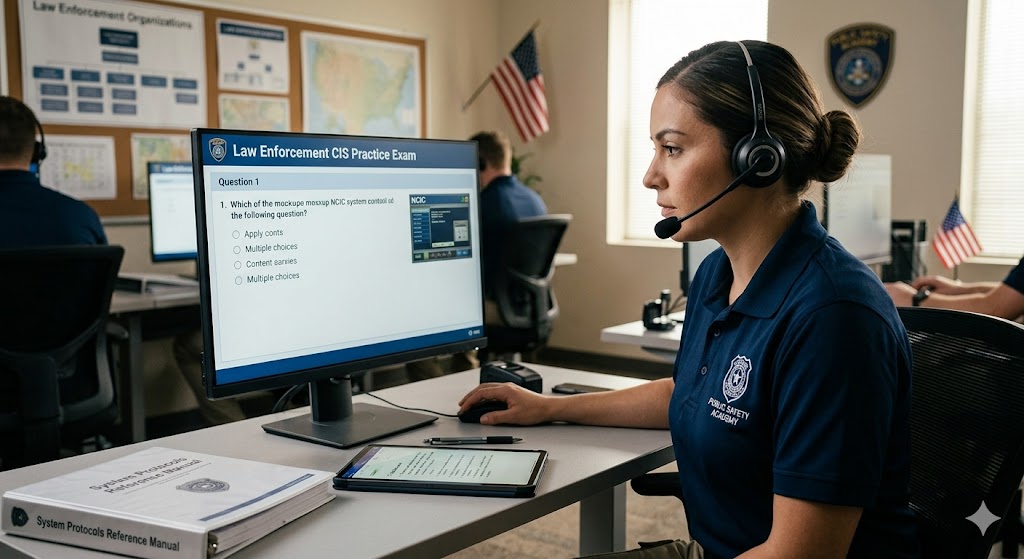
Additional Information
What the Course
Entails and Exam Details
This practice course and the eventual examination cover the
comprehensive knowledge base necessary to operate standardized law enforcement
networks.
You must demonstrate a thorough understanding of systems
such as the National Crime Information Center (NCIC), the National Law
Enforcement Telecommunications System (NLETS), and regional Computer-Aided
Dispatch (CAD) architectures.
Core topics include the legal protocols surrounding Criminal
Justice Information Services (CJIS) data security, appropriate procedures for
querying and entering sensitive data, and interpreting the complex response
codes generated by these systems.
We also emphasize the operational rules governing the
access, use, and dissemination of "hit" confirmations, missing
persons data, stolen vehicle reports, and criminal history records.
What to Expect in the
Final Exam
While exact formats can vary by jurisdiction or certifying
agency (such as individual state CJIS authorities), candidates should generally
prepare for a standardized, computer-based multiple-choice exam.
The examination is designed to be rigorous, often combining
strict time limits with scenario-based questions that require you to apply
protocol knowledge under pressure, simulating real-world dispatcher or patrol
officer environments.
You may encounter questions asking you to identify the
correct message key (MKE) for a given situation or determine the legality of a
specific data dissemination scenario.
Passing score requirements are typically high—often between
75% and 80%—due to the critical nature of the data involved.
You should expect the exam to be "closed book,"
prohibiting any access to procedural manuals or external resources during the
test.
How to Study and
Exam Centers
The key to success is combining conceptual understanding
with repetitive practical application.
Begin by deeply studying the official CJIS or state-specific
LE CIS operations manuals provided by your agency or academy, as these are the
source material for the test.
Utilize this practice test repeatedly to identify weak areas
and familiarize yourself with the phrasing of regulatory questions.
Focus intensely on data entry standards and dissemination
rules, as these are frequently tested areas.
The official certification exams are usually administered in
structured environments.
They take place at authorized locations such as state police
academies, specific law enforcement training headquarters, or approved testing
facilities like Pearson VUE, depending on the requirements of the certifying
state body.
Remote online proctoring may be available in certain
jurisdictions, but physical testing centers remain common for security
purposes.
Job Opportunities
from the Course
Achieving mastery in Law Enforcement Communication and
Information Systems opens the door to numerous vital positions within public
safety agencies.
- Emergency
Communications Officer (911 Dispatcher)
- Police
Records Specialist
- Terminal
Agency Coordinator (TAC)
- Law
Enforcement Support Technician
- Crime
Data Analyst
- Criminal
Justice Information Services (CJIS) Compliance Officer
- State/Federal
Information Systems Administrator
Frequently Asked Questions
Reviews
5.0
Based on 0 reviews
Leave a Review
No reviews yet. Be the first to review!