
Law Society of Ontario Licensing Practice Exam
$69.00
- Buy to unlock unlimited access to all Quiz questions and Answers in this Quiz.
- After purchase you can print a PDF of the whole quiz at any point. The PDF will contain the questions and the correct answers.
About this Exam
The Law Society of Ontario (LSO) licensing exams represent
the final, critical hurdle for candidates seeking to practice as lawyers or
paralegals in Ontario. These rigorous assessments are not designed to test
theory, but rather to ensure that applicants possess the required entry-level
competencies to provide legal services safely, ethically, and effectively to
the public. Passing these exams is a mandatory requirement for licensure,
making thorough preparation absolutely essential. This guide is designed to
help candidates navigate the preparation process using practice exams
effectively.
Ready to test your knowledge?
Buy Now to Access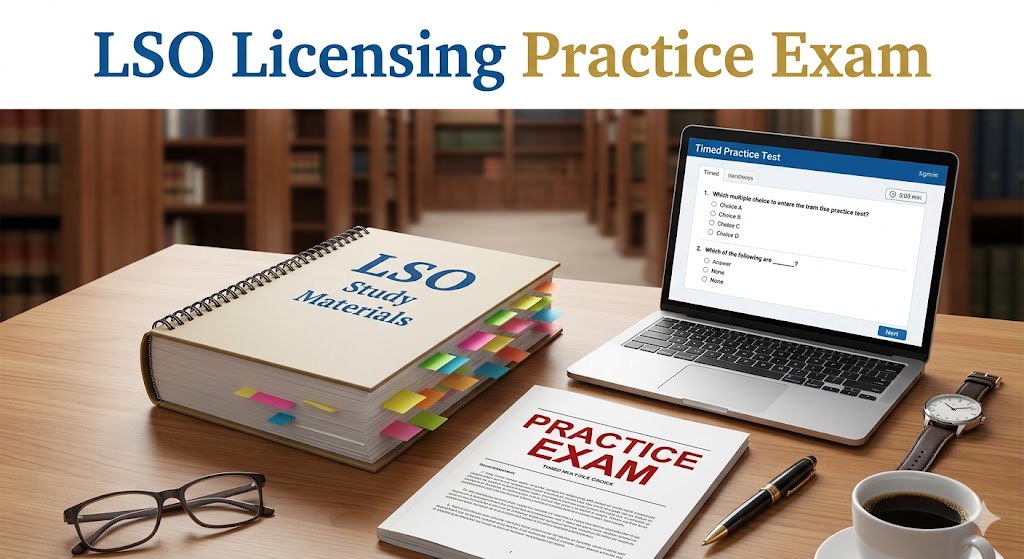
Additional Information
What the Course Entails and Exam Details
While there is no taught "course" meant for the
licensing process, the LSO provides massive, detailed study materials that form
the entirety of the exam syllabus. The exams represent a comprehensive testing
of a candidate's ability to apply the law to factual scenarios.
For lawyer candidates, the process involves two separate
seven-hour examinations: The Barrister Examination and the Solicitor
Examination. The Barrister Exam focuses on practice areas relevant to
litigation, including public law, criminal procedure, family law, and civil
litigation, along with ethical and professional responsibilities. The Solicitor
Exam focuses on transactional practice, covering real estate, business law,
wills, trusts, and estate administration, also heavily featuring ethical
obligations.
For paralegal candidates, a single, comprehensive Licensing
Examination covers competencies in various areas of law permitted within the
paralegal scope of practice, including administrative law, small claims court,
criminal/quasi-criminal law (provincial offences/summary convictions), and
landlord and tenant law, alongside professional ethics.
What to Expect in
the Final Exam
The LSO licensing exams are unique due to their open-book
format and extreme time constraints. All exams consist entirely of complex,
situational multiple-choice questions.
Candidates are permitted to bring the official LSO study
materials, properly bound and indexed, into the testing center. These exams do
not measure rote memorization but rather the ability to quickly locate
information, analyze a complex set of facts, and apply the correct legal
principles under immense time pressure. The examinations are typically split
into two sessions (morning and afternoon) on the test day.
While the passing score is not a set percentage and is
determined statistically for each sitting, standard psychometric methods are
used to ensure the standard for licensure is met.
How to Study and
Exam Centers
Successfully preparing for the LSO exams requires a strict
study schedule and, most importantly, a robust tabbing and indexing strategy.
Because the exams are open-book, you must be able to find precise sections
within thousands of pages of material in seconds.
Many students find it helpful to create or purchase detailed
indices. However, the golden rule of studying for the LSO exams is that indices
are useless if you are not deeply familiar with the structure and content of
the LSO materials themselves.
Actionable study strategies include:
Reading the materials in detail
to understanding the overarching structure.
Building or customizing a
comprehensive index and tabbing the physical materials.
Engaging in active retrieval by
taking high-quality practice exams.
Practice exams are crucial for learning how to manage your
time, testing your index system, and acclimating to the structure of LSO-style
questions. You must simulate exam conditions during practice.
Regarding exam delivery, the LSO has traditionally utilized
large, in-person testing centers in cities like Toronto, Ottawa, and Windsor.
Candidates must check their LSO online portal for specific details on upcoming
exam sittings, as the LSO may update delivery methods or locations.
Job Opportunities
from the Course
Successfully passing the LSO licensing exams and fulfilling
the other licensing requirements (such as experiential training for lawyer
candidates) leads to licensure to practice in Ontario. This opens the door to
numerous prestigious and rewarding career paths, including:
- Associate
Lawyer in Private Practice (ranging from small firms to large Bay Street
firms)
- Licensed
Paralegal (sole practitioner or employed in a law firm/legal department)
- Crown
Attorney or Assistant Crown Attorney
- Duty
Counsel
- Government
Legal Counsel (Municipal, Provincial, or Federal)
- In-House
Corporate Counsel
- Legal
Aid Lawyer
- Not-for-Profit
Legal Advocate
- Judicial
Law Clerk
Frequently Asked Questions
Reviews
5.0
Based on 0 reviews
Leave a Review
No reviews yet. Be the first to review!