
Le Cordon Bleu (LCB) Intermediate Cuisine Practice Exam
$69.00
- Buy to unlock unlimited access to all Quiz questions and Answers in this Quiz.
- After purchase you can print a PDF of the whole quiz at any point. The PDF will contain the questions and the correct answers.
About this Exam
The Le Cordon Bleu (LCB) Intermediate Cuisine program is
the crucial bridge between mastering culinary fundamentals and achieving
professional mastery in French gastronomy.
This certification is specifically designed for students
who have successfully completed Basic Cuisine and wish to deepen their
technical proficiency.
It is also suitable for industry professionals looking to
formalize their experience with a prestigious qualification.
The Intermediate level introduces the complexities of
classical French regional cuisine and specialized culinary preparation methods,
preparing candidates for the rigorous final Superior level.
Ready to test your knowledge?
Buy Now to Access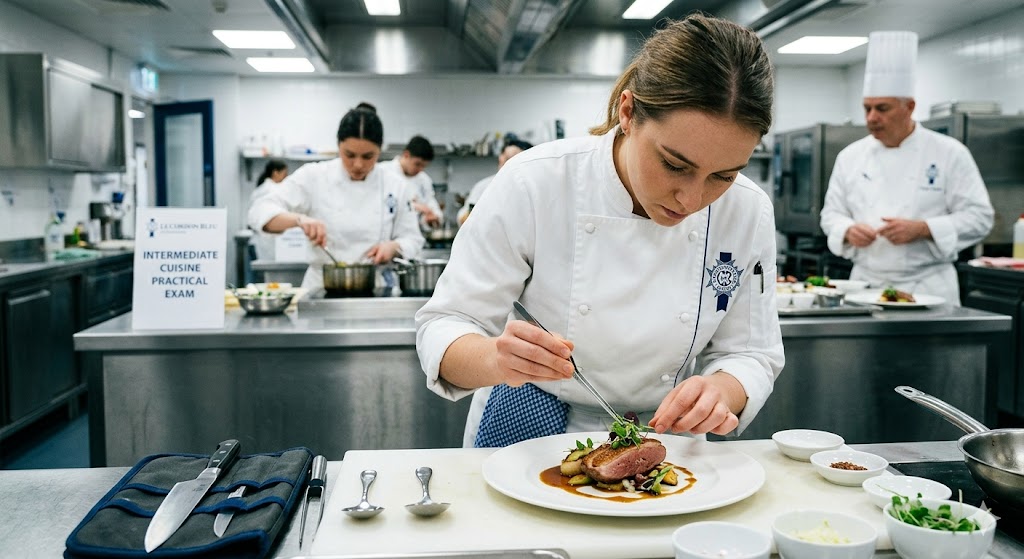
Additional Information
What the Course Entails and Exam Details
This intensive course moves beyond basic knife skills
into the application of complex cooking methods and the mastery of specialized
ingredients.
The curriculum covers a wide spectrum of French classical
dishes, focusing heavily on precision and organization.
Key areas of focus include advanced butchery of fish,
poultry, and meat, and the creation of elaborate classical garnishes.
Students learn to execute derived mother sauces with
consistency and perfect flavor balance.
The course entails a deep dive into regional French
specialties, exploring the unique ingredients and techniques of areas such as
Provence, Burgundy, and Normandy.
Furthermore, students develop essential skills in
advanced plating techniques and aesthetic presentation, understanding that
visual appeal is vital in professional cuisine.
The exam details are structured to test both theoretical
knowledge and practical execution under professional kitchen standards.
What to Expect in the Final Exam
The LCB Intermediate Cuisine Final Exam is a rigorous
test of endurance, technique, and professionalism, structured similarly to a
professional kitchen assessment.
Unlike general certifications, this exam focuses almost
entirely on practical application.
Candidates are usually required to prepare, cook, and
present specific dishes from the Le Cordon Bleu curriculum within a strict time
limit, which often ranges from three to four hours.
A crucial component is the "mise en place," as
candidates must demonstrate organizational efficiency.
A panel of professional Chef Instructors evaluates the
final dishes based on several strict criteria: technical accuracy, flavor and
seasoning, temperature, texture, hygiene during preparation, and artistic
presentation.
While there may be a minor theoretical or written
component depending on the specific campus, the practical component carries the
most significant weight.
A comprehensive pass requires proficiency in all
evaluated areas; there is no single "passing score" number, but
rather a mastery of culinary standards.
How to Study and
Exam Centers
Effective studying for the LCB Intermediate Cuisine exam
requires repetition, simulation, and critique.
The best practice method is to perform full simulations
of your practical exam dishes within the allotted timeframe, replicating the
high-pressure environment of the LCB kitchens.
Do not just practice the main elements; dedicate
significant time to perfecting garnishes, specialized butchery, and, most
importantly, speed and consistency in sauce making.
Creating a detailed time plan or "work plan" is
essential; practice visualizing and writing down every step of the cooking
process before you enter the kitchen.
Ask for feedback on your presentation and flavor from
peers or mentors whenever possible.
As for exam centers, LCB examinations are strictly held
at authorized Le Cordon Bleu campuses worldwide.
You cannot take this practical exam online or at
generalized testing facilities like Pearson VUE.
Exams must be scheduled through the specific LCB
institute where you are enrolled or through their academic department, as they
require access to their specialized professional kitchens.
Job Opportunities from the Course
Successfully achieving the Intermediate Cuisine
certification opens doors to various roles within the hospitality and culinary
arts sectors.
This qualification demonstrates to employers that you
possess advanced technical skills and are capable of managing complex kitchen
stations.
Specific job titles and career paths this certification
unlocks include:
- Commis
Chef in Fine Dining Restaurants
- Demi
Chef de Partie
- Chef
de Partie in Regional or Bistro Establishments
- Junior
Private Chef
- High-End
Catering Assistant
- Cruiseline
Junior Sous Chef
- Food
Stylist for Publications and Media
- Culinary
Instructor Assistant
Frequently Asked Questions
Reviews
5.0
Based on 0 reviews
Leave a Review
No reviews yet. Be the first to review!