
Lead Abatement Supervisor Practice Test
$69.00
- Buy to unlock unlimited access to all Quiz questions and Answers in this Quiz.
- After purchase you can print a PDF of the whole quiz at any point. The PDF will contain the questions and the correct answers.
About this Exam
The Lead Abatement Supervisor certification is a professional credential designed for construction and environmental remediation veterans looking to move into a leadership role. This designation verifies your ability to plan, supervise, and finalize lead-based paint abatement projects. Unlike "Renovator" training, which covers safe work practices during general repairs, a Lead Abatement Supervisor is legally responsible for permanently eliminating lead hazards in residential dwellings and child-occupied facilities.
This role is critical for protecting the public, particularly young children, from the debilitating health effects of lead poisoning. The course is tailored for individuals with prior construction or environmental health experience who are ready to manage teams, design safety plans, and ensure strict regulatory compliance on complex job sites.
Ready to test your knowledge?
Buy Now to Access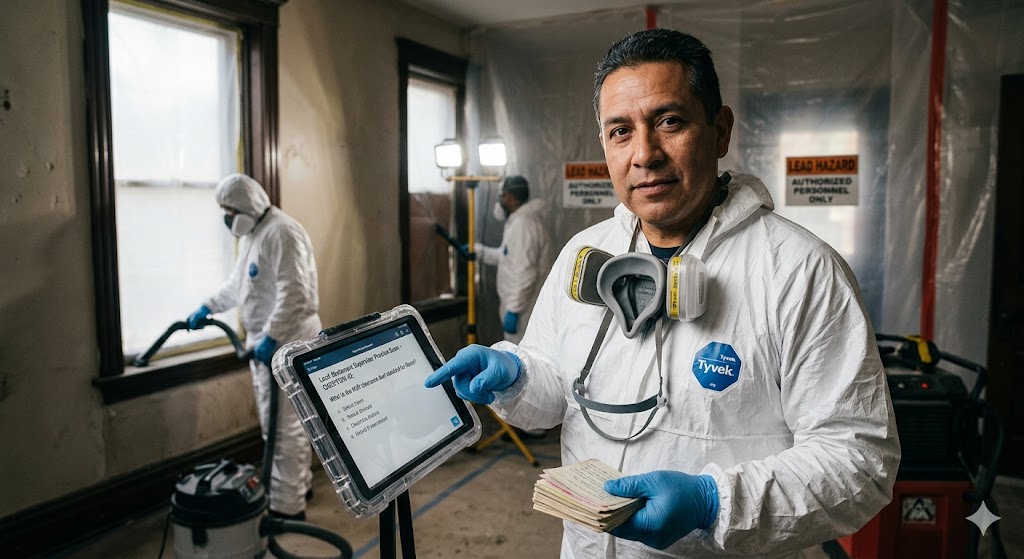
Additional Information
What the Course Entails and Exam Details
This initial certification course typically requires 32 hours (four days) of training from an EPA-accredited or state-authorized provider. It combines intensive classroom learning with hands-on demonstrations. A valid supervisor certificate typically lasts for three years before a refresher course is required.
The core syllabus encompasses several critical domains, requiring you to master the difference between interim controls and permanent abatement.
Key Course Modules:
• Regulations and Health Effects: Understanding EPA (40 CFR Part 745), OSHA (29 CFR 1926.62), and HUD guidelines. Detailed analysis of lead’s toxicology, routes of exposure, and chronic health effects on workers and occupants.
• Identification of Lead Hazards: Learning the science of lead detection, including how to interpret Lead Inspection and Risk Assessment reports. Mastering the use of X-ray Fluorescence (XRF) analyzers and paint chip sampling methodologies.
• Planning and Supervision: Creating critical project documentation, including Occupant Protection Plans, work blueprints, and detailed Abatement Reports. You will learn site preparation, supervisor on-site requirements, and team management strategies.
• Abatement Methods: Training in permanent elimination techniques, such as removal of lead paint (wet scraping, heat gun use), enclosure of surfaces, encapsulation using specialized coatings, component replacement, and soil abatement (removal or covering).
• Workplace Health and Safety: Extensive training on Personal Protective Equipment (PPE), respiratory protection programs, air monitoring procedures, and setting up decontamination facilities.
• Cleanup and Disposal: Mastering clearance dust sampling standards (Table 15.2 of HUD Guidelines), final cleanup protocols (HEPA vacuuming and wet washing), and strict hazardous waste handling and disposal laws.
What to Expect in the Final Exam
After completing the 32-hour course, you must pass two exams. The first is a course completion exam given by the training provider. The second is the third-party state or federal certification exam, which authorizes you to work. This study guide focuses on helping you pass that rigorous third-party assessment.
The exam is designed to test not only your memorization of regulations but your ability to apply them to supervisor scenarios.
Typical Exam Format:
• Question Type: Multiple Choice.
• Number of Questions: Standardly 100 questions.
• Time Limit: Usually 2 to 3 hours.
• Passing Score: Generally between 70% and 80%, depending on the state jurisdiction or EPA region.
• Allowed Materials: Typically closed-book. You are not allowed to bring regulatory manuals or note sheets.
How to Study and Exam Centers
Passing this exam requires a strategic blend of regulatory knowledge and practical reasoning. It is recommended to dedicate significant study time outside of the classroom training.
Actionable Study Strategies
Use Mock Exams Often: The single best way to prepare is by taking a "Lead Abatement Supervisor Practice Test." These tests familiarize you with the wording of common supervisory scenarios and help you identify knowledge gaps.
Master the Regulations: Do not just read the summaries. Review the actual text of OSHA 1926.62 (the Lead in Construction standard) and EPA 40 CFR 745. Study the specific Action Level (30 µg/m³) vs. the Permissible Exposure Limit (PEL, 50 µg/m³), and know what actions a supervisor must take at each level.
Study the HUD Guidelines: Chapter 12 (Abatement) and Chapter 15 (Clearance) of the HUD Guidelines for the Evaluation and Control of Lead-Based Paint Hazards in Housing are crucial. Many question scenarios are pulled directly from these protocols.
Create an Abatement Scenario: Practice writing a mock Occupant Protection Plan. If you can explain step-by-step how to handle the occupants, set up containment, and dispose of the waste, you understand the material.
Where and How to Take the Exam
The process of registering for and taking the official exam varies significantly by state. Most states have "authorized" programs, meaning they manage their own testing. In states without their own programs, the EPA administers the exam.
Initial course exams are usually taken on the last day of your training at the authorized training school. Third-party exams are held at specific governmental testing sites or via authorized online testing portals managed by state environmental departments or professional testing services like Pearson VUE. Contact your state’s lead licensing department (often within the Department of Health or Environmental Quality) to find the nearest testing center and schedule your exam.
Job Opportunities from the Course
A Lead Abatement Supervisor certification is a substantial asset in the environmental health, safety, and construction industries. It transitions you from labor to management, opening doors to advanced technical and consultative positions.
Job Titles and Career Paths:
• Lead Abatement Supervisor: Directly oversees crews removing or enclosing lead-based paint on residential, commercial, or industrial projects. Legally responsible for site safety and clearance results.
• Environmental Remediation Project Manager: Plans and manages large-scale toxic waste cleanup projects, including asbestos, mold, and lead abatement, budgeting, scheduling, and regulatory liaison.
• Environmental Health and Safety (EHS) Specialist: Creates and enforces safety programs for construction or property management firms, ensuring compliance with OSHA and EPA regulations.
• Environmental Consultant: Provides expert advice to property owners, schools, or government agencies regarding lead hazard identification, risk management, and abatement strategies.
• Lead Risk Assessor/Inspector: Often, a supervisor certification is a prerequisite or a complementary credential for becoming a licensed Lead Risk Assessor, who identifies the existence and location of lead hazards.
Frequently Asked Questions
Reviews
5.0
Based on 0 reviews
Leave a Review
No reviews yet. Be the first to review!