
LEED Water Efficiency Practice Test
$69.00
- Buy to unlock unlimited access to all Quiz questions and Answers in this Quiz.
- After purchase you can print a PDF of the whole quiz at any point. The PDF will contain the questions and the correct answers.
About this Exam
The LEED Water Efficiency Practice Exam is a crucial study resource designed for professionals preparing to master the nuances of the Water Efficiency credit category within the LEED rating systems. This study material is specifically tailored for architects, engineers, sustainability consultants, facilities managers, and construction professionals seeking to gain their LEED Accredited Professional (AP) with a specialty, particularly LEED AP Building Design + Construction (BD+C) or Interior Design + Construction (ID+C), as water efficiency is a core component. It is also an excellent tool for LEED Green Associates aiming to elevate their understanding of sustainable water management. These practice materials help candidates validate their ability to effectively manage water resources on projects pursuing certification from the U.S. Green Building Council (USGBC).
Ready to test your knowledge?
Buy Now to Access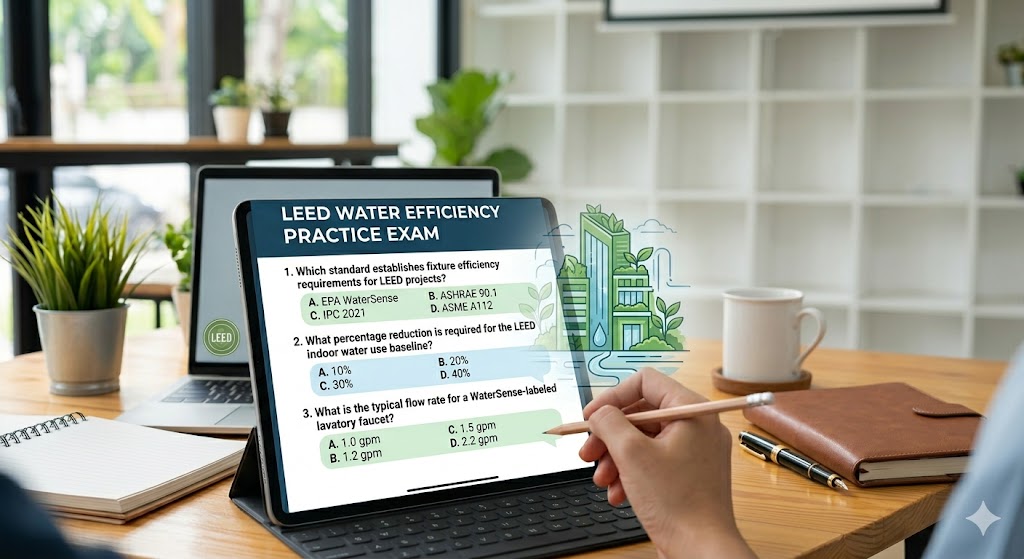
Additional Information
What the Course Entails and Exam Details
This specialized topic covers essential knowledge
required to implement sustainable water strategies in buildings and
developments. When studying for this area, you must master the fundamental
definitions, concepts, and calculations related to both indoor and outdoor
water use reduction.
The core areas of the syllabus include strategies for
reducing potable water consumption for irrigation through efficient landscaping
design and technology. It also focuses heavily on optimizing indoor water
consumption by analyzing the performance of plumbing fixtures, appliances, and
process water systems. You will learn the importance of water metering to track
consumption data and identify savings opportunities. Furthermore, the content
details how to implement alternative water sources, such as rainwater
harvesting and greywater reuse, to substitute the use of potable water where
appropriate.
A critical aspect of the exam content involves analyzing
the prerequisite requirements and specific credit criteria across various LEED
project types. Candidates are expected to demonstrate an understanding of the
calculations needed to determine a project's baseline water usage and
subsequent percentage reduction, proving compliance with USGBC thresholds.
What to Expect in the Final Exam
It is important to clarify that "LEED Water
Efficiency" is usually a significant section within a larger
credentialing exam, such as the LEED AP BD+C, rather than a standalone
100-question test on water alone. The complete LEED AP exam consists of 100
multiple-choice questions administered via computer, which you must complete
within a 2-hour time limit. The final credentialing exam contains approximately
15 to 20 specific questions focused directly on the Water Efficiency category.
The questions will assess your ability to recall
definitions, apply concepts to specific scenarios, and perform essential
calculations. You must answer 100% of the questions. A specific number of these
(usually about 15%) are unassigned "pretest" questions used for
future exam development; however, you will not know which questions are which,
so all must be treated equally.
A passing score on the full LEED AP credentialing exam is
170 on a scaled score of 125 to 200. You will receive your results immediately
upon submitting the exam at the testing facility. The LEED exam is highly
structured, and you must adhere strictly to all standard testing protocols,
including providing valid identification.
How to Study and Exam Centers
Effective preparation requires a structured approach. The
primary study resource must be the official USGBC LEED Reference Guide, which
provides the authoritative details on all requirements, intent, implementation
strategies, and calculations for every Water Efficiency credit.
We highly recommend utilizing comprehensive, high-quality
practice exams, like the one this guide references. Taking these simulations is
essential to familiarize yourself with the phrasing and difficulty level of
USGBC questions and to manage your time effectively during the actual exam.
When using practice tests, you must dedicate time to reviewing not just what
you answered incorrectly, but also why the correct answer is correct
based on the LEED Reference Guide.
Memorizing key baselines for different plumbing fixtures
(such as toilets, urinals, showerheads, and faucets) is crucial for solving
calculation-based questions. Flashcards are extremely effective for this
purpose. You should also ensure you are confident performing basic
calculations, such as percentage reductions in water use.
All formal LEED credentialing exams, including the LEED
AP BD+C which contains this Water Efficiency section, are administered globally
through Prometric, a third-party testing agency. You can choose to take the
exam at a dedicated Prometric testing center near you. Additionally, remote
proctoring options are often available, allowing you to take the exam from your
home or office on a compatible computer system while being monitored online.
You must schedule your exam session through your USGBC account on the USGBC
website.
Job Opportunities from the Course
Earning the LEED AP credential by demonstrating mastery
in categories like Water Efficiency significantly enhances your professional
credibility in the green building market. This achievement validates your
specialized expertise to employers and clients, opening doors to many exciting
career paths.
Below is a list of job opportunities and career paths
that highly value this specialized knowledge:
- Sustainability
Consultant
- LEED
Project Manager
- Green
Building Architect
- Plumbing
Design Engineer (Specializing in Efficiency)
- Sustainable
Landscape Architect
- Facilities
Manager (Focused on Resource Conservation)
- High-Performance
Building Analyst
- Commissioning
Authority (CxA)
- Construction
Project Engineer
- Environmental
Policy Analyst (Building Sector)
- Water
Resources Engineer
Frequently Asked Questions
Reviews
5.0
Based on 0 reviews
Leave a Review
No reviews yet. Be the first to review!