
Legal Research & Writing Practice Exam
$69.00
- Buy to unlock unlimited access to all Quiz questions and Answers in this Quiz.
- After purchase you can print a PDF of the whole quiz at any point. The PDF will contain the questions and the correct answers.
About this Exam
The Legal Research & Writing Practice Exam is an
essential diagnostic tool designed for law students, paralegals, and legal
assistants seeking professional certification. It assesses the fundamental
skills necessary to succeed in any modern law office or corporate legal
department. This comprehensive guide simulates the rigorous environment of
official examinations, evaluating your proficiency in both finding the law and
communicating it effectively. This exam is perfect for candidates preparing for
paralegal certification programs, law school midterms, or state-specific legal
support staff assessments. By engaging with this practice test, you will build
the confidence required to demonstrate your analytical abilities and mastery of
legal citation under timed pressure.
Ready to test your knowledge?
Buy Now to Access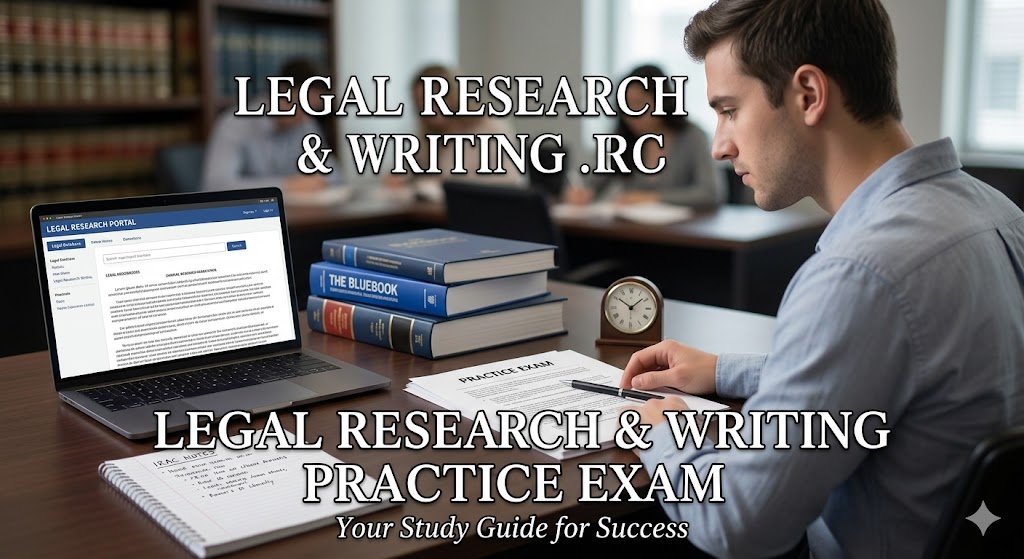
Additional Information
What the Course Entails and Exam Details
The curriculum this practice exam covers is comprehensive
and focuses on practical, real-world legal skills. The course material is
structured around the two core pillars of legal practice. The Legal Research
component entails mastering both traditional and digital methodologies.
Candidates learn to navigate primary authorities, such as case law, statutes,
and regulations, alongside essential secondary sources like legal
encyclopedias, treatises, and ALR annotations. This section emphasizes
efficient search strategies using boolean logic and terms-and-connectors on
major platforms like Westlaw or Lexis+. The Legal Writing component focuses on
translating that research into clear, concise, and persuasive documents. This
entails organizing arguments using the IRAC (Issue, Rule, Application,
Conclusion) framework. Mastery of objective writing, as seen in an interoffice
memorandum, and persuasive writing, utilized in court briefs or motions, is
critical. Furthermore, a substantial portion of the curriculum is dedicated to
the precise application of the current Bluebook or ALWD Citation
Manual rules, ensuring proper attribution and formatting.
What to Expect in the Final Exam
The official final exam, which this practice test
replicates, is typically a multi-part assessment designed to test both
knowledge and application. You can expect a format that combines objective
questions with performance-based components. The first section often contains
50 to 100 multiple-choice questions focusing heavily on research methodology,
knowledge of court systems, and meticulous citation formatting scenarios.
Following the objective portion, the writing section usually presents a
practical application task. Candidates are given a hypothetical factual
scenario and a small, closed "library" of relevant cases and
statutes. Within a strict time limit (frequently two to three hours), you must
analyze the materials and draft a specific legal document, such as an objective
interoffice memorandum or a simple motion to dismiss. A passing score usually
ranges from 70% to 75%, and you must demonstrate proficiency in analytical
reasoning and clear communication to succeed. These exams are always timed,
simulating the urgent deadlines encountered in professional legal practice.
How to Study and
Exam Centers
Successful preparation for this exam requires a combination
of rote memorization and hands-on application. Start your study journey by
drilling citation rules daily; flashcards for Bluebook abbreviations are
highly effective tools. You must dedicate significant time to drafting timed
IRAC analyses, turning raw research notes into finished, logically structured
paragraphs against the clock. We recommend taking this [Legal Research &
Writing Practice Exam] early to establish a baseline of your knowledge.
Carefully review the explanation for every answer you miss, focusing on why
the correct answer is right according to the Bluebook or legal reasoning
principles. You should then retake the practice exam periodically to measure
your improvement and build speed. Regarding the official test day, where and
how you take the exam depends heavily on the specific certification body or
institution. Many national paralegal associations now utilize secure online
proctoring portals, allowing you to take the exam from a quiet, private
location on your own computer. Others require you to attend a brick-and-mortar
testing center, such as an authorized university computer lab or professional
testing facilities like Pearson VUE centers. Be sure to confirm the specific
location requirements when you register for your official exam.
Job Opportunities from the Course
Achieving proficiency in Legal Research and Writing and
earning the associated certification unlocks a diverse array of rewarding
career paths. Employers in both the public and private sectors highly value
these validated skills. Here is a clear list of the specific job opportunities
this certification supports:
- Certified
Paralegal (CP) / Registered Paralegal (RP)
- Corporate
Paralegal
- Senior
Legal Assistant
- Law
Librarian or Research Specialist
- Conflict
Analyst
- E-Discovery
Specialist
- Compliance
Officer or Compliance Analyst
- Contract
Specialist or Contract Administrator
- Legislative
Assistant or Legislative Researcher
- Title
Abstractor / Corporate Records Manager
Frequently Asked Questions
Reviews
5.0
Based on 0 reviews
Leave a Review
No reviews yet. Be the first to review!