
LET Philosophies of Education Practice Test
$69.00
- Buy to unlock unlimited access to all Quiz questions and Answers in this Quiz.
- After purchase you can print a PDF of the whole quiz at any point. The PDF will contain the questions and the correct answers.
About this Exam
The Licensure Examination for Teachers (LET) Philosophies of
Education section is a crucial component of the Professional Education exam
required for all aspiring teachers in the Philippines. This specialized subject
tests candidates' understanding of the foundational theories and philosophical
frameworks that shape educational systems, teaching methodologies, and the
teacher's role in society. This exam is essential for graduates of education
programs who are seeking their professional license to teach in elementary and
secondary schools.
Ready to test your knowledge?
Buy Now to Access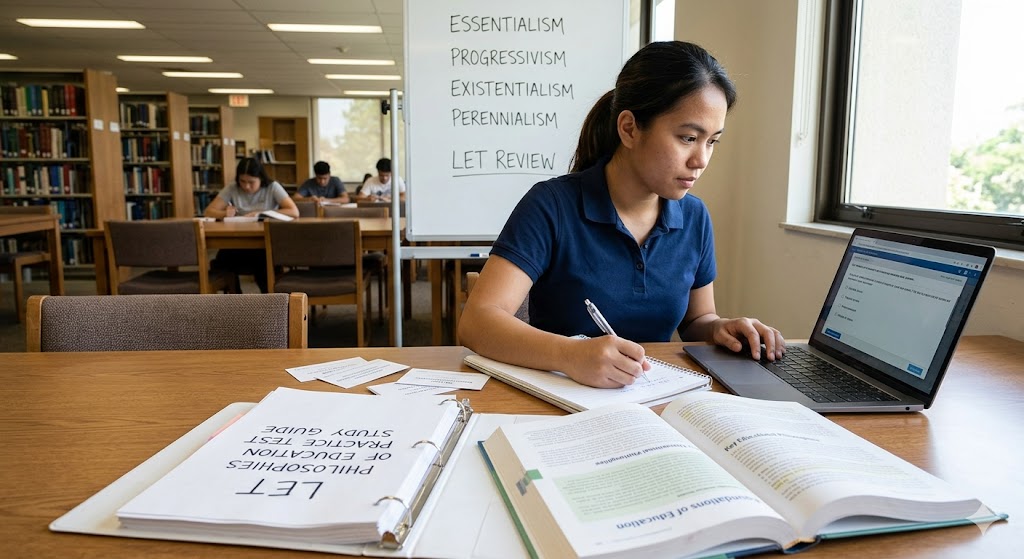
Additional Information
What the Course
Entails and Exam Details
Preparing for the Philosophies of Education practice test
requires a deep dive into the major classical and contemporary educational
philosophies that have influenced teaching and learning worldwide. Candidates
must demonstrate competence in understanding, analyzing, and applying these
philosophies to real-world educational scenarios.
The curriculum covers a broad spectrum of educational
thought, focusing on key frameworks and their applications in the classroom.
Key Subject Areas Covered:
- Classical
Philosophies:
- Idealism:
Emphasis on the search for universal truths, the importance of ideas, and
the teacher as a moral role model.
- Realism:
Focus on objective reality, natural laws, and a curriculum centered on
subject matter.
- Pragmatism
(Experimentalism): Stress on learning through experience,
problem-solving, and education as a process of continuous growth.
- Contemporary
Philosophies:
- Perennialism:
Focus on timeless truths, enduring works (Great Books), and intellectual
development.
- Essentialism:
Emphasis on fundamental skills and core knowledge (3 Rs: Reading,
Writing, Arithmetic), teacher authority, and academic rigor.
- Progressivism:
Child-centered education focused on the needs and interests of the
student, collaborative learning, and democratic principles.
- Existentialism:
Emphasis on individual choice, subjectivity, and personal responsibility
in creating meaning and values.
- Educational
Theories Derived from Philosophies:
- Behaviorism:
Focus on observable behaviors, reinforcement, and conditioning.
- Constructivism:
Emphasis on the learner actively constructing knowledge based on
experiences and interaction.
- Social
Reconstructionism: Focusing on education as a means to address social
problems and reshape society.
- Legal
and Historical Foundations of Philippine Education: Understanding how
these philosophies are reflected in the Philippine Constitution and key
education laws (e.g., RA 9155, RA 10533).
What to Expect in the Final Exam
The actual Licensure Examination for Teachers (LET) is a
rigorous assessment administered twice a year by the Professional Regulation
Commission (PRC).
The Philosophies of Education questions are integrated
within the Professional Education examination, which constitutes 40% of the
total score for both Elementary and Secondary teacher candidates.
Exam Format:
- Type:
Multiple Choice (four options per question).
- Language:
The exam questions are typically provided in English.
- Content
Focus: The Philosophies of Education questions assess not just theoretical
knowledge (e.g., matching a philosophy to its founder) but, more
importantly, the ability to apply that knowledge. Many questions are
situational and ask candidates to identify the philosophy being
demonstrated by a teacher's actions or a school's policy.
Passing Score:
- To
pass the LET, candidates must achieve a weighted general average of at
least 75%, with no rating lower than 50% in any subject test (General
Education, Professional Education, and Specialization, if applicable).
Time Limit:
- The
Professional Education subject typically takes 3 hours to complete (along
with General Education in the morning session).
How to Study and
Exam Centers
Preparation for the Philosophies of Education component
demands both content mastery and strategic test-taking skills.
Effective Study Strategies:
- Master
the Core Philosophies: Create comparison charts highlighting the view of
reality, role of the teacher, purpose of schooling, and curriculum for
each major philosophy (Idealism, Realism, Pragmatism, Perennialism,
Essentialism, Progressivism, Existentialism).
- Use
Active Recall: Test yourself frequently on key terms and conceptual
definitions using flashcards or practice quizzes.
- Analyze
Practice Questions: Utilize reliable LET review materials and practice
tests. Don't just check if you got an answer right; analyze why the
correct answer is correct and why the others are incorrect. Focus
heavily on situational application questions.
- Relate
Concepts to Philippine Context: Study the philosophical underpinnings of
the Philippine educational system, including the emphasis on holistic
development, character formation, and legal mandates.
- Join
Review Sessions: Consider enrolling in accredited LET review centers that
offer comprehensive lectures and refresher courses focused on Professional
Education subjects.
Where and How to Take the Exam:
- The
LET is administered at designated testing centers across the Philippines.
- Candidates
must apply for the examination through the Professional Regulation
Commission (PRC) online portal (LERIS).
- Applications
must be submitted within the specified period, usually months before the
exam date.
- Testing
centers are located in key cities throughout all regions (e.g., Manila,
Cebu, Davao, Baguio, Cagayan de Oro, Iloilo). The exact list of testing
venues is posted by the PRC along with the list of qualified applicants
before the examination.
- This
is a physical, paper-and-pencil examination; there is currently no online
testing option for the LET.
Job Opportunities
from the Course
Passing the LET and obtaining a professional license
opens extensive career opportunities in the field of education. Understanding
the philosophies of education is essential for effective teaching and
leadership in any educational setting.
- Public
School Teacher (Elementary or Secondary): The primary and most common
career path for licensed teachers in the Philippines, involving classroom
instruction in government schools.
- Private
School Teacher (Elementary or Secondary): Employment opportunities in
diverse private educational institutions, which often value candidates
with a strong command of varied educational philosophies.
- College/University
Instructor: Licensed teachers with relevant experience (and often master’s
degrees) can teach Professional Education courses, including Foundations
of Education, at the tertiary level.
- Educational
Administrator/Supervisor: A strong grasp of educational philosophy is
crucial for roles like school principal, supervisor, or curriculum
coordinator.
- Curriculum
Developer: Designing instructional materials and programs that are
philosophically sound and aligned with educational goals.
- Tutor/Academic
Coach: Providing personalized instruction and support to students outside
the formal school setting.
- Education
Policy Analyst: Using foundational knowledge of educational purpose to
analyze and advocate for effective education policies.
Frequently Asked Questions
Reviews
5.0
Based on 0 reviews
Leave a Review
No reviews yet. Be the first to review!