
Level 3 Certificate in Emergency Response Ambulance Driving (CERAD) Exam 3 Practice
$69.00
- Buy to unlock unlimited access to all Quiz questions and Answers in this Quiz.
- After purchase you can print a PDF of the whole quiz at any point. The PDF will contain the questions and the correct answers.
About this Exam
The Level 3 Certificate in Emergency Response Ambulance
Driving (CERAD) is the regulated, gold-standard qualification in the United
Kingdom for ambulance service personnel who must operate vehicles under both
routine and emergency response conditions.
This essential certification is specifically designed for
frontline ambulance staff, including Emergency Care Assistants (ECAs),
Associate Ambulance Practitioners (AAPs), and HCPC registered Paramedics.
It equips them with the advanced cognitive and practical
skills required to claim essential legal exemptions under Road Traffic
legislation, ensuring they can safely and responsibly navigate "blue
light" scenarios to reach patients when every second counts.
Ready to test your knowledge?
Buy Now to Access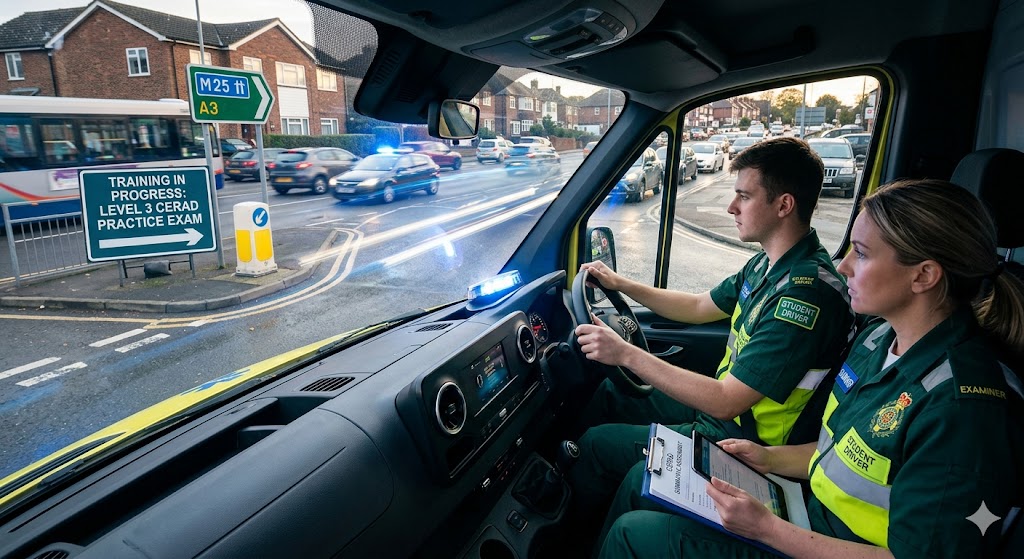
Additional Information
What the Course
Entails and Exam Details
This intensive course typically spans four weeks of
full-time training, combining comprehensive theoretical knowledge with
hands-on, high-stress practical driving.
The syllabus covers a rigorous list of core competencies
tailored for operational ambulance vehicles (including B and C1 categories).
Key topics include:
- Advanced
understanding of UK driving legislation, regulations, and the unique
exemptions applicable to emergency services.
- The
application of the System of Car Control (Roadcraft, the police driver’s
handbook), focusing on mirrors, position, speed, and gear selection.
- Routine
vehicle preparation, daily inspections, and safety checks (VDI/PDI).
- Advanced
braking techniques, safe cornering principles, and precision reversing
manoeuvres.
- Navigation
skills under pressure and route planning.
- Driving
and navigation during the hours of darkness and under adverse weather
conditions.
- Emergency
response driving (blue light use) and overtaking techniques at speed.
- Managing
human factors and physiological stressors that affect driving performance
in high-pressure scenarios.
The exam itself consists of a combination of theoretical
and practical assessments designed to verify that the student is competent
across all these domains.
What to Expect in
the Final Exam
The full Level 3 CERAD qualification process involves
multiple distinct components that must be passed sequentially.
Here is a breakdown of the typical structure:
- Theory
Assessments (MCQ): Students must complete a series of multiple-choice
question (MCQ) exams, usually divided into separate units (e.g., Exam 1
and Exam 2). Each paper typically has 50 questions, and the pass mark is
set high, often at 86% (43 out of 50). The time limit is approximately 75
minutes per paper. These exams strictly assess knowledge of Roadcraft, the
Highway Code, and emergency response law.
- Learner
Workbook and Portfolio: Throughout the course, candidates must maintain a
detailed workbook and a portfolio of evidence demonstrating their progress
and application of theory in their practical training.
- Practical
Driving Assessments (Summative Drives): The critical component is the set
of final practical assessments. This usually involves four separate
summative driving tests conducted by qualified examiners. These drives
will cover a wide range of environments and scenarios, including:
- An
initial assessment of vehicle checks and control.
- Routine
patient transport services driving (PTS simulation).
- Independent
driving assessment, including motorway and complex junctions.
- Final
"Blue Light" assessment, where the candidate must safely manage
real-time traffic under emergency conditions, claiming appropriate
exemptions.
Candidates must demonstrate not just speed, but smooth,
systematic car control, constant awareness, and impeccable decision-making to
receive a final pass.
How to Study and Exam Centers
Studying for the Level 3 CERAD qualification requires a
dedicated, proactive approach due to its intensive nature and high pass
standards.
Actionable Study Strategies:
Immerse in the Core Texts:
Your ultimate study tools are Roadcraft: The Police Rider's/Driver's Handbook
and the current Highway Code. Memorize the "System of Car Control"
phases and the legal definition of every road sign and rule.
Utilize Provided Course
Materials: Engage deeply with the study materials, workbooks, and presentations
provided by your training provider (e.g., Qualsafe or FutureQuals accredited
centers). These are specifically tailored to the MCQ content.
Practice Commentary Driving: A
powerful practical tool is "commentary driving," where you say aloud
every observation, decision, and system phase you are applying while driving
(even in your personal vehicle). This embeds the cognitive process required
during the final assessments.
Mock Theory Tests: Practice
with mock MCQ papers available from your training center to improve speed and
identify knowledge gaps.
Exam Centers:
Unlike general driving theory tests taken at Pearson VUE
centers, the Level 3 CERAD exams are not publically accessible. They are
provided exclusively through specialized, accredited training centers or
authorized NHS ambulance service driver training schools.
To undertake this qualification, a learner must be
sponsored, employed, or in the contract process with an NHS or private
CQC-registered ambulance service provider. The theory exams and practical
assessments are conducted directly by the certified trainers within that
approved framework.
Job Opportunities
from the Course
Successfully gaining the Level 3 Certificate in Emergency
Response Ambulance Driving is the essential key that unlocks the ability to
drive an emergency vehicle within the UK pre-hospital sector.
It provides legal certification to operate on frontline
ambulances and claiming road traffic exemptions.
The certification unlocks the following career paths:
- Ambulance
Support Worker
- Emergency
Care Assistant (ECA)
- Associate
Ambulance Practitioner (AAP)
- HCPC
Registered Paramedic (a prerequisite for their operational driving duties)
- Emergency
Medical Technician (EMT)
- Blue
Light/Emergency Response Driving Instructor (requires further diplomas)
- Event
Medic / TV/Commercial Medical Cover Driver
Frequently Asked Questions
Reviews
5.0
Based on 0 reviews
Leave a Review
No reviews yet. Be the first to review!