
Limited Aviation Weather Reporting System (LAWRS) Practice Exam
$69.00
- Buy to unlock unlimited access to all Quiz questions and Answers in this Quiz.
- After purchase you can print a PDF of the whole quiz at any point. The PDF will contain the questions and the correct answers.
About this Exam
The Limited Aviation Weather Reporting System (LAWRS)
certification is a specialized credential issued by the Federal Aviation
Administration (FAA). It is designed specifically for aviation professionals,
including Air Traffic Control Specialists, Flight Service Station personnel,
and contract weather observers, whose primary duties require them to observe,
report, and disseminate surface aviation weather on a limited basis. These
observers work at facilities where an Automated Surface Observing System (ASOS)
or Automated Weather Sensor System (AWSS) is operational, but human
augmentation is necessary to ensure safety and precision. The certification
validates your ability to step in when the automation needs support, such as
during severe weather events or specific atmospheric phenomena.
Ready to test your knowledge?
Buy Now to Access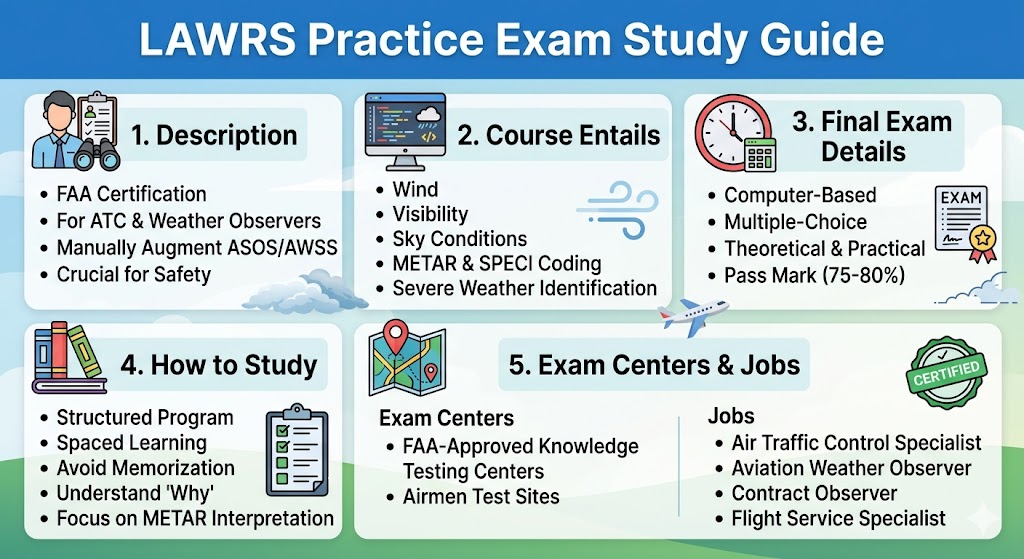
Additional Information
What the Course
Entails and Exam Details
The LAWRS course delivers the essential training needed
to become a reliable extension of automated systems. It provides a
comprehensive syllabus focused on the observation, process, and dissemination
of critical weather data. The course covers precise methods for identifying and
reporting elements such as wind speed and direction, visibility, present
weather, sky conditions (cloud cover and layers), temperature, dew point, and
accurate altimeter settings. A significant portion of the training emphasizes
manual augmentation. Students will learn how to identify and augment
observations for specific phenomena that sensors might miss or misinterpret,
including thunderstorms, tornadic activity, hail, volcanic ash, and virga. The
course is deeply rooted in understanding the coding of METAR (Meteorological
Aerodrome Report) and SPECI (Special Aviation Weather Report) to ensure data is
transmitted flawlessly into the National Weather Service database.
What to Expect in
the Final Exam
The LAWRS Final Exam is an Airman Knowledge Test that
evaluates your command of the theoretical principles of aviation meteorology
and practical observation. It typically follows a computer-based,
multiple-choice format. You can expect questions that require you to visually
interpret weather phenomena, decode complex METAR and SPECI reports, identify
hazardous weather conditions, and demonstrate the correct protocols for
augmenting automated systems. While the exact number of questions and time
limit can vary slightly, a typical exam structure may include around 60
questions with a dedicated timeframe, such as 90 minutes to two hours. To pass
and earn your certification, a high level of proficiency is required, with a
passing score generally set at 75% or 80%. Remember, this is a test of your
competency to ensure flight safety, so accuracy is paramount.
How to Study and
Exam Centers
Effective preparation for the LAWRS exam hinges on moving
beyond simple memorization and toward a true understanding of meteorological
concepts. Begin with a structured FAA-approved study program or course from a
reputable aviation school. Consistency is key; use spaced learning and dedicate
focused time each day to review material rather than cramming. Utilize practice
tests to gauge your knowledge, but focus on understanding why a
particular answer is correct. Become an expert in interpreting METAR and SPECI
reports and practicing the augmentation rules. You will need to obtain a
logbook endorsement from a certified instructor or a completion certificate
from an approved course to be eligible to sit for the real exam. The final test
must be taken at an FAA-approved Knowledge Testing Center or Airmen Test Site.
You can find a list of these official locations near you through the FAA
website. Make sure to schedule your exam in advance.
Job Opportunities
from the Course
Earning your LAWRS certification unlocks essential career
paths in both the public and private aviation sectors. The ability to provide
limited, high-accuracy weather reporting is a highly valued skill. Career
opportunities following certification include: Air Traffic Control Specialist
(who uses LAWRS skills for augmented observation from the tower), Aviation
Weather Observer, Contract Weather Observer, Flight Service Station Specialist,
Weather Augmenter, and other specific roles within operational flight support
that demand certified weather expertise.
Frequently Asked Questions
Reviews
5.0
Based on 0 reviews
Leave a Review
No reviews yet. Be the first to review!