
Limited Scope of Radiography Practice Exam
$69.00
- Buy to unlock unlimited access to all Quiz questions and Answers in this Quiz.
- After purchase you can print a PDF of the whole quiz at any point. The PDF will contain the questions and the correct answers.
About this Exam
The Limited Scope of Radiography
Practice Examination is a vital, specialized certification administered by the
American Registry of Radiologic Technologists (ARRT) on behalf of various state
licensing entities. This exam is expertly designed for healthcare
professionals, such as medical assistants, orthopedic technicians, and
chiropractic assistants, who work in focused medical environments rather than
full-scale hospital radiology departments. Its primary purpose is to rigorously
evaluate the knowledge and cognitive abilities of operators who use
radiographic equipment to image specific anatomic regions, rather than the
entire human body. By earning this credential, you validate your competence to
safely perform essential X-ray procedures, ensuring high-quality patient care
and safety within your defined scope of practice.
Ready to test your knowledge?
Buy Now to Access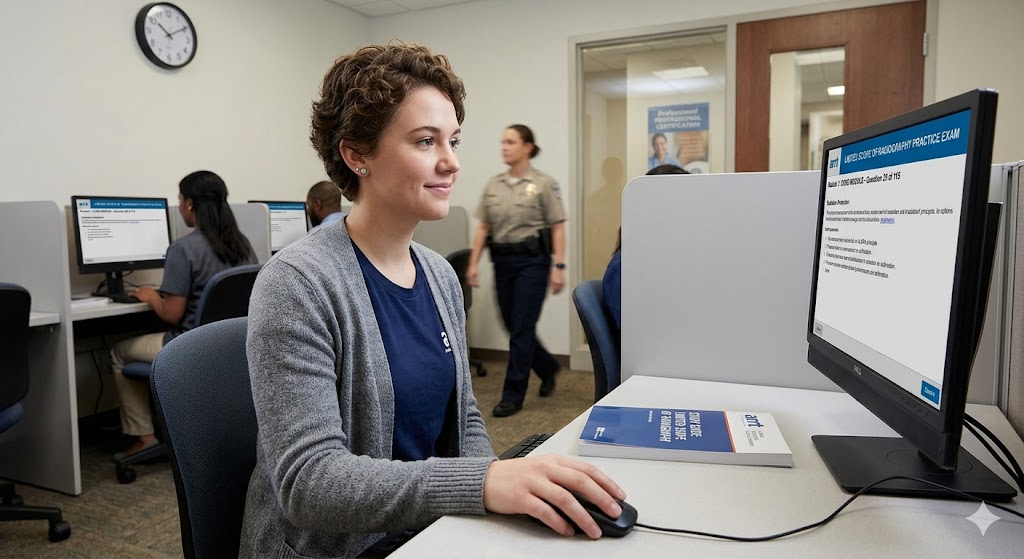
Additional Information
What the Course Entails and
Exam Details
This examination is structured to
be comprehensive while focusing strictly on the critical domains required for a
limited scope of practice. It is divided into multiple modules: a mandatory Core
Module and one or more Procedure Modules, which you select based on
your specific state licensing requirements. The Core Module is the
foundation of the exam and consists of approximately 115 questions. It
meticulously covers five essential content areas: Patient Interactions and
Management, including legal and ethical aspects, interpersonal
communication, infection control, and medical emergencies; Radiation Physics
and Radiobiology, covering the basic principles of how radiation is
produced and its biological effects; Radiation Protection, focusing on
minimizing patient exposure and personnel protection; Image Acquisition and
Evaluation, including digital imaging characteristics, technical charts,
and image quality criteria; and Equipment Operation and Quality Assurance,
detailing imaging equipment components and quality control procedures. The Procedure
Modules are focused assessments for specialized anatomical regions,
including Chest, Extremities, Skull/Sinuses, Spine,
and Podiatric. To properly prepare, candidates are expected to have
completed specific educational requirements, often including significant
didactic instruction and a defined number of clinical hours under the direct
supervision of a certified radiologic technologist.
What to Expect in the Final
Exam
You can expect a professional,
standardized, computer-based testing environment on exam day. Understanding the
exact format and scoring metrics is key to managing test anxiety and optimizing
your performance. The Core Module is a timed assessment, allotting you 1
hour and 55 minutes to complete the questions. Each chosen Procedure
Module will have its own separate time limit, typically 25 or 30 minutes.
The questions are primarily multiple-choice. Your scoring will be provided as a
standard scaled score. This scaled score range is from 1 to 99, with a passing
score set at a scaled value of 75. State licensing entities are the
ultimate authority for determining pass/fail status based on this
ARRT-administered test. At the testing center, you will be required to leave
all personal belongings in a secure locker, and strict biometric and identification
checks will be performed before you are allowed to begin.
How to Study and Exam Centers
Preparation is paramount for a
challenging assessment like this. Your study strategy should be multifaceted
and active. Start by meticulously reviewing the official ARRT Content
Specifications. This outline should be your primary roadmap, as it lists every
concept, procedure, principle, and piece of vocabulary that may appear on the
exam. Do not rely on one source; use multiple third-party study guides and seek
out an ARRT-certified technologist as a mentor or study partner for
clarification and discussion. Create a realistic study schedule that allocates
dedicated time for each content area, using flashcards for key definitions and
equations. Most importantly, practice with realistic practice exams at regular
intervals to improve both knowledge and time-management skills. Prioritize
understanding the reasoning behind correct answers. To schedule your
exam, you must first apply directly to your state licensing entity to
determine eligibility. Once you receive an eligibility letter, you will
typically schedule your testing appointment at a Pearson VUE professional
testing center, arriving well ahead of time with two forms of valid
identification.
Job Opportunities from the Course
A limited scope of radiography
certification unlocks dedicated career paths within the medical imaging field.
It is a valued credential that can significantly enhance your professional
value and open doors to specialized roles across various outpatient settings.
Rather than a table, here is a clear list of the specific job titles and career
paths this certification typically unlocks:
- Limited
Scope X-Ray Technician (LXMO)
- Limited
Radiologic Technologist
- Orthopedic
Physician Office X-Ray Operator
- Chiropractic
Assistant with X-Ray Certification
- Outpatient
Clinic Radiologic Technician
- Urgent
Care Center X-Ray Operator
Frequently Asked Questions
Reviews
5.0
Based on 0 reviews
Leave a Review
No reviews yet. Be the first to review!