
Lineman Apprenticeship Orientation Practice Test
$69.00
- Buy to unlock unlimited access to all Quiz questions and Answers in this Quiz.
- After purchase you can print a PDF of the whole quiz at any point. The PDF will contain the questions and the correct answers.
About this Exam
The Lineman Apprenticeship Orientation Practice Test is an
essential study tool designed for aspiring outside plant electrical workers.
This comprehensive assessment is crafted to help you prepare
for the formal orientation or entry exam required to enter a lineman
apprenticeship program.
It is specifically tailored for individuals looking to build
a rewarding, high-voltage career with utility companies, electric cooperatives,
or via the International Brotherhood of Electrical Workers (IBEW) local union
halls.
By using this practice test, you can identify knowledge
gaps, build testing confidence, and ensure you have the foundational skills
needed for the rigorous physical and mental training that lies ahead.
Ready to test your knowledge?
Buy Now to Access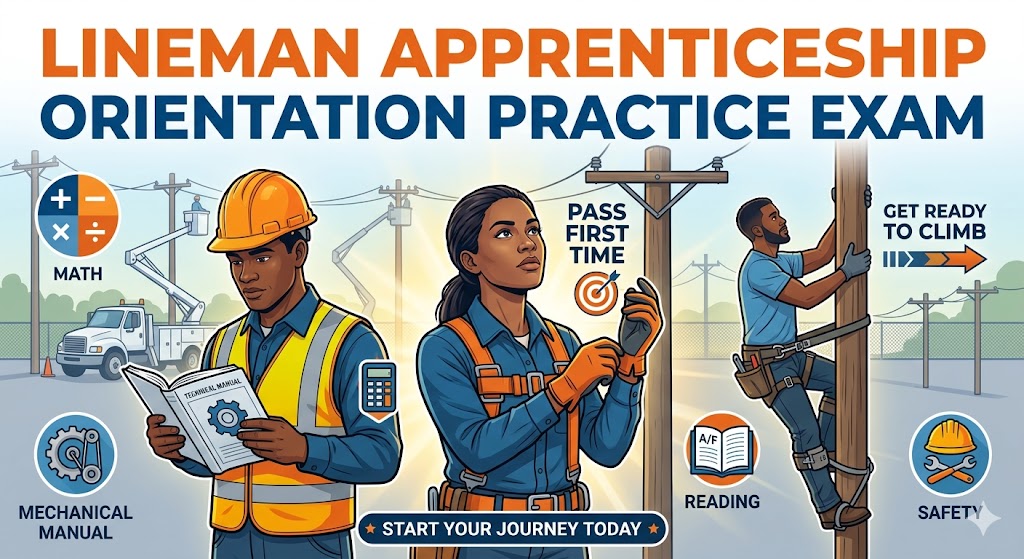
Additional Information
What the Course Entails and Exam Details
This comprehensive practice course covers the core areas
that are vital for success on the official orientation exam.
It includes detailed modules and practice questions on four
primary domains.
The first domain is Applied Mathematics, which focuses on
solving practical, trade-related problems using arithmetic, fractions,
decimals, percentages, ratios, and basic algebraic concepts.
The second area, Mechanical Reasoning, assesses your
understanding of fundamental physical principles such as forces, leverage,
gears, pulleys, and simple machines.
Reading Comprehension, the third domain, challenges you to
quickly process and accurately recall information from technical manuals,
safety regulations, and operational documents.
Finally, the Introduction to Lineman Basics module covers
essential terminology, common tools, basic safety practices, and an overview of
the tools and equipment used in the field, setting a strong foundation for your
future career.
What to Expect in
the Final Exam
While the exact final orientation exam can vary slightly
between different joint apprenticeship and training committees (JATCs) or
individual utility companies, most standardized tests follow a predictable
format.
You should expect a timed, multiple-choice assessment that
is typically proctored.
A standard orientation exam can have between 60 and 100
questions, with separate, dedicated time limits for each major section, such as
46 minutes for 33 Algebra and Functions questions.
Passing scores generally fall between 70% and 80%,
indicating a solid grasp of the foundational competencies.
It is important to remember that this exam is not just about
recall; it evaluates your aptitude to learn and problem-solve, making it a
critical gateway for securing an apprenticeship position.
How to Study and
Exam Centers
Effective preparation is the key to passing this challenging
assessment on your first attempt.
Begin by reviewing fundamental math and mechanical
principles using textbooks or online educational resources.
A primary study strategy is to take multiple simulated,
timed practice tests to familiarize yourself with the question formats and to
build your time-management skills.
Use flashcards to master new technical terms and create a
structured study schedule that dedicates time to every core section.
When you are ready to take the actual Lineman Apprenticeship
Orientation Exam, please be aware that it is not typically administered at
global testing centers like Pearson VUE.
Instead, it is almost exclusively given at the local
facilities of the employing utility company, rural electric cooperative, or the
training center of an IBEW Local JATC.
Always verify the exact date, time, and location of your
test with the specific apprenticeship program to which you have applied.
Job Opportunities
from the Course
Successfully passing the Lineman Apprenticeship Orientation
Exam, often considered the entry point "certification," is the vital
first step that unlocks a path to numerous high-paying and stable career
opportunities in the electrical trade. A list of career paths includes:
- Apprentice
Lineman (immediate role)
- Ground
Hand
- Utility
Line Technician
- Tree
Trimmer (Power Line Clearance)
- Substation
Technician Apprentice
- Troubleman
Apprentice
- Fiber
Optic Installer
Heavy Equipment Operator for Utility Crews
Frequently Asked Questions
Reviews
5.0
Based on 0 reviews
Leave a Review
No reviews yet. Be the first to review!