
Linked Lists Structures, Operations, and Types in Data Structures Practice Test
$69.00
- Buy to unlock unlimited access to all Quiz questions and Answers in this Quiz.
- After purchase you can print a PDF of the whole quiz at any point. The PDF will contain the questions and the correct answers.
About this Exam
Mastering fundamental data structures is the cornerstone of
a successful career in software development and competitive programming. The Linked
Lists Data Structures Practice Exam is meticulously designed to evaluate
and enhance your understanding of one of computer science's most essential
dynamic structures. This practice test goes beyond simple definitions; it
challenges your ability to conceptualize, manipulate, and optimize linked list
implementations across various complexity levels.
This comprehensive assessment is ideal for computer science
students, aspiring software engineers, backend developers preparing for
technical interviews, and existing professionals looking to solidify their
algorithmic foundations. Passing this practice exam signals robust readiness
for real-world challenges, complex coding assessments, and professional
certifications in data structures and algorithms.
Ready to test your knowledge?
Buy Now to Access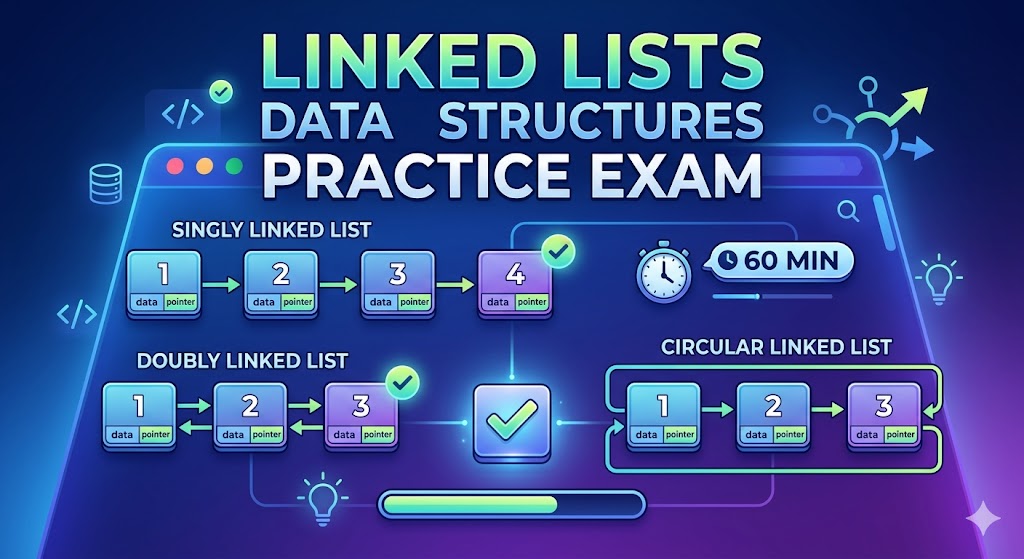
Additional Information
What the Course
Entails and Exam Details
To excel in this practice test, candidates must demonstrate
thorough proficiency in both the theoretical and practical aspects of linked
lists. The preparatory curriculum and the exam itself cover the following
critical areas:
- Core
Concepts and Structures: A deep understanding of what a linked list
is, how it differs from static arrays, the role of nodes, data fields, and
pointers/links, including concepts of heads, tails, and null terminators.
Candidates must be comfortable visualizing and diagramming these
structures.
- Essential
Operations: Mastery of implementing and analyzing foundational
operations is key. This includes traversal (visiting each node), insertion
(at the beginning, end, and specific positions), deletion (head, tail,
specific node), searching for specific data, updating node values, and
reversal.
- Types
of Linked Lists: Proficiency across different list variants is
assessed. This covers Singly Linked Lists (unidirectional traversal),
Doubly Linked Lists (bidirectional traversal with previous and next
pointers), and Circular Linked Lists (where the last node connects back to
the first), understanding the structure, advantages, and drawbacks of
each.
- Algorithmic
Analysis: You must be able to accurately determine the time and space
complexity (Big O) for each operation on all linked list types and compare
them effectively.
- Intermediate
and Advanced Techniques: The exam may include challenges on detecting
cycles in a list, finding the middle node efficiently, merging sorted
lists, implementing sentinel or dummy nodes to handle edge cases, and
using two-pointer approaches to solve complex problems.
The overall linked list curriculum prepares you to implement
these structures efficiently from scratch in common programming languages like
C++, Java, and Python.
What to Expect in
the Final Exam
While the exact structure of a professional data structures
exam can vary, this practice test mirrors the comprehensive nature of a final
assessment.
- Format:
The exam typically combines various question types. You will encounter
multiple-choice questions testing theoretical definitions, properties of
list types, identifying the best scenario for each structure, and
analyzing pre-written code snippets for correctness or output prediction.
Practical components will require you to write functions to perform
specific operations (like in-place reversal or node deletion) and analyze
the Big O complexity of given code or a theoretical operation.
- Duration
and Time Limits: Expect a timed assessment, typically ranging from 60
to 120 minutes, simulating professional testing conditions. Effective time
management is crucial to address all sections.
- Passing
Score: The passing score is realistic and comprehensive, usually set
around 70% to 80% to ensure true mastery. This requires solid
comprehension across all topic areas.
- Rules:
For this practice test, rules should be self-enforced to get the most
value, which might include no external resources. Professional
certification exams will have strict proctoring guidelines. Focus on
common pitfalls: improper pointer updates (null pointer exceptions),
ensuring correct memory allocation and deallocation (if applicable to your
language), and handling crucial edge cases such as empty lists, lists with
only one node, or operations at the very beginning or end of the list.
How to Study and Exam Centers
Effective preparation is paramount. Your study strategy
should blend theoretical understanding with extensive practical coding.
- Active
Recall and Visualization: Use diagrams to visualize exactly how
pointers change during insertion and deletion. This is non-negotiable for
true linked list mastery. Practice explaining operations to yourself or a
study partner.
- Comprehensive
Coding Practice: Implement all three linked list types from scratch
multiple times in different programming languages. Write functions for
every fundamental operation and test them thoroughly, including critical
edge cases. Do not simply copy code; understand why every line is
necessary.
- Diverse
Problem Solving: Leverage platforms like LeetCode, HackerRank, or
competitive programming sites to solve a variety of linked list
challenges, focusing on interview patterns and in-place manipulations.
Re-visit previously difficult problems until you can solve them with confidence.
- Big
O Mastery: Consistently analyze and document the time and space complexity
of every operation you practice. Understand the trade-offs between array
and linked list performance.
- Mock
Assessments: Take this and other practice tests multiple times to
build speed, identify weak points, and reduce test-day anxiety. Review
every mistake in detail.
Regarding access, as a Practice Test, this entire
experience is typically delivered online. You will not need to travel to a
physical testing center like Pearson VUE or a university facility. The test is
accessible through a secure web portal, allowing you to complete it on your
personal device at your convenience. This flexibility is designed to make
rigorous preparation accessible and efficient. Always ensure you have a stable
internet connection and a conducive environment before starting the timed
assessment.
Job Opportunities
from the Course
A strong grasp of linked lists is foundational and directly
relevant to numerous lucrative careers across the technology sector.
Successfully navigating this practice test signals proficiency that employers
in these fields value highly:
- Software
Engineer: Fundamental for understanding and implementing various
algorithms, managing dynamic memory, and optimizing application
performance.
- Backend
Developer: Linked lists are often used in system components like
buffers, caches, and managing data streams efficiently in server-side
applications.
- Algorithm
Engineer: Essential for designing and implementing optimized data
structures and advanced algorithms from the ground up, where performance
is paramount.
- System
Software Developer: Knowledge of low-level memory management and
efficient list manipulation is crucial in building operating systems,
drivers, and embedded systems.
- Embedded
Systems Engineer: Dynamic memory allocation and link management are
fundamental in embedded systems with limited resources.
- Competitive
Programmer: Speed and accuracy in implementing and manipulating data
structures are core requirements for success in competitive coding.
- Quantitative
Analyst/Financial Engineer: Algorithms and data structures (including
optimized lists) can be used in developing and implementing complex
trading models.
- Data
Scientist: While typically using higher-level libraries, foundational
data structure knowledge provides a distinct advantage in understanding
and optimizing underlying data processing and algorithmic performance.
Frequently Asked Questions
Reviews
5.0
Based on 0 reviews
Leave a Review
No reviews yet. Be the first to review!