
Linux Fundamentals Practice Test
$69.00
- Buy to unlock unlimited access to all Quiz questions and Answers in this Quiz.
- After purchase you can print a PDF of the whole quiz at any point. The PDF will contain the questions and the correct answers.
About this Exam
The Linux Fundamentals certification and its
corresponding exam are designed to validate an individual's core understanding
of the Linux operating system. This is a crucial foundational step for anyone
aspiring to enter the vast field of open-source technology, system
administration, cloud computing, or cybersecurity. The course and exam are
tailor-made for IT beginners, students, and professionals looking to officially
document their foundational Linux knowledge. By proving mastery of fundamental
command-line skills and system concepts, candidates demonstrate they possess
the essential skills required for entry-level technical roles.
Ready to test your knowledge?
Buy Now to Access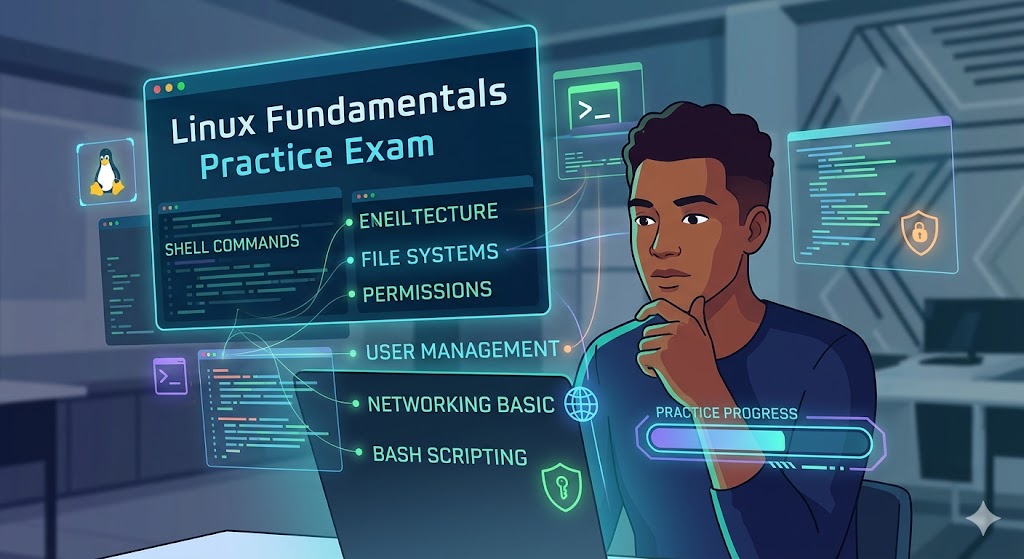
Additional Information
What the Course
Entails and Exam Details
This comprehensive course provides a solid grasp of the
essential skills needed to navigate and manage a Linux environment effectively.
The syllabus is structured around several core domains. Candidates must
demonstrate proficiency in the Linux command line, including basic file
manipulation commands (like ls, cd, cp, mv, and rm), text processing utilities
(such as grep, awk, and sed), and input/output redirection. The curriculum also
covers basic file system hierarchy and navigation, understanding standard
permissions (read, write, execute), and the principles of user and group
management. Additionally, participants will learn basic system configuration
and networking fundamentals.
What to Expect in
the Final Exam
The final exam for Linux Fundamentals is typically a
performance-based assessment, designed to test practical skills rather than
just theoretical recall. While some multiple-choice questions may be included
to gauge broad conceptual knowledge, the core of the exam often involves
solving real-world scenarios within a live terminal environment. Candidates
should expect to be presented with a set of tasks or problems to complete
within a strict time limit, which is generally around 60 to 90 minutes. A strong
passing score, often 70% or higher, is typically required to earn the
certification. Specific rules, such as whether documentation is permitted, can
vary, but generally, the use of external aids is prohibited. The focus is
squarely on your ability to confidently apply fundamental Linux commands.
How to Study and Exam Centers
Achieving success on the Linux Fundamentals exam requires
a combination of structured learning and hands-on practice. Begin by
identifying a reputable course provider or self-study materials that cover the
exam objectives thoroughly. Leverage virtual labs and sandbox environments to
practice commands extensively, making mistake-proof experimentation possible.
Creating flashcards for key commands and their common options can reinforce
memory recall. Engaging in online communities and forums can provide invaluable
support and insights from others who have taken the path. To register and take
the exam, candidates typically use authorized online portals managed by the
certification body. Depending on the specific provider, you may also have the
option to take the exam at a physical testing center, such as Pearson VUE,
which offers proctored environments globally. Always verify the current testing
options directly with your chosen certification provider.
Job Opportunities
from the Course
Earning a Linux Fundamentals certification opens the door
to a wide range of rewarding entry-level and intermediate career opportunities.
It serves as a concrete indicator to employers that you possess the core
competencies needed to work effectively in a Linux-based technical environment.
Some of the common job titles and career paths this certification can unlock
include:
- Junior
Linux System Administrator: Assisting in the daily maintenance and
troubleshooting of Linux servers.
- Junior
Network Administrator: Supporting network operations, often on Linux-based
infrastructure.
- IT
Support Technician: Providing technical assistance in environments that
rely heavily on Linux systems.
- Data
Center Technician: Managing physical and virtual infrastructure within a
data center environment.
- Quality
Assurance Engineer: Testing software and systems, often requiring
command-line proficiency.
- Security
Analyst (Entry-Level): Starting a path in cybersecurity, with Linux
knowledge as a foundation for security tools.
- Cloud
Support Associate: Supporting customers using cloud services, which are
predominantly Linux-based.
- DevOps
Engineer (Junior): Beginning a career that bridges software development
and IT operations, where Linux is a foundational skill.
Frequently Asked Questions
Reviews
5.0
Based on 0 reviews
Leave a Review
No reviews yet. Be the first to review!