
Linux Professional Institute Certification Level 1 (LPIC-1) Practice Test
$69.00
- Buy to unlock unlimited access to all Quiz questions and Answers in this Quiz.
- After purchase you can print a PDF of the whole quiz at any point. The PDF will contain the questions and the correct answers.
About this Exam
The Linux Professional Institute Certification Level 1,
known as LPIC-1, is the first step in the world's most notable
vendor-neutral Linux certification program. Designed for early-career
professionals, it validates a candidate's fundamental understanding of the
Linux operating system. This certification proves your ability to use, install,
and configure a computer running Linux, along with configuring basic networking
and performing essential maintenance tasks via the command line. The LPIC-1
Practice Exam is a critical tool for success, meticulously designed to
prepare you for the two final exams (101 and 102) that make up this prestigious
qualification. Whether you are a system administrator, support technician, or
aspiring DevOps engineer, a passing score on the LPIC-1 practice test
demonstrates that you are ready to kickstart your professional Linux journey.
Ready to test your knowledge?
Buy Now to Access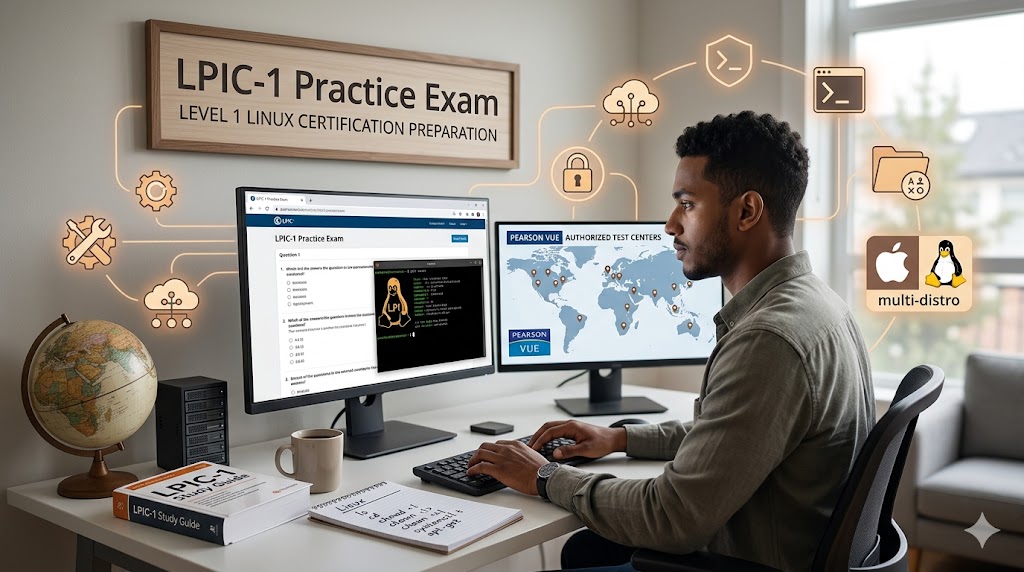
Additional Information
What the Course
Entails and Exam Details
Preparing for the LPIC-1 certification through a structured
course or self-study, and validating that knowledge with a comprehensive
practice test, covers a broad syllabus. The course aims to equip you with
proficiency in real-world Linux system administration.
Core topics you will master include:
- System
Architecture: Understanding Linux system architecture, hardware
settings, the boot process, runlevels, and systemd/SysVinit
initialization.
- Linux
Installation and Package Management: Designing hard disk layouts,
installing boot managers, managing shared libraries, and mastering Debian
(apt) and RPM/YUM package management systems.
- GNU
and Unix Commands: Working proficiently on the command line,
processing text streams with filters, basic file management, streams,
pipes, redirects, and process management (creating, monitoring, killing).
- Devices,
Filesystems, and the FHS: Creating partitions and filesystems,
maintaining filesystem integrity, controlling mounting/unmounting, and
managing file permissions and ownership.
- Shells
and Shell Scripting: Customizing the shell environment and writing
simple scripts to automate tasks.
- User
Interfaces and Desktops: Fundamental knowledge of X11 and graphical
desktops.
- Administrative
Tasks: Managing user and group accounts and automating system
administration with cron.
- Essential
System Services: System time maintenance, logging, Mail Transfer Agent
(MTA) basics, and managing printers.
- Networking
Fundamentals: Basics of Internet protocols (TCP/IP), persistent
network configuration, basic troubleshooting, and client-side DNS.
- Security:
Performing fundamental security administration, setting up host security,
and securing data with encryption.
What to Expect in the Final Exam
The actual LPIC-1 certification is achieved by passing two
separate exams: Exam 101 and Exam 102. Your practice test should
ideally mirror the structure and challenge of these final assessments.
Each 90-minute final exam consists of approximately 60
questions. The questions are a mix of standard multiple-choice
(single and multiple-response) and fill-in-the-blank (often simulating a
command, path, or key term, testing practical, exact knowledge).
The exams use a scaled scoring system from 200 to 800, and
the passing score for each exam is typically 500. Success on both is
required to earn the LPIC-1 certification. There are no official prerequisites.
You must take the exams in a strictly proctored environment, where no external
resources are permitted.
How to Study and
Exam Centers
Effective study for the LPIC-1 requires a balanced
combination of theoretical knowledge and hands-on practice. The LPIC-1
Practice Exam is your best friend in this process, allowing you to test
your knowledge against the official objectives under simulated time
constraints.
- Actionable
Study Strategies:
- Master
the Official Objectives: Use the official LPI exam objectives as your
roadmap.
- Build
a Multi-Distro Home Lab: Install various Linux distributions (e.g.,
Ubuntu/Debian, CentOS/Fedora) on virtual machines. Hands-on practice
is non-negotiable. Replicate administrative tasks and common
troubleshooting scenarios.
- Consult
Multiple Sources: Utilize the LPI’s own learning materials,
authoritative study guides (e.g., those from LPI press partners),
high-quality video courses, and official documentation (man pages).
- Teach
and Learn in Forums: Engaging in communities allows you to solidify
your own understanding while learning from others' experiences.
- Use
Practice Tests Strategically: Do not just aim for a high score. Use a
quality practice test to identify knowledge gaps, practice time
management, and become accustomed to the phrasing of Linux command and
term-based questions.
- Exam
Centers: The final, official exams are delivered via Pearson VUE,
a global leader in professional testing. You have two primary options:
- Online
Proctoring (OnVUE): You can take the exam from the comfort of your
home or office. A verified Pearson VUE Proctor monitors you via your
webcam to ensure security. Current OnVUE requirements supported only
Windows and MacOS systems for the testing software, although LPI has
expressed intent to support Linux in the future.
- Physical
Testing Centers: You can take the exam in person at an authorized
Pearson VUE testing facility worldwide. Use the "Test Center
Locator" on the Pearson VUE website to find the location nearest
you.
Job Opportunities
from the Course
A successfully passed LPIC-1 Practice Test indicates
that you are ready for the final certification, and earning that certification
unlocks numerous opportunities in the flourishing Linux and open-source world.
It signals to employers that you have the essential skills to manage Linux
systems effectively.
The LPIC-1 certification opens doors to the following
specific career paths and job titles:
- Junior
Linux System Administrator
- Linux
Support Technician
- IT
Support Specialist (Linux)
- Junior
DevOps Engineer (with Linux focus)
- Network
Administrator (Linux Environment)
- Data
Center Technician (Linux)
- Linux
Helpdesk Specialist
- Junior
Systems Engineer
- Cloud
Engineer (Starting Role with Linux focus)
- Systems
Operator (Linux)
Frequently Asked Questions
Reviews
5.0
Based on 0 reviews
Leave a Review
No reviews yet. Be the first to review!