
Lippincott Pharmacology Practice Exam
$69.00
- Buy to unlock unlimited access to all Quiz questions and Answers in this Quiz.
- After purchase you can print a PDF of the whole quiz at any point. The PDF will contain the questions and the correct answers.
About this Exam
The Lippincott
Pharmacology Practice Exam is a cornerstone assessment tool used by nursing,
medical, and pharmacy students across the globe.
It is specifically designed to evaluate a student's grasp
of how drugs interact with the human body, serving as an essential stepping
stone before tackling high-stakes licensure tests like the NCLEX or USMLE.
This exam is ideal for healthcare students who want to
test their clinical reasoning and ensure they are fully prepared to administer
medications safely and effectively in a real-world setting.
Ready to test your knowledge?
Buy Now to Access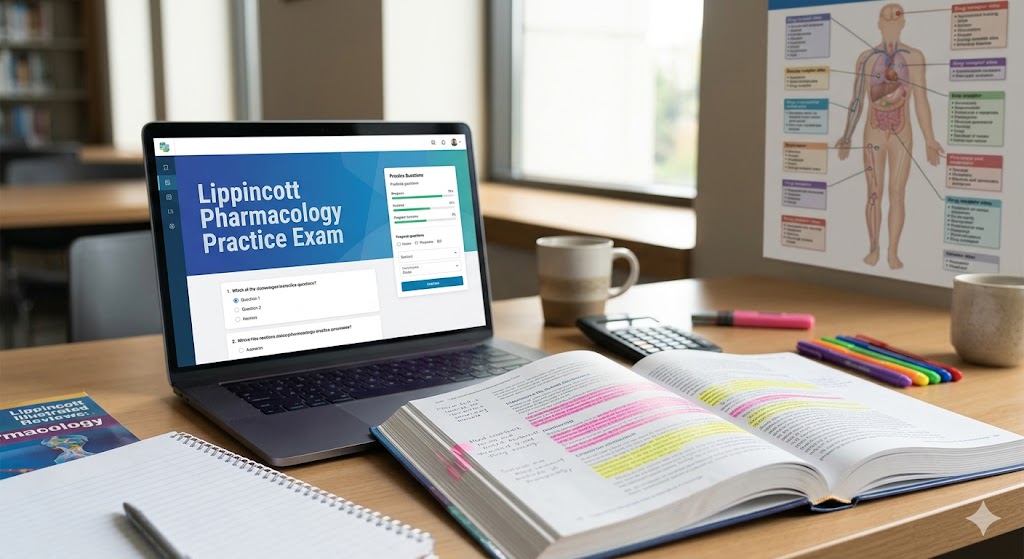
Additional Information
What the Course Entails and Exam Details
A rigorous pharmacology course aligned with Lippincott’s
standards covers a massive breadth of scientific and clinical information.
You will dive deep into pharmacokinetics, which explores
how the body absorbs, distributes, metabolizes, and excretes drugs.
You will also study pharmacodynamics, focusing on
receptor interactions and the physiological effects of medications.
The syllabus typically groups study materials by drug
classifications, including cardiovascular drugs, central nervous system agents,
antimicrobials, and endocrine medications.
A heavy emphasis is placed on identifying adverse
effects, understanding contraindications, recognizing drug-to-drug
interactions, and mastering nursing or clinical implications for patient
education.
What to Expect in the Final Exam
The final practice exam is intentionally challenging to
mirror the difficulty of national board exams.
You can expect a heavy reliance on multiple-choice
questions (MCQs) and the highly dreaded "select-all-that-apply"
(SATA) format, which forces you to know the material inside and out without
relying on process of elimination.
The exam also heavily features scenario-based case
studies that test your ability to apply pharmacological theory to patient care.
Passing score requirements are usually determined by your
specific academic program, but a benchmark of 75% to 80% is standard to prove
clinical competency.
Time limits generally allow for about one to two minutes
per question, so pacing yourself and managing test anxiety is a critical rule
for success.
How to Study and Exam Centers
Mastering this subject requires active learning rather
than passive reading.
Begin by incorporating visual aids, such as the Lippincott
Illustrated Reviews, which help map out complex drug pathways and
mechanisms of action.
Create a structured study schedule where you use
flashcards for rote memorization of drug prefixes and suffixes, while relying
on question banks to practice critical thinking.
When it comes time to take the test, the location will
depend on your institution.
Most university students will take this exam via secure
online learning portals like Canvas, ExamSoft, or ATI, often monitored by
digital proctoring software.
Alternatively, some programs require you to sit for the
exam in person at authorized university testing centers or independent physical
facilities like Pearson VUE, especially if it serves as a standardized exit
exam.
Job Opportunities
from the Course
Successfully conquering pharmacology opens the door to
incredibly rewarding and highly respected careers in healthcare.
Registered Nurse (RN) – You will be on the front lines of
patient care, directly responsible for administering medications and monitoring
for life-threatening side effects.
Nurse Practitioner (NP) – With advanced training, you
will be able to diagnose conditions and independently prescribe medications to
your patients.
Clinical Pharmacist – You will act as the ultimate
medication expert, advising doctors on the best pharmaceutical interventions
and preventing dangerous drug interactions.
Medical Doctor (MD) or Doctor of Osteopathic Medicine
(DO) – You will utilize your pharmacological expertise every single day to
treat diseases, manage chronic conditions, and save lives.
Pharmacology Researcher – You will work in laboratories
or pharmaceutical companies, contributing to the development of new,
groundbreaking drugs and therapies.
Frequently Asked Questions
Reviews
5.0
Based on 0 reviews
Leave a Review
No reviews yet. Be the first to review!