
Lippincott Respiratory Practice Exam
$69.00
- Buy to unlock unlimited access to all Quiz questions and Answers in this Quiz.
- After purchase you can print a PDF of the whole quiz at any point. The PDF will contain the questions and the correct answers.
About this Exam
The Lippincott
Respiratory Practice Exam is a premium preparatory resource designed for
nursing and respiratory therapy students preparing for licensure and
certification exams, such as the NBRC (National Board for Respiratory Care)
Therapist Multiple-Choice (TMC) Examination or clinical simulations.
This practice exam is curated to help students bridge the
gap between theoretical knowledge and practical application. It offers a
comprehensive review of essential respiratory care concepts, allowing
test-takers to identify areas of strength and weakness before challenging the
actual board exams. This tool is designed for anyone pursuing a career as a
Certified Respiratory Therapist (CRT) or Registered Respiratory Therapist
(RRT).
Ready to test your knowledge?
Buy Now to Access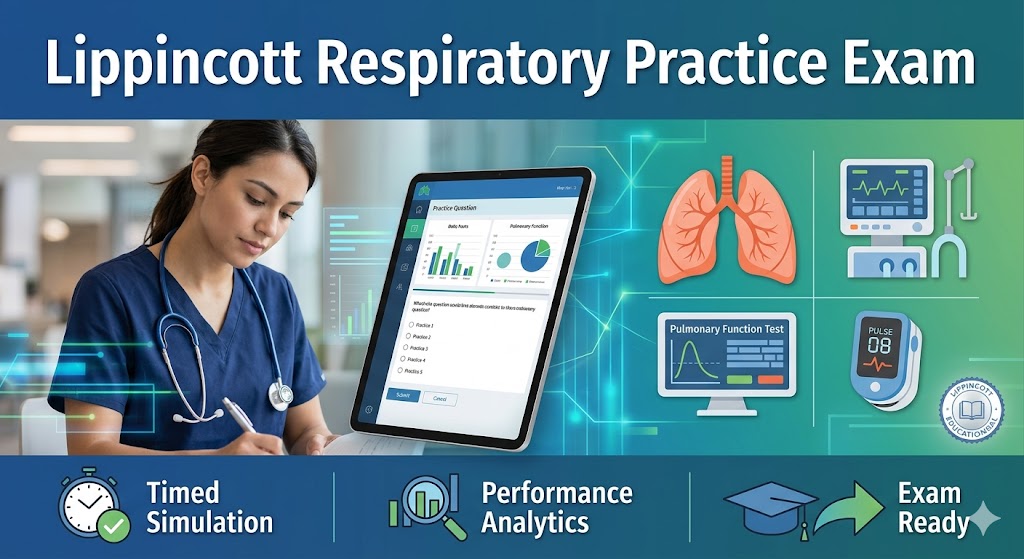
Additional Information
What the Course Entails and Exam Details
The preparation curriculum typically covers advanced concepts in cardiopulmonary physiology, pathophysiology, and therapeutic interventions.
The focus is on developing critical thinking skills across a wide array of core respiratory topics, including:
• Patient Assessment and Diagnostics: Including arterial blood gas (ABG) analysis, pulmonary function testing (PFT), and imaging interpretation.
• Therapeutic Modalities: Oxygen therapy, humidity/aerosol therapy, and airway management techniques.
• Mechanical Ventilation: Both invasive and non-invasive ventilation strategies, graphics analysis, and weaning protocols.
• Pharmacology: Detailed knowledge of bronchodilators, corticosteroids, and other respiratory medications.
• Specialty Care: Neonatal and pediatric respiratory care, and cardiopulmonary rehabilitation.
________________________________________
What to Expect in the Final Exam
While the "Lippincott Respiratory Practice Exam" itself is a study tool, it is designed to simulate the experience of the final NBRC board exams.
The practice environment mirrors the high-stakes atmosphere students will encounter.
• Exam Format: The format predominantly consists of computerized, multiple-choice questions (MCQs). Many questions are scenario-based, requiring candidates to apply clinical logic to real-world patient situations.
• Passing Score Requirements: When using this tool within an academic program, passing scores are determined by the institution. For the official NBRC licensing exams, passing scores are scaled based on the difficulty of the specific exam form.
• Time Limits: Standard time limits are applied to simulate the pacing required during the actual 3-hour TMC exam, encouraging efficient time management.
• Rules: The final NBRC exams are administered in secure proctored environments where no external resources are permitted. Lippincott's practice exam helps students acclimatize to this strict format.
________________________________________
How to Study and Exam Centers
Effective preparation requires a structured study plan combined with active testing techniques.
Instead of passively reading textbooks, students should use the "Lippincott Respiratory Practice Exam" to identify knowledge gaps. Following each practice session, thoroughly review the rationales provided for both correct and incorrect answers; this is where the deepest learning occurs. It is also recommended to create timed simulation environments to build stamina.
Exam Centers:
Because "Lippincott Respiratory Practice Exam" is a digital educational product, it does not require a physical exam center. Students typically access the practice test online via institutional portals, learning management systems (like Canvas or Blackboard), or individual access codes purchased with Lippincott textbooks.
The actual licensing exams (like the TMC or CSE) must be taken at authorized Pearson VUE professional testing centers located globally.
________________________________________
Job Opportunities from the Course
Successfully utilizing preparation tools like the Lippincott Respiratory Practice Exam is a crucial step toward achieving licensure. Once licensed, numerous career paths become available in diverse healthcare settings.
Here are specific job opportunities unlocked by this path:
• Registered Respiratory Therapist (RRT)
• Certified Respiratory Therapist (CRT)
• Neonatal/Pediatric Respiratory Specialist
• Critical Care Respiratory Therapist (ICU/CCU)
• Pulmonary Function Technologist
• Home Care Respiratory Therapist
• Sleep Disorder Specialist (Polysomnographic Technologist)
• Cardiopulmonary Rehabilitation Specialist
• Respiratory Care Manager or Educator
Frequently Asked Questions
Reviews
5.0
Based on 0 reviews
Leave a Review
No reviews yet. Be the first to review!