
Liquid Penetrant Testing Level 1
$69.00
- Buy to unlock unlimited access to all Quiz questions and Answers in this Quiz.
- After purchase you can print a PDF of the whole quiz at any point. The PDF will contain the questions and the correct answers.
About this Exam
The Liquid Penetrant Testing Level 1 (PT-1) certification
is a fundamental stepping stone for individuals aspiring to enter the dynamic
and critical field of Non-Destructive Testing (NDT). This entry-level
certification is meticulously designed for newcomers to the industry, providing
them with the essential theoretical and foundational practical skills required
to perform liquid penetrant inspections effectively.
As a certified PT-1 technician, you will be qualified to
conduct inspections on non-porous materials, such as metals, plastics, and
ceramics, to detect surface-breaking flaws like cracks, porosity, and seams
that are invisible to the naked eye. This pivotal technique relies on the
principles of capillarity and is widely employed across numerous sectors where
structural integrity and safety are paramount. Achieving your PT-1
certification demonstrates a level of competence that is attractive to
employers, signaling your readiness to begin your career and gain the valuable
on-the-job experience necessary for further advancement.
Ready to test your knowledge?
Buy Now to Access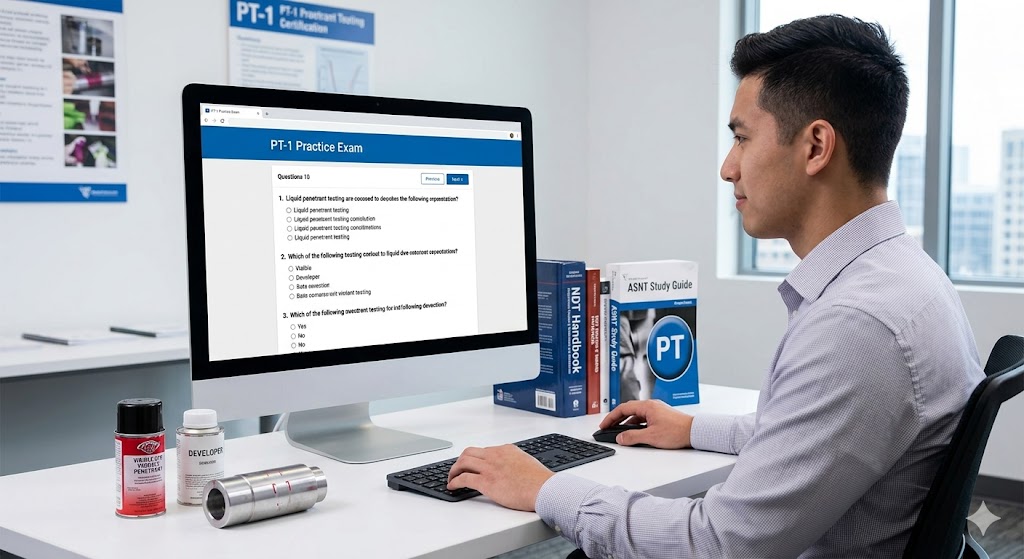
Additional Information
What the Course Entails and Exam Details
A typical comprehensive PT-1 training course encompasses
both in-depth classroom learning and essential hands-on practical application.
The structured syllabus covers a broad range of topics, ensuring that
candidates are not only familiar with the underlying physical principles but
also proficient in the operational steps and interpretation of results. Key
course topics often include:
- Principles
of Liquid Penetrant Testing: Understanding the core concepts of capillary
action, surface tension, and viscosity that make the process possible.
- Types
of Penetrants: Differentiating between the various penetrant groups,
including visible (color contrast) and fluorescent dyes, and their
respective application methods and sensitivity levels.
- Surface
Preparation and Cleaning: Recognizing the critical importance of a clean
surface for accurate testing and learning effective techniques for
pre-cleaning and post-cleaning parts.
- Penetrant
Application and Removal: Master the proper application techniques
(spraying, brushing, dipping) and, more importantly, the crucial step of
excess penetrant removal without washing out indications from defects.
- Developers:
Exploring the different types of developers (dry powder, aqueous,
non-aqueous) and their function in drawing the entrapped penetrant out to
form visible indications.
- Interpretation
and Evaluation of Indications: Learning to distinguish between relevant
(flaw), non-relevant, and false indications, and understanding how to
interpret indications according to codes, standards, and specifications.
- Standards,
Codes, and Specifications: Becoming familiar with key industry documents
from organizations like ASNT (American Society for Nondestructive
Testing), ASTM (American Society for Testing and Materials), and ASME
(American Society of Mechanical Engineers).
- Equipment,
Safety, and Quality Control: Understanding the operation and maintenance
of PT equipment, essential safety precautions (especially for fluorescent
inspection with UV light), and quality control checks for materials and
processes.
What to Expect in
the Final Exam
While specific details can vary depending on the
certifying body (e.g., ASNT’s SNT-TC-1A, or specific employer programs), a
standard PT-1 certification process generally involves a multi-part
examination. However, for the general theory portion that many standard practice
exams focus on, here is what you can often expect:
- General
(Theory) Exam: This section typically consists of multiple-choice
questions assessing your understanding of the theoretical concepts,
physical principles, and procedural knowledge covered in the course.
Questions will test your ability to apply logic and theory to common
inspection scenarios. A common parameter would be 40-70 questions.
- Passing
Score Requirements: The typical required passing score for individual
parts is often 70% or higher, and sometimes a composite score across all
parts of the exam must be 80% or higher to achieve certification.
- Time
Limits: You should expect time limits for each part of the exam. The time
allocated usually provides approximately 1 to 1.5 minutes per question. A
typical 50-question general exam might have a time limit of around 60 to
90 minutes. Note: For any standard online practice exam, check the
specific timer provided.
- Practical
Component (Real Certification): It is critical to remember that for a full
PT-1 certification, you will also need to pass a practical
examination. This part involves you demonstrating your ability to perform
the actual PT inspection steps (surface prep, penetrant application,
excess removal, developing, interpretation, and reporting) on a set of
test samples with known flaws, under the observation of a qualified
examiner. The general theory exam (which this guide and practice exams
support) is only one part of the journey.
How to Study and
Exam Centers
Preparation is absolutely key to success, both in your
training course and your final exams. Here are some actionable strategies to
enhance your learning and performance:
- Actively
Use Practice Exams: Take advantage of high-quality online PT-1 practice
tests, just like the one this guide supports. These simulate the real
general theory exam environment, help you get accustomed to the
multiple-choice format and time pressure, and allow you to identify any
areas of weakness where you need to revise further. The very article
you are reading now is part of such a practice-oriented resource.
- Engage
with Course Materials: Pay close attention during class, take detailed
notes, and actively participate in discussion. Ensure you thorough read
any assigned textbooks or training manuals, such as ASNT's "Liquid
Penetrant Testing Classroom Training Book."
- Focus
on Practical Details: When studying theory, try to connect it to the
practical application. Visualize the steps you will take, think about the
rationale behind each, and pay attention to specific procedural details
for each penetrant method.
- Understand,
Don't Just Memorize: Strive for a deeper understanding of why steps
are performed. Memorizing answers without grasping the underlying logic
can fail you when questions are phrased differently or applied to novel
situations.
- Form
Study Groups: If possible, collaborate with your course peers. Discussing
concepts and quizzing each other can be an effective and motivating way to
reinforce your knowledge.
- Review
Standards and Formulas: Familiarize yourself with the names and
functions of key codes and standards and practice any required
calculations (though these are generally minimal for Level 1 PT).
Exam Centers and Locations:
For a practice exam as this guide suggests, you
are often already within a dedicated online portal. For the real PT-1
certification exam, the process is usually handled through one of several
avenues:
- NDT
Schools and Training Centers: Most accredited NDT training providers are
authorized to conduct certification exams immediately following their
courses.
- In-Company
Certification: Many large companies have established, approved internal
"Written Practices" that define their own NDT personnel
qualification and certification program (often following SNT-TC-1A
guidelines). These companies would conduct exams in their own facilities.
- Accredited
Exam Centers (AECs): Certain international schemes like PCN (Personnel
Certification in Nondestructive Testing) use Accredited Exam Centers for
their assessments.
- Certification
Bodies (e.g., ASNT): For central certification programs, you would follow
the application and examination processes of the specific central body,
which could involve taking exams at designated testing locations (e.g.,
Pearson VUE test centers for certain ASNT exams, although PT Level 1 is
frequently school/employer-led). Always confirm with your training
provider or certifying organization regarding the specific exam procedures
and approved centers relevant to your situation.
Job Opportunities from the Course
Successfully achieving your PT-1 certification, combined
with requisite practical experience, can open the door to a variety of
entry-level and foundational roles within the Non-Destructive Testing industry
and related fields. These positions often provide a solid platform for career
growth, learning diverse skills, and potentially earning a good income without
a university degree. Here is a clear list of potential job opportunities and
career paths:
- NDT
Trainee
- NDT
Technician Level 1 (with a primary focus on Liquid Penetrant Testing)
- NDT
Inspector Assistant
- Quality
Control Inspector (with PT endorsement)
- Manufacturing
Technician (with inspection duties)
- Aerospace
NDT Technician (entry-level)
- Structural
Steel Welder’s Helper / In-process Inspector
- Maintenance,
Repair, and Overhaul (MRO) Assistant
These roles are crucial across a vast array of thriving
industries, including:
- Aerospace
(aircraft manufacturing and maintenance)
- Energy
(oil and gas, pipelines, power generation)
- Transportation
(railroads, shipbuilding)
- Infrastructure
(bridges, dams, buildings)
- Manufacturing
(castings, forgings, machined parts)
Frequently Asked Questions
Reviews
5.0
Based on 0 reviews
Leave a Review
No reviews yet. Be the first to review!