
Live Fire Instructor Certification Practice Exam
$69.00
- Buy to unlock unlimited access to all Quiz questions and Answers in this Quiz.
- After purchase you can print a PDF of the whole quiz at any point. The PDF will contain the questions and the correct answers.
About this Exam
The Live Fire Instructor Certification is a vital credential
for fire service professionals dedicated to hands-on training. This
certification ensures that instructors possess the specialized knowledge and
skills required to conduct live fire training exercises safely and effectively.
It is designed for experienced firefighters who want to step into leadership
roles as lead instructors for structural, exterior, or acquired structure
burns. Achieving this certification validates your ability to manage high-risk
training environments and protect the safety of all participants. It sets a
standard of excellence and responsibility crucial for modern fire service
instruction.
Ready to test your knowledge?
Buy Now to Access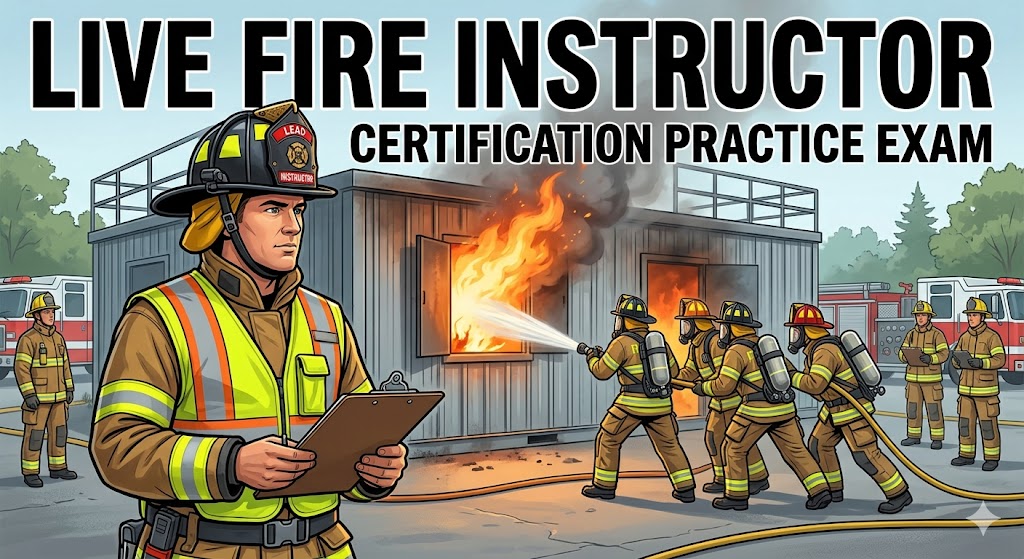
Additional Information
What the Course Entails and Exam Details
To prepare for the exam, candidates must master the
principles outlined in current standards, typically NFPA 1403 (Standard on Live
Fire Training Evolutions). The coursework covers a broad range of critical
topics, starting with rigorous safety requirements and risk management
strategies. Students learn about acquiring suitable structures for burn
exercises, preparing the site, and ensuring proper fuel loads. The syllabus
also details the roles and responsibilities of the instructor-in-charge, safety
officers, and ignition teams. Other key areas include pre-burn briefings,
emergency procedures, and post-burn critiques to ensure maximum learning.
Understanding water supply requirements and fire control techniques during
training scenarios is also paramount.
What to Expect in the Final Exam
The certification process generally concludes with a
comprehensive, rigorous final examination designed to test both theoretical
knowledge and practical application. The written portion typically consists of
multiple-choice questions based on standard firefighting texts and the specific
live fire training standards adopted by the issuing agency. Candidates are
usually required to achieve a minimum passing score, often around 70% to 80%,
to demonstrate mastery of the material. A practical skills evaluation is often
a mandatory component of this examination process. During the practical exam,
candidates must demonstrate their ability to plan, supervise, and execute a
live fire evolution in a controlled environment. The practical portion is
heavily focused on the candidate’s ability to maintain safety standards
throughout the entire training exercise.
How to Study and Exam Centers
Success on the Live Fire Instructor Certification exam
requires a balanced study approach involving thorough review and practical
application. Start by creating a dedicated study schedule that allows you to
focus on one main topic area at a time. It is essential to carefully review all
relevant texts, including NFPA 1403 and your state’s specific fire service
training materials. Utilize the Live Fire Instructor Certification Practice
Exam to identify your strengths and weaknesses before taking the actual test.
Form study groups with other candidates to discuss scenarios, share insights,
and review critical safety protocols. For information on exam centers, check
with your state's Fire Marshal’s office, fire academy, or designated testing
centers like Pearson VUE. The administrative agency handling the certification
will provide specific details on how to register and locate authorized test
centers in your region.
Job Opportunities
from the Course
Earning this certification significantly enhances your
resume and opens up specialized career paths within the fire service. Here are
some of the job titles and opportunities this certification can unlock:
- Lead
Live Fire Instructor at state or local fire academies.
- Fire
Department Training Officer specializing in hands-on operations.
- Safety
Officer for live fire training evolutions.
- Contract
instructor for private emergency response training companies.
- Field
Evaluator for firefighter practical skills testing.
- Specialized
training consultant for industrial fire brigades.
Frequently Asked Questions
Reviews
5.0
Based on 0 reviews
Leave a Review
No reviews yet. Be the first to review!