
Live Fire Training Instructor Practice Test
$69.00
- Buy to unlock unlimited access to all Quiz questions and Answers in this Quiz.
- After purchase you can print a PDF of the whole quiz at any point. The PDF will contain the questions and the correct answers.
About this Exam
The Live Fire Training Instructor certification is a
critical credential designed for experienced fire service professionals who
possess the knowledge, skills, and maturity to oversee inherently dangerous,
yet essential, live fire training evolutions. It’s for those dedicated to
upholding the highest safety standards—primarily based on NFPA 1403—while
providing firefighters with the realistic experience needed to perform
effectively in real-world structural fires. This certification is not just
about understanding fire behavior; it’s about mastering risk management, strict
adherence to protocols, and supervising both instructors and students in a
high-stakes environment. Candidates are typically experienced firefighters who
also hold fundamental instructor and, often, officer certifications.
Ready to test your knowledge?
Buy Now to Access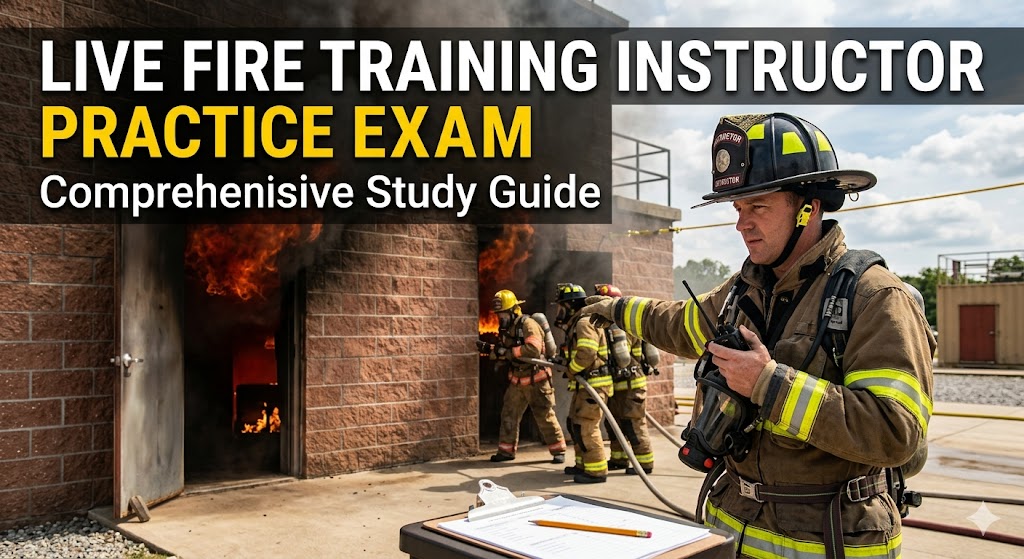
Additional Information
What the Course Entails and Exam Details
A standard Live Fire Training Instructor course focuses
heavily on safe operational procedures for live fire exercises. You will delve
deep into the requirements of NFPA 1403: Standard on Live Fire Training
Evolutions, mastering principles of risk-benefit analysis, planning, and
documentation. Core topics often include:
- Instructor
Responsibilities and Qualifications: Understanding the distinct roles
and prerequisite requirements for all personnel involved.
- NFPA
1403 Standards and Applications: Comprehensive study of fuel load
limits, environmental considerations, structure requirements, and required
safety features for both acquired structures and purpose-built burn
buildings.
- Risk
Management & Safety Procedures: Identifying hazards, implementing
safety controls, required equipment (PPE, SCBA, thermal imagers), and
developing evacuation plans.
- Planning
and Documentation: Creating detailed pre-burn plans, permits, weather
considerations, and ensuring proper record-keeping.
- Burn
Evolution & Fuel Selection: Understanding different fuel types,
ignition procedures, controlling fire intensity, and supervising the
entire evolution.
- Roles
& Supervision: Defining and executing the responsibilities of the
Instructor-In-Charge, Safety Officer, Ignition Officer, and supervising
instructors, ensuring strict participant ratios and monitoring.
- Legal
& Ethical Considerations: Navigating liability, adhering to best
practices, and post-burn critiques and evaluations.
What to Expect in the Final Exam
While the full certification process often incorporates both
a knowledge-based written exam and a practical skills evaluation (such as
planning and supervising a live fire), this guide is geared towards the type
of written knowledge assessment a practice test prepares you for. You can
generally expect:
- Exam
Format: A multiple-choice format, often with scenario-based questions
that test your understanding and application of NFPA 1403 standards. There
might be anywhere from 50 to 100+ questions.
- Passing
Score: Requirements vary, but a common illustrative passing
score is 70% to 80%. Be sure to check the specific requirements of
your state or certifying body.
- Time
Limit: Expect a timed exam, typically ranging from 1 to 3 hours.
Practicing under timed conditions is crucial.
- Exam
Rules: Written exams are almost universally closed book. You
will need to rely solely on your knowledge, recall of specific standards,
and ability to apply them in scenarios. Some computer-based exams may not
allow backward navigation, so answer each question carefully before
proceeding.
How to Study and
Exam Centers
Effective study methods are key to success:
- Master
NFPA 1403: This is non-negotiable. Get the current edition, read it
cover-to-cover multiple times, take detailed notes, and understand every
requirement. Use highlighters and create summaries of key sections.
- Use
Recommended Textbooks & Course Materials: Your primary course
manual and resources from organizations like IFSTA or Jones & Bartlett
are invaluable. They often contain key takeaways, practical tips, and
chapter reviews.
- Take
Practice Tests Repeatedly: Utilize this practice test and any others
available. This familiarizes you with the question style, identifies
knowledge gaps, and helps with time management. Analyze why
incorrect answers were wrong and why the correct answer is right
according to the standards.
- Create
Flashcards & Study Guides: Focus on definitions, critical values
(fuel load limits, temperatures), key safety protocols, specific
responsibilities of different roles, and common pitfalls. Use acronyms to
help with recall.
- Simulate
Scenario Planning: Practice developing fictional pre-burn plans based
on NFPA 1403 requirements for different types of structures (acquired vs.
purpose-built).
- Teach
the Material: Explaining complex rules to a colleague or study partner
is one of the best ways to solidify your own understanding.
- Where
to Take the Exam: Testing procedures vary significantly by
jurisdiction.
- State
Fire Academies & Training Agencies: Many exams are administered
directly by state-level fire training commissions or academies.
- Accredited
Pro Board / IFSAC Certifying Bodies: Look for accredited
organizations within your region that can administer Pro Board or IFSAC
recognized certifications.
- Authorized
Testing Centers / Colleges: Some written components might be
delivered through recognized computer-based testing centers or affiliated
community colleges.
- Online
Portals: Written only portions may increasingly be offered via
secure online proctored platforms, but this is less common than in-person
for the full certification which includes practicals. Always verify the exact
exam location and method with your specific course provider or certifying
entity.
Job Opportunities
from the Course
A Live Fire Training Instructor certification is highly
respected and essential for key fire service roles. Possible job titles
include:
- Live
Fire Training Instructor (LFI / LFIT): Actively instructing and
supervising live fire training exercises.
- Instructor-In-Charge
(IIC): The primary leader designated as overall "in-charge"
of live fire training evolutions.
- Fire
Service Training Officer: Developing, coordinating, and overseeing
entire training programs, including live fire aspects.
- Lead
Fire Service Instructor: Often responsible for curriculum development
and leading teams of instructors in a specific discipline.
- Fire
Department Safety Officer: Leveraging deep safety knowledge to oversee
departmental operations, including high-risk training.
- State
/ Regional Fire Academy Instructor: Teaching accredited fire service
courses, including specialized training like live fire instructor
development.
- Fire
Service Consultant: Providing expert advice on training safety,
standards compliance, and program development for various organizations.
- Industrial
Fire Brigade Instructor: Leading and supervising realistic fire
training for industrial emergency response teams.
Frequently Asked Questions
Reviews
5.0
Based on 0 reviews
Leave a Review
No reviews yet. Be the first to review!