
Living Environment Regents Practice Test
$69.00
- Buy to unlock unlimited access to all Quiz questions and Answers in this Quiz.
- After purchase you can print a PDF of the whole quiz at any point. The PDF will contain the questions and the correct answers.
About this Exam
The Living Environment Regents exam is a foundational
science assessment designed for high school students in New York State. It
serves as a culmination of the one-year Living Environment course, which is
essentially a comprehensive study of biology and the natural world. This exam
is a critical requirement for students aiming to earn a Regents diploma,
validating their understanding of core biological principles. Its purpose is to
ensure that students possess the scientific literacy and analytical skills necessary
for future academic endeavors and informed citizenship. By evaluating a
student's grasp of life science concepts and their practical application, the
Living Environment Regents provides a clear benchmark of scientific
proficiency.
Ready to test your knowledge?
Buy Now to Access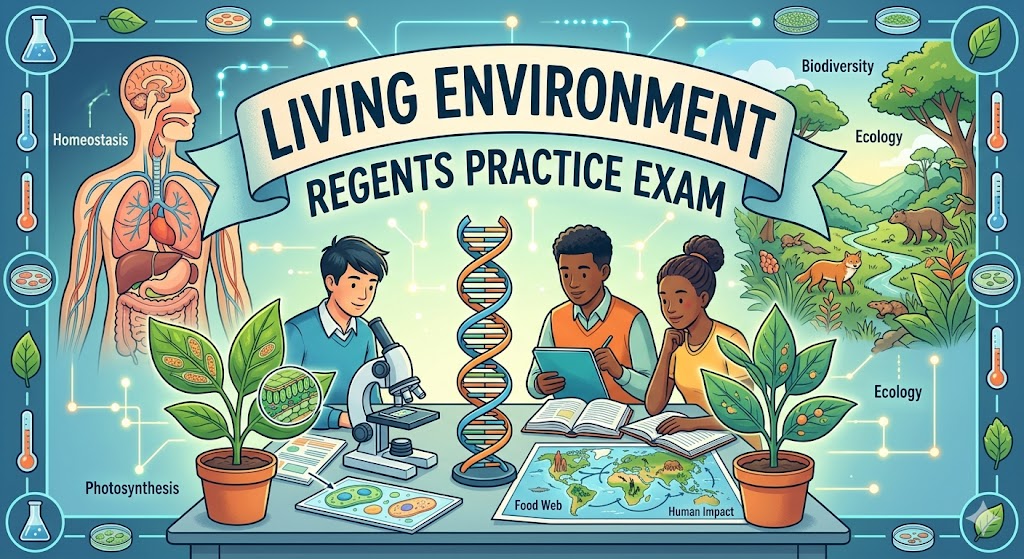
Additional Information
What the Course
Entails and Exam Details
The Living Environment course covers a wide array of vital
topics that form the basis of modern biology. Students delve into the
microscopic world of Cells, learning about their structure, function,
and processes like respiration and photosynthesis. The course explores Genetics
and Heredity, uncovering how traits are passed down through generations and
the role of DNA. Another major pillar is Evolution, which explains the
mechanisms behind the diversity of life on Earth. A substantial portion is
dedicated to the Human Body, analyzing how complex systems work together
to maintain Homeostasis.
Furthermore, students study Ecology, focusing on
ecosystems, biodiversity, and the significant impact humans have on the
biosphere. A unique and critical aspect of this course is the heavy emphasis on
Laboratory Skills. Throughout the year, students complete a series of
mandated laboratory activities, which are directly tested in the "Part
D" section of the final exam, ensuring they can apply scientific methods
and analyze data in a hands-on context.
What to Expect in
the Final Exam
The final Living Environment Regents exam is a robust,
comprehensive assessment. It typically spans three hours and is structured into
four distinct parts, labeled A through D, each designed to test a different
type of knowledge and skill.
- Part
A: Consists of approximately 30 Multiple-Choice Questions.
These questions focus on your knowledge and understanding of core
biological concepts and vocabulary derived directly from the syllabus.
- Part
B: Contains a mix of Multiple-Choice and Constructed-Response
(Open-Ended) questions. These require you to interpret data, analyze
graphs and diagrams, and apply your knowledge to solve real-world
problems.
- Part
C: Consists primarily of Constructed-Response questions. This
section challenges you to synthesize information, write coherent
scientific explanations, and demonstrate a deeper understanding of major
themes, such as human impact and global issues.
- Part
D: Is the practical application section, testing your knowledge of the
four state-mandated laboratory investigations. You will answer questions
based on the procedures, data analysis, and conclusions of these specific
experiments.
A student’s score is calculated as a scaled score from 0 to
100. A score of 65 is generally considered a passing grade, meeting the
requirement for a Regents diploma.
How to Study and
Exam Centers
Effective preparation for the Living Environment Regents
requires a blend of consistent coursework and strategic practice.
- Master
the Mandated Labs: Dedicate significant time to reviewing the
procedures and conclusions of the four state-mandated labs. Knowing these
inside-out is a guaranteed way to secure points in Part D.
- Practice
with Past Exams: The absolute best resource is the trove of publicly
available Past Regents Exams. Set aside time to take full-length,
timed practice tests, then carefully review your answers against the
provided key and rating guide to identify weak areas.
- Create
Visual Aids: Biology is a visual science. Sketch and label diagrams of
cells, human body systems, and food webs to help reinforce complex
processes.
- Review
Key Vocabulary: The exam frequently uses specific scientific terms.
Ensure you have a strong command of the vocabulary for each unit.
The Living Environment Regents exam is not taken online and
cannot be scheduled through standard Pearson VUE or other third-party centers.
It is a pencil-and-paper exam administered only at authorized physical testing
centers within the State of New York. These locations are exclusively the high
schools where students are currently enrolled and completing their Living
Environment course. The exams are administered during three specific statewide
testing windows: January, June, and August.
Job Opportunities
from the Course
While the Living Environment Regents is a high school
credential, it unlocks the pathway to higher education and a vast range of
compelling, specialized career paths. A strong performance in this exam is a
clear indicator of success in future biological, ecological, and medical
studies. Here are some key career titles this foundation helps you work
towards:
- Environmental
Scientist
- Biology
Teacher (High School)
- Registered
Nurse
- Medical
Doctor / Physician
- Clinical
Laboratory Technician
- Wildlife
Biologist
- Conservationist
- Biotechnologist
- Science
Writer / Educator
- Veterinarian
- Genetic
Counselor
- Forensic
Scientist (Biology Specialization)
- Ecotourism
Guide
Frequently Asked Questions
Reviews
5.0
Based on 0 reviews
Leave a Review
No reviews yet. Be the first to review!