
Locomotive Engineer Trainee Practice
$69.00
- Buy to unlock unlimited access to all Quiz questions and Answers in this Quiz.
- After purchase you can print a PDF of the whole quiz at any point. The PDF will contain the questions and the correct answers.
About this Exam
The [Locomotive Engineer Trainee Practice Test] is a
vital tool designed for aspiring individuals seeking a career operating
locomotives in the railroad industry. This comprehensive practice exam serves
as a robust preparation resource, simulating the challenging qualification
assessments encountered during the hiring and training process for locomotive
engineer trainees at major railroads.
It is specifically crafted for candidates aiming to demonstrate their understanding of fundamental railroad safety rules, operational procedures, mechanical principles, and problem-solving abilities required to safely and efficiently control powerful trains. Whether you are a rail enthusiast looking to turn your passion into a profession, or someone exploring a dynamic career with significant responsibility, this practice test will gauge your readiness and build confidence for the official evaluations
Ready to test your knowledge?
Buy Now to Access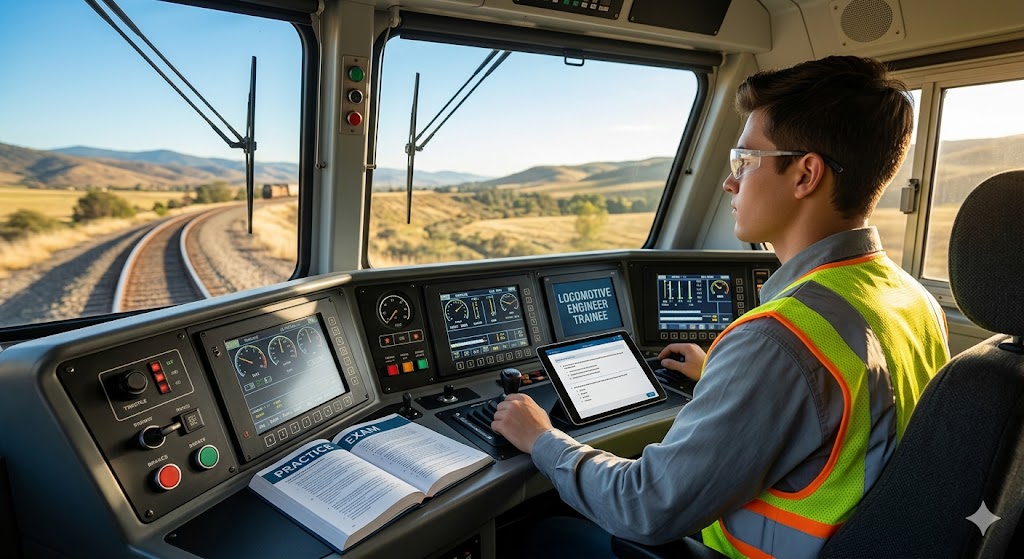
Additional Information
What the Course Entails and Exam Details
This practice exam does not constitute a full course
itself but rather a targeted assessment of the core knowledge and skills
required. However, preparing for it involves delving into critical areas
essential for any locomotive engineer. The core topics and skills covered
include:
- Railroad
Safety Rules and Regulations: Deep understanding of safety protocols,
signal systems, track warrants, and industry-specific regulations designed
to prevent accidents and ensure secure operations.
- Operating
Rules and Procedures: Mastery of specific rules governing train movement,
switching operations, speed restrictions, and communication procedures.
- Locomotive
Mechanical and Electrical Systems: Basic knowledge of how diesel-electric
locomotives function, including air brake systems, power distribution, and
troubleshooting fundamental mechanical issues.
- Train
Handling Principles: Understanding the physics of train movement,
including dynamic braking, slack control, grade negotiation, and fuel
efficiency.
- Signals
and Trackside Indicators: Ability to interpret various signal aspects,
signs, and markers critical for navigating the rail network safely.
- Problem-Solving
and Decision-Making: Evaluating complex situations, applying rules
correctly, and making critical decisions under pressure, particularly
concerning safety.
- Basic
Mathematics and Physics: Practical application of concepts like speed,
distance, time calculation, force, and weight distribution.
What to Expect in the Final Exam
The actual qualification exams for locomotive engineer
trainees are rigorous and structured, varying slightly by railroad. However,
you can generally expect the following format and characteristics, which this
practice test aims to replicate:
- Exam
Format: Most qualification assessments utilize multiple-choice questions
administered via computer. These questions are designed to test not just
rote memorization but your practical application of rules and concepts.
Some railroads may also include written components, practical
demonstrations, or simulations later in the training process.
- Time
Limits: You will be under strict time constraints for each section or the
entire exam. Expect typical limits ranging from 2 to 4 hours, depending on
the comprehensiveness of the specific test. Efficiency and speed, coupled
with accuracy, are crucial.
- Number
of Questions: The number of questions can vary significantly, often
exceeding 100 or even 200 questions across multiple sections. The practice
test aims to provide a representative number (e.g., 50-100 questions)
within a similar format.
- Passing
Score Requirements: Railroads typically require very high passing scores,
often 80%, 85%, or even 90% or higher for key safety and operating rules
sections. Failure to meet these standards can result in disqualification
from the training program.
- Strict
Rules: The final exams are proctored in controlled environments.
Absolutely no outside assistance, notes, or electronic devices are
permitted. Identification verification is mandatory.
How to Study and Exam Centers
Actionable Study Strategies:
Utilize Multiple Practice
Tests: Take the [Locomotive Engineer Trainee Practice Test] multiple times.
Analyze both correct and incorrect answers thoroughly. Understand the why
behind each answer, referencing official rules whenever possible. This builds
familiarity with question style and content.
Study Official Railroad
Materials: Most major railroads provide study guides or rulebooks (e.g.,
General Code of Operating Rules - GCOR) to applicants. Study these
meticulously, as they are the source material for the actual exams.
Focus on Safety and Rules:
Prioritize understanding safety protocols and operating rules. These are the
most critical sections and often have the highest required passing scores.
Practice Time Management: Time
yourself when taking practice exams. Get accustomed to answering questions
quickly and efficiently without sacrificing accuracy.
Simulate Exam Conditions: Find
a quiet, distraction-free environment to take your practice tests. This helps
replicate the focus needed for the actual proctored exam.
Supplement with Educational
Resources: Explore online forums, educational websites, and books related to
railroad operations, locomotive mechanics, and safety rules to deepen your
understanding.
Create Flashcards: For key
definitions, signal aspects, and specific rules, use flashcards for quick and
effective recall.
Exam Centers:
- Practice
Tests: You can typically access the [Locomotive Engineer Trainee Practice
Test] and other similar preparation resources online through dedicated
educational platforms, test preparation websites, and sometimes even
within the careers section of railroad websites. These are accessible
anywhere with an internet connection.
- Final
Exams: The official qualification exams are administered directly
by the hiring railroad company. They do not typically use third-party
testing centers like Pearson VUE for initial entry tests. After being
selected as a candidate and proceeding through the interview process, you
will be scheduled to take the exam at specific railroad training
facilities, corporate offices, or designated hiring centers located across
the country. The location will be communicated to you directly by the
railroad's human resources or training department.
Job Opportunities from the Course
Passing the [Locomotive Engineer Trainee Practice Test]
is a critical first step towards securing a position and succeeding in a
locomotive engineer training program. Successfully completing the subsequent
official training and evaluations unlocks various rewarding career
opportunities within the railroad industry, including:
- Locomotive
Engineer Trainee: The initial position upon hiring, where you will undergo
intensive classroom and on-the-job training.
- Certified
Locomotive Engineer: Once fully trained and certified, you will be
responsible for safely operating locomotives and controlling trains.
- Locomotive
Conductor: Often a prerequisite role or parallel career path involving
managing train operations, coordinating with the engineer, and ensuring
crew and train safety.
- Remote
Control Operator (RCO): Specialized role utilizing remote control
technology to operate locomotives in rail yards.
- Yardmaster:
Responsible for managing operations within a specific rail yard,
coordinating train movements and crew assignments.
- Trainmaster:
Supervisor responsible for overseeing train operations, crews, and safety
within a larger territory, managing multiple yardmasters and train crews.
- Road
Foreman of Engines: Management role overseeing locomotive engineers,
providing training, conducting check rides, and ensuring rule compliance.
- Various
Management and Operational Roles: Experienced locomotive engineers often
progress into various management, safety, and operational leadership
positions within the railroad company.
Frequently Asked Questions
Reviews
5.0
Based on 0 reviews
Leave a Review
No reviews yet. Be the first to review!