
Logic Pro Certification CRAS Practice Test
$69.00
- Buy to unlock unlimited access to all Quiz questions and Answers in this Quiz.
- After purchase you can print a PDF of the whole quiz at any point. The PDF will contain the questions and the correct answers.
About this Exam
The Logic Pro Certification CRAS Practice Test is a
comprehensive evaluation tool designed to prepare students and audio
professionals for successful certification in Apple's industry-leading Digital
Audio Workstation (DAW), Logic Pro. This specific practice exam is tailored
around the curriculum and standards of the Conservatory of Recording Arts and
Sciences (CRAS), ensuring that candidates are not only familiar with the
software's vast features but also proficient in applying them within a
professional audio production environment.
The certification itself is designed for individuals who
have a foundational understanding of music production and are looking to
validate their skills with a formal credential. Aspiring music producers, sound
designers, mix engineers, and audio post-production specialists all benefit
from this certification, as it demonstrates a proven level of expertise to
potential employers and clients.
Successfully passing this practice exam signifies that you possess a strong command over Logic Pro’s interface, recording capabilities, editing tools, MIDI sequencing, software instruments, mixing console, and automation features. It is a critical stepping stone for anyone serious about a career in modern audio production.
Ready to test your knowledge?
Buy Now to Access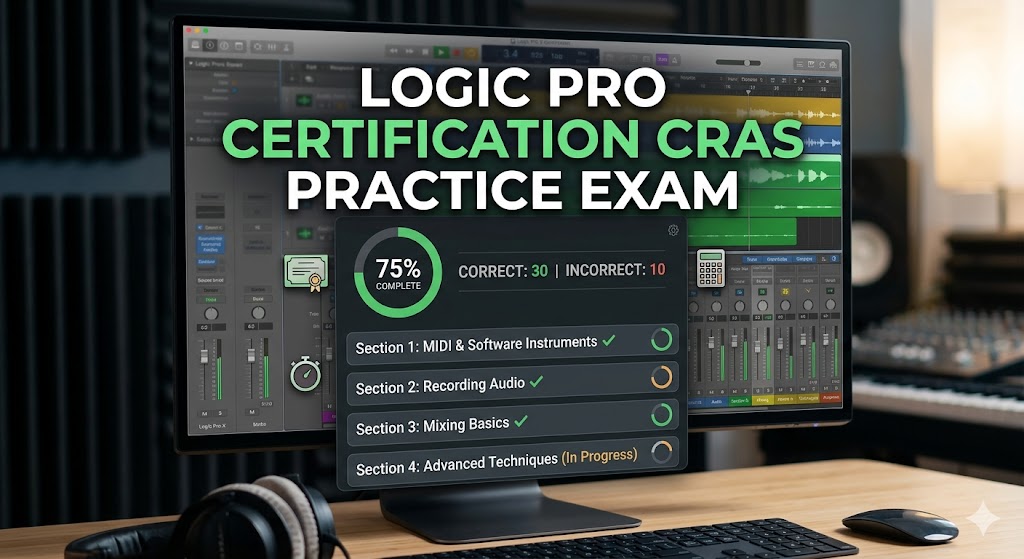
Additional Information
What the Course Entails and Exam Details
While specific course structures and exam details may
evolve, a comprehensive Logic Pro course designed for this certification
typically covers a wide spectrum of essential topics and practical skills:
- Logic
Pro Interface & Navigation: Gaining familiarity with the main windows,
editors, transport controls, and workflow customization options.
- Project
Management: Learning effective ways to create, save, back up, and organize
projects, including handling audio files and assets.
- Recording
Audio & MIDI: Understanding signal flow, setting up recording takes,
punching in/out, and managing audio/MIDI recordings efficiently.
- Editing
Techniques: Mastering the diverse editing tools for both audio and MIDI
data, including region editing, quantization, flex time/pitch, and comping
takes.
- MIDI
& Software Instruments: Deep diving into Logic Pro's extensive library
of virtual instruments, MIDI programming, and editing MIDI continuous
controller (CC) data.
- Mixing
& Automation: Exploring the mixer's architecture, inserting effects,
using sends/auxes, and applying various types of track and region
automation.
- Working
with Plug-ins & Effects: Understanding how to use the built-in effects
plug-ins effectively for creative processing and sound shaping.
- System
Configuration & Troubleshooting: Optimizing Logic Pro's performance,
managing audio interfaces, and basic troubleshooting procedures.
Exam Details (Typical Structure):
The final certification exam generally includes the
following characteristics:
- Format:
A comprehensive assessment consisting primarily of multiple-choice
questions, which may be supplemented by scenario-based questions or
practical application tasks within a controlled environment.
- Number
of Questions: Typically ranges from 60 to 80 questions.
- Time
Limit: Generally between 90 and 120 minutes.
- Passing
Score: Usually requires a score of 75% or higher to achieve certification.
- Attempts:
Policies on retakes vary; candidates are advised to consult official
guidelines.
- Proctoring:
The exam is typically proctored to ensure integrity, whether taken
in-person or online.
What to Expect in
the Final Exam
When you step into (or log in to) the final examination,
you can expect a demanding but fair assessment of your true proficiency with
Logic Pro. The exam is carefully structured to test not just rote memorization,
but your ability to apply knowledge efficiently in realistic production
scenarios.
- Balanced
Content: Expect questions derived from all core areas of the syllabus. A
significant portion will test your understanding of interface operation,
practical recording/editing tasks, MIDI workflows, mixing principles, and
plug-in usage.
- Scenario-Based
Questions: You may encounter questions presented as specific audio
production problems. For example, you might be asked to identify the
correct signal flow path in a given image or determine the best
tool/technique for achieving a particular editing or mixing result
described in the prompt.
- Detailed
Knowledge: The exam doesn't just touch upon surface-level features; it
dives into specific parameters, key commands, and advanced functionalities
that seasoned Logic Pro users utilize daily.
- Time
Pressure: The allotted time is designed to be sufficient for a
well-prepared candidate, but it does require efficient thinking and
decisive answers. Managing your time across all questions is crucial.
- Strict
Testing Environment: Whether in a dedicated testing center or via an
online proctoring service, the environment will be quiet and controlled,
with no access to outside resources (including notes or the internet)
during the exam. Integrity and fairness are paramount.
How to Study and Exam Centers
Diligent preparation is the key to conquering the Logic
Pro Certification. Utilize a variety of resources and active learning
techniques:
- Active
Practice is Paramount: Spend hours actively using Logic Pro. Complete
projects from start to finish, experimenting with every feature, tool, and
plug-in you can find. Recreate complex routing scenarios and troubleshoot
issues yourself.
- Review
Course Materials: If you've taken a formal Logic Pro course (e.g., at
CRAS), thoroughly review all lectures, notes, assignments, and practical
exercises.
- Utilize
Official Documentation & Resources: Study the official Logic Pro
documentation and explore Apple's online resources, which often include
deep-dive articles and video tutorials.
- Take
Multiple Practice Tests: Engage with comprehensive practice tests like
this one repeatedly. Analyze both correct and incorrect answers to
understand the underlying logic and identify weak areas for further study.
Simulating exam conditions (timed, no help) during practice is highly
beneficial.
- Collaborate
and Teach: Discussing concepts with peers or even explaining Logic Pro
features to others can reinforce your own understanding significantly.
- Master
Key Commands: Efficiency is a major factor. Dedicate time to learning and
practicing essential keyboard shortcuts.
Exam Centers and How to Take the Exam:
As this is a certification often associated with specific
institutions like CRAS, the examination process typically follows one of these
routes:
Authorized Educational Institutions: If you are a student
at CRAS or another authorized school, the certification exam is likely
administered directly on-campus in a proctored lab environment or through a
secure internal portal. You would schedule your exam with the relevant
department or advisor.
Proctored Online Testing: Some
certification programs offer a secure, proctored online testing option.
Candidates schedule an exam time, install specific proctoring software, and are
monitored remotely via webcam and screen sharing during the entire test
duration.
Consult official CRAS information or your program
coordinator for precise details on registration, scheduling, and available
testing methods. Ensure you understand the system requirements and logistics
well in advance of your exam date.
Job Opportunities
from the Course
Achieving a Logic Pro Certification, backed by strong
practical skills, opens doors to a diverse range of rewarding career paths in
the vibrant audio industry. Employers and clients recognize the validated
proficiency that this credential represents. Specific job opportunities
include:
- Music
Producer: The core role of creating, arranging, and producing music
tracks, leveraging Logic Pro’s extensive virtual instruments and
production tools.
- Audio
Engineer (Studio/Recording): Recording live instruments, vocals, and
ensembles, managing studio sessions, and ensuring high-quality audio
capture.
- Mix
Engineer: Crafting the final sonic balance, applying creative and
technical processing, and preparing tracks for mastering.
- Sound
Designer: Creating original sound effects, atmospheric audio, and
synthetic sounds for film, television, video games, commercials, and other
media.
- Post-Production
Audio Specialist: Editing dialogue, integrating sound effects and music,
and managing the overall audio for visual media projects.
- MIDI
Programmer: Designing and sequencing intricate MIDI parts for various
musical styles, virtual orchestrations, and electronic music productions.
- Recording
Artist (using Logic Pro): Many musicians use Logic Pro as their primary
creative platform for songwriting, demo recording, and producing their own
music.
- Logic
Pro Instructor/Educator: Teaching Logic Pro proficiency to individuals or
within educational institutions.
- Audio
Editor: Working on dialogue cleaning, podcast editing, and various other
audio refinement tasks.
- A&R
(Artists and Repertoire) Scout/Assistant: Evaluating talent and assisting
in artist development, often involving analyzing demos and music
production quality.
- Studio
Manager/Assistant: Overseeing day-to-day operations and assisting
engineers in professional recording facilities.
Frequently Asked Questions
Reviews
5.0
Based on 0 reviews
Leave a Review
No reviews yet. Be the first to review!