
Long Term Care (LTC) Nursing Assistant Practice Test
$69.00
- Buy to unlock unlimited access to all Quiz questions and Answers in this Quiz.
- After purchase you can print a PDF of the whole quiz at any point. The PDF will contain the questions and the correct answers.
About this Exam
Are you aspiring to
provide compassionate care for seniors and individuals in need?
The journey to becoming a Certified Nursing Assistant (CNA)
with a specialized focus in Long Term Care (LTC) begins here.
Long Term Care Nursing Assistants play a critical role in
the lives of residents in nursing homes, assisted living facilities, and other
residential care settings.
The actual CNA certification exam is a comprehensive
assessment that tests both your knowledge and your practical skills.
This LTC Nursing Assistant Practice Exam is a valuable resource designed to simulate that testing environment and help you prepare effectively
Ready to test your knowledge?
Buy Now to Access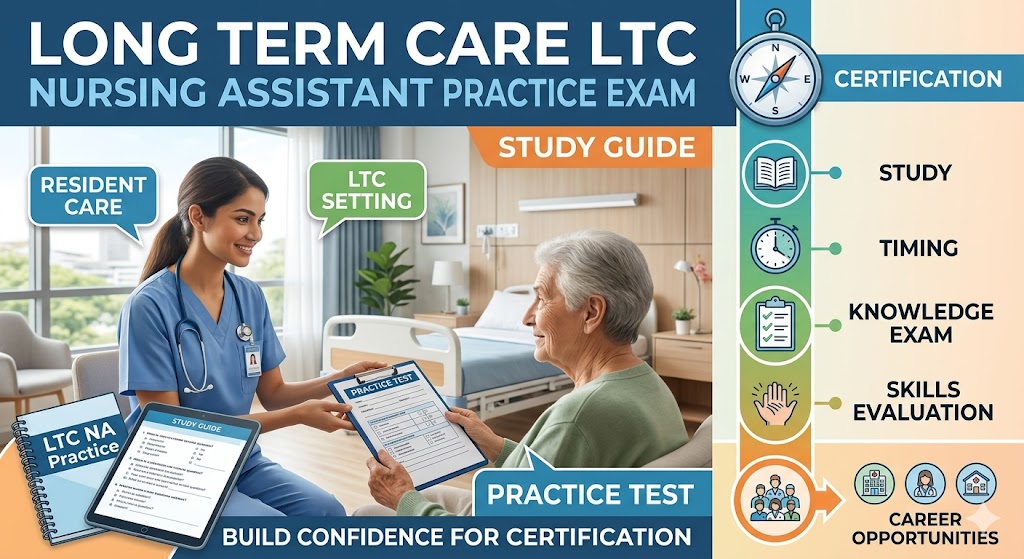
Additional Information
What the Course Entails and Exam Details
While a practice test itself doesn't have a syllabus,
it is a reflection of the content covered in a formal Nursing Assistant
program.
To excel as a Long Term Care NA, you must master a wide
range of topics and skills.
Core areas typically include providing for the physical,
emotional, and social needs of residents in an LTC setting.
This involves assistance with activities of daily living
(ADLs) such as hygiene, dressing, and mobility.
You will learn important concepts like maintaining standard
precautions, controlling infections, and respecting resident rights.
The practice test covers these domains by presenting
questions that test your understanding of communication techniques, observation
and documentation, ethical and legal standards, and specific challenges related
to aging and restorative care.
Ultimately, the practice exam is your way to gauge
proficiency in the knowledge you have acquired throughout your training.
What to Expect in
the Final Exam
The ultimate goal of this study guide is to prepare you for
the actual Certified Nursing Assistant certification exam.
Most states use a two-part examination to verify your
competency.
First, there is a knowledge component, typically consisting
of a multiple-choice exam with questions ranging from 60 to 80.
You will have a specific time limit, often between one to
two hours, to complete this part.
Second, you must pass a skills evaluation where you
demonstrate several randomly selected clinical skills, such as handwashing,
transferring a resident, or checking vital signs.
A nurse evaluator will observe your performance and grade
each step according to specific criteria.
To receive certification, you must achieve a passing score
on both the knowledge and skills portions of the exam, usually around 75-80% or
higher, depending on your state.
It is important to know your state’s specific rules, such as
arriving early with valid photo ID and following dress codes for the skills
test.
How to Study and Exam Centers
Effective preparation is essential for success.
Make studying for both the knowledge and skills portions of
the certification exam a regular part of your schedule.
This practice test is a core tool; take it seriously and
treat it like the real thing to build your test-taking endurance.
Make sure to review not only the questions you got wrong but
also the rationales for all answers to deepen your understanding.
Beyond the practice exam, study your comprehensive Nursing
Assistant textbook and any supplemental materials.
Clinical practice is invaluable for the skills part of the
test; practice in your clinical setting and seek feedback from your
instructors.
To take the actual CNA certification exam, you must first
complete a state-approved training program.
From there, you can typically find and register for exam
dates and centers through your state’s department of health or nursing board.
Common exam administration partners include Pearson VUE,
Prometric, and other vendors.
These organizations manage physical testing centers which
may be located in colleges, authorized training schools, or other facilities.
Some states may even allow testing at specific physical test
centers or authorized schools in your area, or occasionally through online
portals for the knowledge portion.
Job Opportunities
from the Course
Becoming a Certified Nursing Assistant with an LTC focus
opens numerous career paths.
You can find employment in various settings and advance your
career.
Potential job titles and paths include:
Job Titles:
- Certified
Nursing Assistant (CNA)
- Nursing
Assistant (NA)
- Long
Term Care Nursing Assistant
- Patient
Care Assistant (PCA) in an LTC facility
- Home
Health Aide (HHA) with LTC experience
- Restorative
Care Aide
- Medication
Aide/Technician (requires additional training and certification)
Career Paths:
- Advance
into nursing as a Licensed Practical Nurse (LPN) or Licensed Vocational
Nurse (LVN).
- Continue
education to become a Registered Nurse (RN) with an Associate or
Bachelor's degree (ADN, BSN).
- Pursue
specialized nursing roles such as Certified Registered Nurse Anesthetist
(CRNA) or Nurse Practitioner (NP).
- Transition
into healthcare administration and management within a long-term care
facility.
- Specialize
in areas like dementia care, wound care, or hospice services.
Frequently Asked Questions
Reviews
5.0
Based on 0 reviews
Leave a Review
No reviews yet. Be the first to review!