
Los Angeles County Sheriff's Department (LASD) RADIO Practice Exam
$69.00
- Buy to unlock unlimited access to all Quiz questions and Answers in this Quiz.
- After purchase you can print a PDF of the whole quiz at any point. The PDF will contain the questions and the correct answers.
About this Exam
The LASD RADIO Practice Exam is a specialized
proficiency test designed specifically for personnel within the Los Angeles
County Sheriff's Department (LASD). This includes both sworn deputy
sheriffs and professional staff, such as communications operators and
dispatchers. Effective and safe communication is the lifeblood of law
enforcement operations. This exam serves as a critical internal benchmark to
ensure that every individual authorized to use the LASD radio system possesses
the necessary knowledge and skills to communicate clearly, accurately, and
securely under all conditions.
Ready to test your knowledge?
Buy Now to Access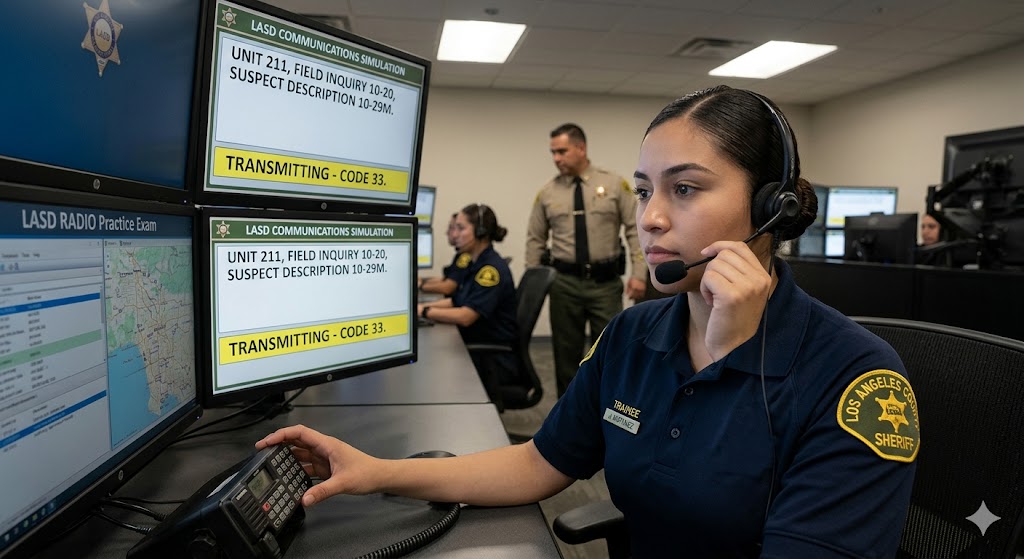
Additional Information
What the Course Entails and Exam Details
This examination is not a public certification course but
rather an essential internal requirement within the LASD training framework. It
evaluates mastery of the official communication protocols and best practices
outlined in the department's Communications Training Manuals. The material
covered is extensive and vital for daily operations and officer safety. Key
areas of study include:
- LASD
Official 10-Codes: Complete memorization and application of
standardized codes such as 10-4 (Acknowledgment), 10-20 (Location), 10-33
(Officer Needs Assistance - Emergency), and many others specific to LASD.
- Phonetic
Alphabet: Fluid use of the law enforcement phonetic alphabet (Adam,
Boy, Charles, etc.) to convey names, license plates, and other precise
information without error.
- Radio
Etiquette and Discipline: Mastering the art of brevity, clarity, and
professionalism. Trainees must learn how to efficiently "key"
the microphone, listen before speaking, and yield to priority traffic.
- Emergency
Transmission Protocols: The precise procedures for declaring and
managing emergency radio traffic, including "Code 33"
(Emergency, Do Not Transmit).
- LASD
Frequency Management: Understanding the structure and use of the
department's multiple radio frequencies, including station, tactical, and
mutual aid channels.
- Operation
of Communications Equipment: Familiarity with both mobile and handheld
radio units, their settings, and troubleshooting basic issues.
What to Expect in
the Final Exam
While the "practice" exam helps you prepare, the
final proficiency test is designed to be challenging and realistic. It
typically assesses knowledge and practical application across several modules.
Candidates must demonstrate competence under pressure to qualify for radio use.
The exam format may include:
- Dynamic
Multiple-Choice Sections: Written questions testing your knowledge of
10-codes, phonetic alphabet conversion, and department communication
policies.
- Written
Scenario Response: Providing the correct radio transmission for a
hypothetical law enforcement situation.
- Practical
Communication Scenarios (The Practical Exam): This is the most
critical component. In a controlled, simulated environment, you will be
given active law enforcement scenarios. You must use a department radio to
make precise transmissions, including providing locations, descriptions,
and calling for assistance. Evaluation criteria focus on accuracy,
brevity, use of proper codes, and maintain "radio calm"
during stressful simulations.
- Passing
Score: The LASD maintains high standards for communication
proficiency. A passing score typically requires near-perfect mastery of
the codes and protocols (often 80% or higher on written portions)
and flawless execution of practical scenarios during training. This test
is a proficiency requirement for ongoing and initial qualification.
- Time
Limit: Both written and practical components are timed to simulate the
real-world need for rapid and efficient communication.
How to Study and
Exam Centers
Preparation for the LASD RADIO exam must be rigorous and
systematic. Because this is an internal requirement, successful preparation
hinges on using official department resources and consistent practice.
Actionable Study Strategies:
Memorize the Official LASD 10-Code and Phonetic Alphabet
List: Create flashcards, use spaced repetition software, and have family or
colleagues quiz you daily. This must become second nature.
Role-Play Scenarios:
Practice with a fellow trainee or deputy. Create scenarios (e.g., traffic stop,
foot pursuit, domestic dispute) and take turns making the transmissions. Focus
on proper radio discipline and using the correct codes.
Listen to Official LASD
Transmissions: If permitted by policy and available, listen to authorized
training recordings or live scanner traffic from different LASD stations to
understand how seasoned personnel communicate.
Take LASD Practice Exams:
Utilize any official practice tests or quizzes provided during your training
academy or station-level instruction. Treat them like the final exam.
Review the Communications
Training Manual: Study the text and all self-tests. Pay close attention to
definitions of special codes like Code 3, Code 4, and Code 20.
Exam Centers:
The LASD RADIO Practice Exam and final qualification test
are administered internally by the department. They are not available at public
testing centers like Pearson VUE. Authorized testing locations include:
- LASD
Sheriff's Communications Center (SCC): The central hub for department
communications, located at Eastern Avenue in Los Angeles, is a
primary location for advanced training and final proficiency testing for
communications personnel.
- Station
Training Units: Initial training and station-specific radio
qualification may be conducted at individual LASD stations by the
designated Station Training Officer (STO).
- LASD
Training Academy: For recruits, the fundamental radio communication
training and initial qualification tests are conducted at the LASD
Training Academy (STAR Center).
Job Opportunities
from the Course
Successfully passing the LASD RADIO qualification exam is a
mandatory requirement for several critical career paths within the department.
It does not lead to a public certification but is a gateway to continued
service and advancement. The roles requiring this qualification include:
- Deputy
Sheriff: Proficiency is required for field operations, officer safety,
and effective coordination.
- Deputy
Sheriff Trainee: Mastery is essential for graduating from the academy
and being assigned to field duties.
- Sheriff's
Communications Operator (Dispatcher): This is the ultimate
communication role, requiring the highest level of mastery of all radio
procedures and protocols.
- Supervising
Communications Operator: Advancement to leadership in communications
requires proven expertise in all areas of the RADIO qualification.
- Specialized
Units: Transfer to specific units, such as Aero Bureau, Special
Enforcement Bureau (SEB), or Search and Rescue, also requires maintaining
current radio qualification and adapting to specialized communication
protocols.
Frequently Asked Questions
Reviews
5.0
Based on 0 reviews
Leave a Review
No reviews yet. Be the first to review!