
Louisiana Pest Control Technician Practice Test
$69.00
- Buy to unlock unlimited access to all Quiz questions and Answers in this Quiz.
- After purchase you can print a PDF of the whole quiz at any point. The PDF will contain the questions and the correct answers.
About this Exam
The path to becoming a licensed pest control professional in Louisiana begins with understanding the essential principles tested in the state examinations. Passing these tests is a vital requirement for anyone aspiring to legally work as a pest control technician, allowing individuals to apply pesticides responsibly and effectively. The actual Louisiana Pest Control Technician examinations, administered by the Louisiana Department of Agriculture and Forestry (LDAF), assess foundational knowledge in pesticide safety, regulations, environmental stewardship, and common pest identification and control strategies. This article, framed as a comprehensive study guide, explores the structure of the actual state exams that your studies—aided by tools like practice tests—are preparing you to conquer, positioning a practice exam as a key preparatory step in this process
Ready to test your knowledge?
Buy Now to Access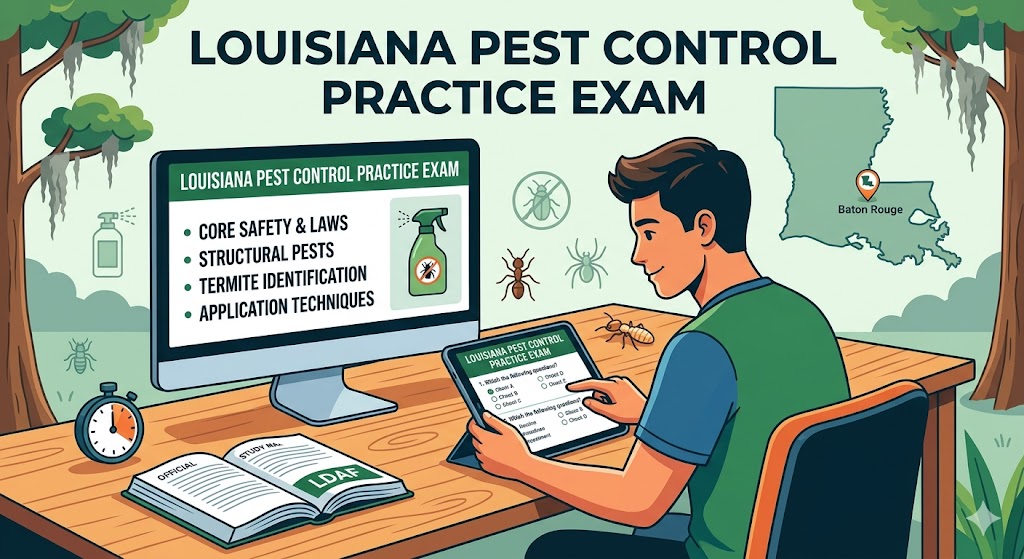
Additional Information
What the Course Entails and
Exam Details
While there is no single mandated "course" to
become a pest control technician, preparation involves self-study and often
hands-on training under the supervision of a certified applicator. The
examinations typically comprise two main components: a core foundational
knowledge section and category-specific sections. Here are the core areas
covered:
- National
Core Principles: Expect significant focus on general pesticide knowledge.
This includes understanding different types of pesticides, their
formulations, and correct labeling practices. Essential core topics also
cover pesticide safety procedures, proper mixing and application
techniques, and managing environmental considerations such as minimizing
drift and protecting non-target organisms. Furthermore, you must
demonstrate a grasp of federal pesticide laws and Louisiana-specific
regulations.
- Category-Specific
Topics (Common Examples):
- General
Structural Pest Control: Focuses on identifying and managing pests
commonly found in and around human structures. This includes insects,
spiders, rodents, and other nuisance pests. You will need to understand
diverse control methods, from physical exclusion and sanitation to
responsible pesticide application strategies.
- Termite
Control: Dedicated to the unique challenges of detecting and controlling
wood-destroying organisms. This section covers termite biology, species
identification, standard inspection protocols, and a comprehensive
understanding of diverse treatment methods, including soil treatments,
baits, and structural modifications.
- Landscape
and Ornamental Pest Control: For technicians focusing on pests affecting
trees, shrubs, and ornamental plants. This involves identifying common
plant pests and diseases and understanding appropriate management
techniques.
What to Expect in the Final
Exam
The final Louisiana Pest Control Technician examination
is a comprehensive test designed to measure your proficiency. While specific
details might slightly fluctuate, here are the typical characteristics of the
state exams:
- Exam
Format: The primary format for foundational tech exams is multiple-choice.
Some subcategory exams might include different question types or varying
amounts, generally containing between 50 and 100 multiple-choice
questions.
- Passing
Score: A successful completion of each exam, both core and specific
categories, typically requires a passing grade of 70%.
- Time
Limits: You will likely be allotted a specific amount of time to complete
each exam. Typical state exam time limits provide a duration of
approximately two hours (120 minutes) for 50-100 questions.
- Specific
Rules: The examinations are generally closed-book. Ensure you have valid
photo identification ready. Any specific rules about calculators, scrap
paper, or electronic devices will be detailed by the exam administrators
and must be strictly followed.
How to Study and Exam Centers
Achieving success on the state exam requires diligent
study and a multi-faceted approach. Here are effective study strategies and
crucial information on testing centers:
- How
to Study:
- Official
Study Manuals: Acquire and meticulously study the official Louisiana
Department of Agriculture and Forestry and LSU AgCenter manuals. Focus on
both the National Pesticide Applicator Certification Core Manual and any
relevant category-specific study materials. These are the primary sources
for the exam content.
- Active
Learning: Don't just read. Take detailed notes, create flashcards for key
terms, safety procedures, and pest information, and summarize complex
concepts in your own words. Consider teaching principles to others.
- Practice
Tests: Utilize high-quality Louisiana Pest Control Technician Practice
Tests, such as the one referenced by this guide. Taking timed practice
exams allows you to become familiar with the question style, manage your
time effectively, and identify areas where your knowledge needs
reinforcement. Focus on understanding why answers are correct or
incorrect.
- Join
Study Groups: Connecting with peers or online forums for pesticide
certification can provide valuable insights, resources, and motivation.
- Exam
Centers:
- Current
Transition: Testing locations and methods are evolving. It is critical to
note that testing in the district offices is ending on October 15,
2025.
- In-Person
Testing (From November 2025): Beginning in November 2025, in-person
testing will only be offered at the LDAF Main Office in Baton Rouge,
at 5825 Florida Blvd. You will need to schedule an appointment.
- Remote/Online
Testing (From November 2025): Also starting in November 2025, remote
testing will be an option through an authorized online testing vendor. Note
that online testing systems may charge an additional fee.
- Registration:
To register for an exam, you typically need to complete an application
for pesticide exams and pay the required fees to the Louisiana Department
of Agriculture and Forestry. Always check the official LDAF website or
contact them directly for the most current application forms, fee
schedules, and registration details for either in-person or remote
testing.
Job Opportunities from the Course (License)
Becoming a licensed pest control professional, initiated
by passing the foundational examinations, unlocks diverse career opportunities
in a stable and growing industry. Here are common job titles and career paths
this certification facilitates:
- Pest
Control Technician: The entry-level role, responsible for performing
inspections, identifying pest issues, and applying treatments to manage
diverse pest populations in residential and commercial settings.
- Termite
Control Specialist: A dedicated role focused specifically on the complex
tasks of detecting and controlling wood-destroying organisms.
- Landscape/Ornamental
Pest Control Technician: Working primarily outdoors on plants, trees, and
ornamental features to manage pests and diseases affecting landscaping.
- Pest
Control Sales and Service Technician: A role combining technician
responsibilities with customer service and sales, assessing client needs
and recommending comprehensive pest control solutions.
- Company
Service Manager or Owner: With experience and additional certifications
(like fully certified applicator), individuals can advance into leadership
roles, managing teams or operating their own pest control businesses.
Frequently Asked Questions
Reviews
5.0
Based on 0 reviews
Leave a Review
No reviews yet. Be the first to review!