
LSAT Practice Test
$69.00
- Buy to unlock unlimited access to all Quiz questions and Answers in this Quiz.
- After purchase you can print a PDF of the whole quiz at any point. The PDF will contain the questions and the correct answers.
About this Exam
The Law School Admission Test (LSAT) is an integral
component of the law school admission process in the United States, Canada, and
a growing number of other countries. It is specifically designed to assess the
essential skills required for success in law school, such as advanced reading
comprehension, critical thinking, and analytical reasoning. This practice exam
is an indispensable tool for aspiring law students who are preparing to take
the official LSAT. It serves as a comprehensive simulation, mirroring the
structure, timing, and question types of the actual test. Engaging with this
guide allows test-takers to familiarize themselves with the exam’s format,
build necessary stamina, identify specific areas of weakness, and reduce
test-day anxiety, providing a clear path to achieving a competitive score for
their law school applications.
Ready to test your knowledge?
Buy Now to Access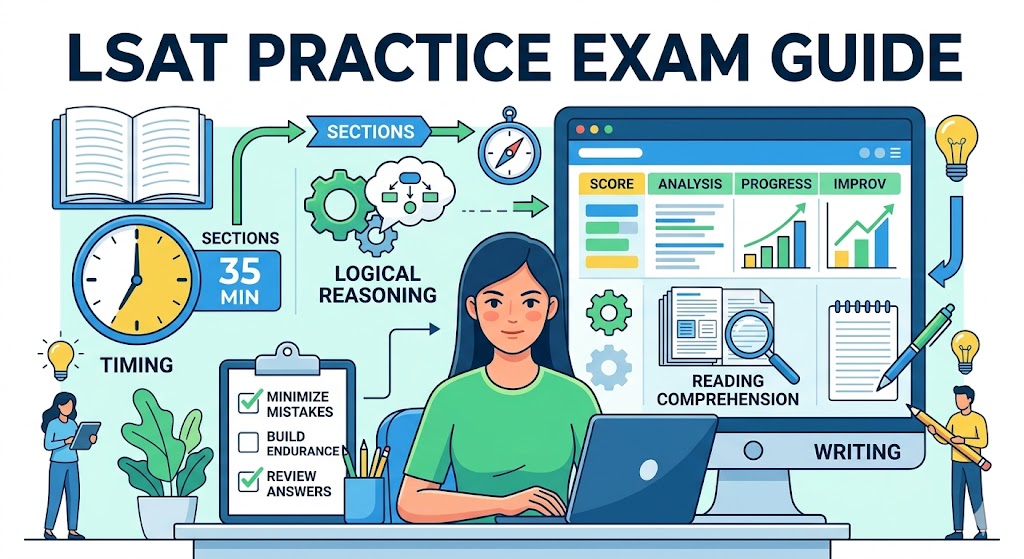
Additional Information
What the Course
Entails and Exam Details
This practice test comprehensively covers the core
intellectual skills evaluated by the modern LSAT. Instead of teaching a
particular body of knowledge, it focuses on the application of high-level
reasoning and comprehension abilities. While not a "course" with a
fixed syllabus, the practice exam is structured to reflect the exact
composition of the current test administration. The primary domains include:
- Logical
Reasoning: This section requires you to analyze, critically evaluate, and
complete arguments. You must identify assumptions, detect logical flaws,
determine how evidence strengthens or weakens an argument, and draw
well-supported conclusions from short passages.
- Reading
Comprehension: This section involves reading long, complex, and high-level
texts derived from the humanities, social sciences, biological and
physical sciences, and law. You must answer questions that measure your
understanding of main ideas, structure, tone, and specific details, as
well as your ability to draw inferences and make applications.
- Experimental/Variable
Section: The practice test will often include an unscored section, which
is either an additional Logical Reasoning or Reading Comprehension
section. This section is essential for simulating the four-section
structure and timing of the actual test.
- Argumentative
Writing: While not part of the multiple-choice score, the LSAT includes a
required, unscored writing task. A practice test will provide a prompt
requiring you to construct a persuasive, evidence-based argument that
balances differing viewpoints.
What to Expect in the Final Exam
The official LSAT is a computer-based, proctored exam
with a total of four 35-minute sections. You can expect the following
structure:
- Exam
Structure: The exam consists of two scored Logical Reasoning sections, one
scored Reading Comprehension section, and one unscored
experimental/variable section which can be either Logical Reasoning or
Reading Comprehension. The unscored section is not identified, requiring
full effort on all four parts.
- Timing
and Format: Each of the four multiple-choice sections is strictly timed at
35 minutes. After the second section, there is a mandatory 10-minute
break. The total active testing time for the main exam is approximately
two hours and 20 minutes, with the entire session, including check-in,
taking around three and a half hours.
- Scoring:
Your LSAT performance is reported as a scaled score ranging from 120 to
180. There is no official "passing" score; instead, your score
is used to generate a percentile rank, which indicates how you performed
relative to other test-takers over the previous three years. This score
and percentile are critical for competitive admission.
- Writing
Sample: The Argumentative Writing section is completed separately from the
main multiple-choice test, using your own computer from a location of your
choice. You have 35 minutes to write the essay after a short reading
period. Although unscored, a writing sample is required for a complete
score report and is reviewed by law schools.
How to Study and Exam Centers
Effective preparation with a practice exam is vital for
success. Here are actionable strategies and information on test locations:
- Simulate
Test Conditions: Take full-length, timed practice tests, ideally in a
quiet room without interruptions, to build stamina and internalize the
aggressive timing of each section.
- Thoroughly
Analyze Performance: Do not just score your test; actively review every
question, especially those you missed or were unsure about. Understand why
the correct answer is right and why the other options are wrong to
identify patterns in your mistakes.
- Focus
on Official Materials: Utilize practice tests and preparation tools from
the Law School Admission Council (LSAC), such as LawHub, which provides
access to numerous past LSAT administrations in the current computer-based
format.
- Build
Endurance and Strategy: Take a diagnostic test early in your preparation
to establish a baseline. Then, create a consistent study schedule that
includes targeted practice on weak areas and regular full-length timed
tests. Work on pacing yourself to ensure you can complete every question
within the given time.
- Testing
Centers and Methods: The actual LSAT is administered in two formats:
either as a remotely proctored online exam using your own computer, or in
person at a digital test center managed by LSAC's testing partner (such as
Prometric). You will select your preference when you register for a
specific test date through your LSAC account.
Job Opportunities
from the Course
While an LSAT Practice Test itself does not lead to a
direct certification or job, achieving a strong score on the official LSAT is
the fundamental gatekeeper for admission to law school. Earning a Juris Doctor
(JD) degree, which follows a strong LSAT score, unlocks a diverse and
prestigious range of career paths within the legal field. Here are key job
opportunities that originate with a strong LSAT score:
- Attorney
/ Lawyer (specializing in areas like corporate, criminal, family, or
environmental law)
- Judge
- Corporate
Counsel
- Legal
Consultant
- Law
Professor / Academic
- Public
Defender
- Prosecutor
- Politician
/ Public Servant
- Compliance
Officer
- Mediator
/ Arbitrator
- Legislative
Analyst
- Legal
Editor / Writer
- Chief
Executive Officer (CEO) or other executive leadership roles, as legal
training is highly valued in business
Frequently Asked Questions
Reviews
5.0
Based on 0 reviews
Leave a Review
No reviews yet. Be the first to review!