
LSUHSC Office of Compliance Programs (OCP) Practice Exam
$69.00
- Buy to unlock unlimited access to all Quiz questions and Answers in this Quiz.
- After purchase you can print a PDF of the whole quiz at any point. The PDF will contain the questions and the correct answers.
About this Exam
The LSUHSC Office of Compliance Programs (OCP) mandatory training program is designed for all members of the Louisiana State University Health Sciences Center community. This includes every student, faculty member, staff employee, resident, fellow, and even volunteers and affiliates who interact with the institution's education, research, or clinical care missions. Its primary purpose is to cultivate a "compliant culture" by ensuring everyone understands and adheres to the vast landscape of federal and state laws, regulations, and university policies that govern a modern academic medical center. This is not just a checkbox exercise; it is an essential ethical and legal foundation for anyone working or studying at LSUHSC, aiming to protect patient privacy, research integrity, and institutional resources.
Ready to test your knowledge?
Buy Now to Access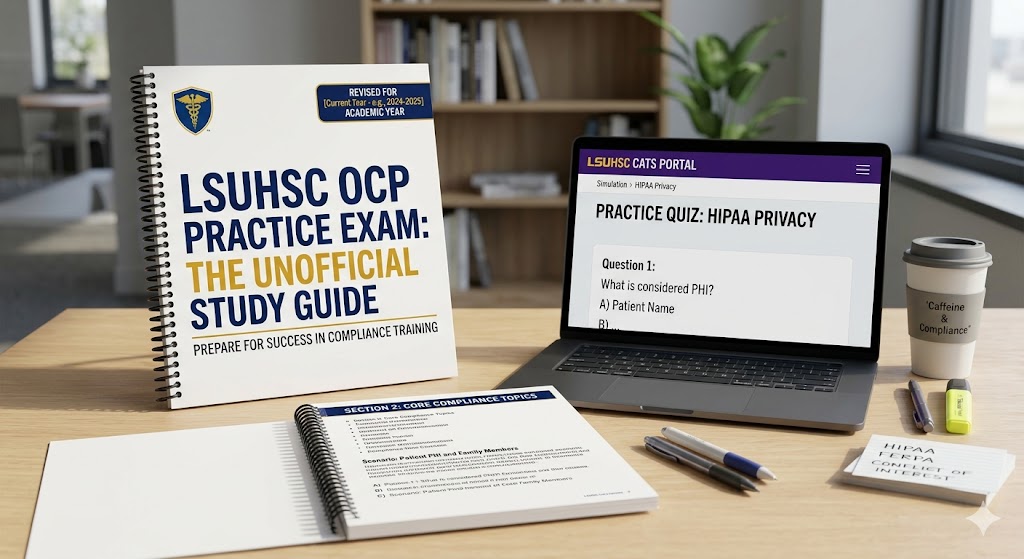
Additional Information
What the Course Entails and Exam Details
The OCP compliance program is not a single course with a
universal syllabus. Instead, it is a comprehensive curriculum delivered through
online, web-based platforms, primarily the Compliance and Training System
(CATS) or the Knowledge Delivery System (KDS). The exact modules you are
required to complete are customized based on your specific role and
responsibilities at LSUHSC.
Core topics that form the foundation of the program
include:
- HIPAA
Privacy and Security: Essential training on protecting Patient Health
Information (PHI) and the required safeguards for electronic data.
- The
Code of Conduct: LSUHSC's foundational document outlining the ethical
principles and behavioral expectations for all community members.
- FERPA
(Family Educational Rights and Privacy Act): Specifically for faculty,
staff, and students, detailing the privacy rights regarding educational
records.
- Fraud,
Waste, and Abuse (including the False Claims Act): Understanding how
to identify, prevent, and report financial misconduct and improper billing
in healthcare and research.
- Title
IX and Sexual Misconduct: Critical training on preventing and
responding to sexual harassment, discrimination, and violence.
- Conflicts
of Interest (COI): Guidance on recognizing and managing financial and
non-financial conflicts that could bias institutional responsibilities,
particularly in research and clinical decision-making.
- Research
Compliance: Specialized modules for those involved in research,
covering topics like Human Subject Protection (often utilizing the CITI
program), Animal Welfare, and Scientific Misconduct.
- Information
Security Awareness: Practices to keep your digital identity and
university systems secure from cyber threats.
Exam Details:
It is crucial to understand that the "LSUHSC OCP
Practice Exam" is an unofficial study tool, not an official LSUHSC
product. Your actual "final exam" is the successful, documented
completion of each required official compliance module within CATS/KDS.
However, to prepare for the official assessments, this unofficial practice exam
aims to mimic the typical experience:
- Format:
Each official module typically concludes with a mandatory, web-based quiz,
composed primarily of multiple-choice and true/false questions. Scenarios
are often used to test your application of the rules.
- Passing
Score: Most official OCP modules require a minimum passing score of
80% on the end-of-module quiz.
- Time
Limits: Official assessments are typically untimed, allowing you to
review module materials while taking the quiz. However, for this practice
exam simulation, we recommend pacing yourself to ensure you truly
understand the material without relying on constant look-ups.
- Rules:
The real value comes from your honest effort. In the official CATS/KDS,
you can usually retake the quizzes multiple times until you achieve the
passing score. The real "rule" is mastery and understanding, not
just a high score.
What to Expect in
the Final Exam
While "Practice Exam" is the common term, at
LSUHSC, you won't sit for a single, high-stakes comprehensive final. Instead,
your "final" is the complete set of required "Compliance
Certificates" you earn. You are not considered "compliant" until
all of your assigned modules in CATS/KDS show a status of "Complete."
Expect to encounter:
- Scenario-Based
Questions: You will be asked how to apply a rule to a realistic
situation. For example: "A family member asks for a patient's lab
results. What is the correct action under HIPAA?" or "You
discover a colleague is reusing single-use research supplies to save
money. Who should you notify?"
- Definitional
Knowledge: Knowing the precise meaning of terms like "PHI"
(Protected Health Information), "COI" (Conflict of Interest), or
"FERPA."
- Policy
application: Knowing where to find and how to apply specific LSUHSC
policies, such as the social media policy or the policy on reporting
non-compliance.
- Recertification
Requirements: Some training, such as HIPAA Privacy and Security, must
be repeated every single year. You will receive email reminders when it's
time to re-certify.
How to Study and
Exam Centers
Since this training is a mandatory prerequisite and not a
competitive certification, the goal of your study should be genuine
comprehension, not just memorization.
Actionable Study Strategies:
Treat it Like a Real Class:
Schedule dedicated, uninterrupted time to go through the modules. Do not try to
rush them while multi-tasking.
Active Engagement: Don't
just click through the slides. Read every word, watch every video, and take
your own notes. TheCATs/KDS platform often has interactive elements; engage
with them fully.
Focus on "Why":
For each rule and policy, ask yourself: Why does this rule exist? What harm is
it trying to prevent? (e.g., preventing patient identity theft, ensuring
research results are trustworthy).
Analyze Your Mistake: When
you get a practice or quiz question wrong, do not just click for the correct
answer. Go back into the module text and find the specific policy or statement
that explains why your answer was wrong.
Use Official Resources:
The OCP website and the CATS/KDS home page contain links to the full policies,
frequently asked questions (FAQs), and contact information for the Compliance
Team. Utilize these when you need clarification.
Exam Centers:
There is no physical testing center to visit. All official
LSUHSC OCP compliance training and assessments are conducted online and are
accessible 24/7 through specific internal university portals.
- For
current students, faculty, and staff: You will log into the CATS
(Compliance and Training System) or KDS (Knowledge Delivery System) using
your official LSUHSC user ID and password, from any computer with internet
access.
- For
research-specific training (like human subject protection): You may
need to create and utilize a CITI Program account and affiliate it with
LSUHSC.
- For
volunteers or affiliates without a full LSUHSC logon: Your department
coordinator will work with the OCP to create specific access for you.
Job Opportunities
from the Course
Completing the OCP mandatory training does not, by itself,
grant a new job title like "Certified Compliance Officer." However,
it is an absolute and non-negotiable requirement to hold almost any role
at LSUHSC, particularly those that involve handling sensitive data, interacting
with patients, or conducting research.
Successfully completing this training demonstrates to the
institution that you are an ethical, safe, and reliable professional who can be
trusted to work with critical resources.
Specific examples of career paths at LSUHSC where this
training is a prerequisite include:
- Medical,
Dental, Nursing, or Allied Health Student: Complete compliance
training is required to progress in your curriculum and participate in
clinical rotations.
- Resident
Physician / Fellow: Mandatory for all advanced medical trainees
working in LSUHSC-affiliated hospitals.
- Research
Coordinator / Research Assistant: Required for access to human or
animal research protocols and data.
- Principal
Investigator (PI) / Faculty Researcher: Required to lead and receive
funding for research projects.
- Clinical
Staff (e.g., Nurse, Tech, Therapist): Required to provide patient care
and access electronic medical records.
- Administrative
and Clerical Staff (e.g., in billing, admissions, or department offices):
Required for handling patient, student, or financial data.
- IT
Specialist / Data Analyst: Crucial for understanding data security and
privacy requirements in a health sciences environment.
- University
Volunteer / Community Partner: Required for many on-campus and
affiliated activities.
In short, while it doesn't give you a new title, it is the
key that unlocks the door to your entire career or educational journey at
LSUHSC.
Frequently Asked Questions
Reviews
5.0
Based on 0 reviews
Leave a Review
No reviews yet. Be the first to review!