
LTAP Maintenance of Traffic (MOT) Practice Exam
$69.00
- Buy to unlock unlimited access to all Quiz questions and Answers in this Quiz.
- After purchase you can print a PDF of the whole quiz at any point. The PDF will contain the questions and the correct answers.
About this Exam
The Maintenance of Traffic (MOT) certification, often
administered through the Local Technical Assistance Program (LTAP) in various
states, is a critical safety credential for the highway construction industry.
This course is designed for individuals responsible for
planning, supervising, implementing, or maintaining temporary traffic control
zones.
It ensures that workers, supervisors, and engineers
understand how to protect themselves and the public while maximizing traffic
flow through construction or maintenance areas.
This certification is typically required for personnel
ranging from entry-level laborers and flaggers to worksite supervisors and
transportation engineers responsible for designing traffic control plans.
Ready to test your knowledge?
Buy Now to Access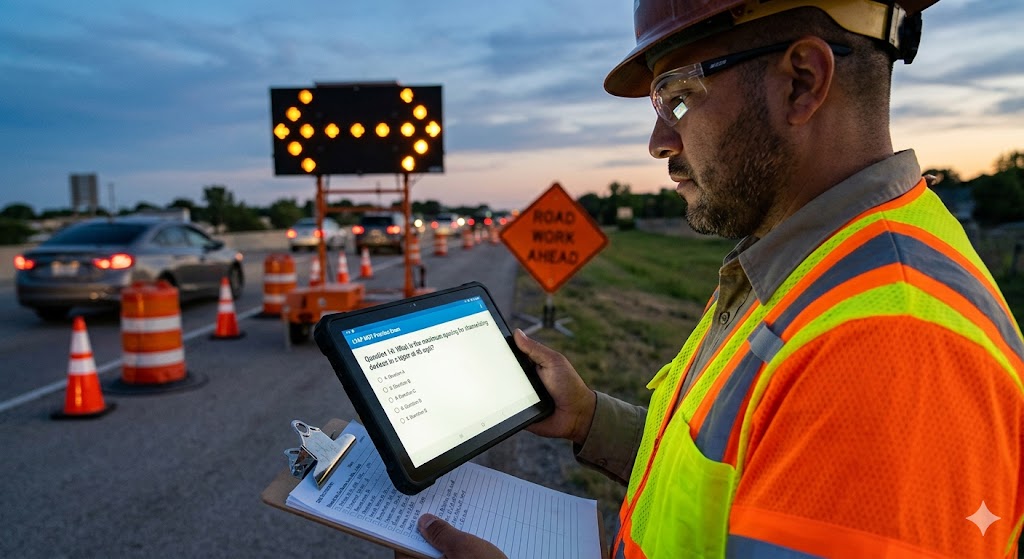
Additional Information
What the Course Entails and Exam Details
The MOT course provides comprehensive training based on
the Manual on Uniform Traffic Control Devices (MUTCD) and specific state
Department of Transportation standards.
The primary objective is to teach participants how to
correctly set up, maintain, and remove temporary traffic control devices.
Core topics covered in the syllabus include the
fundamental principles of work zones, the standard components of a temporary
traffic control zone (Advance Warning Area, Transition Area, Activity Area, and
Termination Area), and the appropriate use of various devices such as signs,
cones, drums, and barricades.
You will also learn about flagging operations, mobile
operations, night work considerations, and legal requirements regarding worker
and pedestrian safety.
What to Expect in
the Final Exam
While exact parameters can vary slightly by state and
certification level (Basic, Intermediate, or Advanced), the MOT final exam is
typically a proctored, closed-book assessment.
The format is predominantly multiple-choice questions
designed to test your understanding of the standards and your ability to apply
them in real-world scenarios.
For Intermediate and Advanced levels, a standard exam
usually consists of approximately 50 questions, and students are given a time
limit of around two hours to complete it.
A passing score is typically set at 70% or 75%. Some
comprehensive programs may also include a practical demonstration component,
particularly regarding flagging procedures.
How to Study and
Exam Centers
Effective preparation is key to success on the MOT exam.
Your primary study resource must be the standard
reference material provided during the course, typically an official workbook
and the relevant sections of the MUTCD.
Focus on understanding the geometry of traffic control
zones—such as taper lengths and device spacing charts—rather than just
memorizing definitions.
Take multiple full-length practice exams to become
familiar with the phrasing of the questions and to identify areas where your
knowledge is weak.
To sit for the actual exam, you must register through an
authorized training center, such as your state's LTAP center, a university
transportation technology center, or an approved private safety training
provider.
Many training centers now offer hybrid options, where you
complete the instruction online and attend a designated physical location for
the proctored final exam.
Job Opportunities
from the Course
Obtaining your Maintenance of Traffic (MOT) certification
is a vital career step that unlocks numerous positions in roadway construction,
maintenance, and safety management.
This certification is often non-negotiable for
contractors working on state and federal highway projects.
The certification unlocks the following career paths and
job titles:
- Worksite
Traffic Supervisor
- Traffic
Control Technician
- Highway
Construction Laborer
- Maintenance
of Traffic Specialist
- Construction
Safety Coordinator
- Roadway
Maintenance Worker
- Civil
Engineering Technician (Inspector)
- Asphalt
Paving Foreman
- Utility
Contractor Supervisor
Frequently Asked Questions
Reviews
5.0
Based on 0 reviews
Leave a Review
No reviews yet. Be the first to review!