
LTO Non Professional Driver's License PracticeTest
$69.00
- Buy to unlock unlimited access to all Quiz questions and Answers in this Quiz.
- After purchase you can print a PDF of the whole quiz at any point. The PDF will contain the questions and the correct answers.
About this Exam
Congratulations
on taking the first step towards your driving mobility in the Philippines! The
Land Transportation Office (LTO) Non-Professional Driver's License (NPDL) is
your official permit to operate a private motor vehicle for personal use.
Designed for
individuals aged 17 and older who want to drive their own car or motorcycle
without receiving compensation for driving, this license is a key milestone for
personal independence and daily convenience. Whether you're commuting to
work, running errands, or planning a road trip, having an NPDL gives you the
freedom to move at your own pace.
This guide and associated practice tests are carefully
crafted to help you prepare thoroughly for the LTO's assessment, ensuring you
not only pass the exams but also become a safe and responsible driver.
Ready to test your knowledge?
Buy Now to Access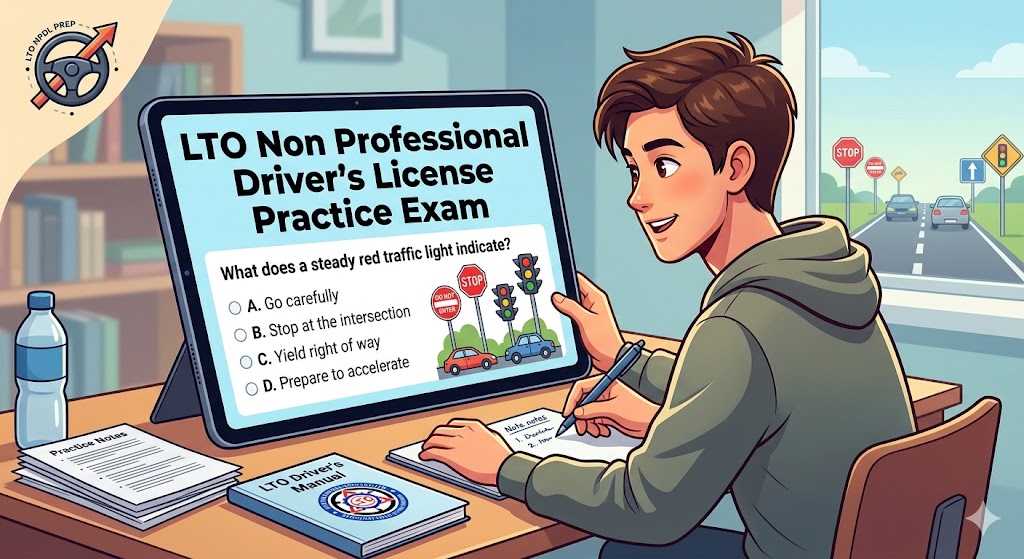
Additional Information
What the Course Entails and Exam Details
Before you can hold that license, the LTO ensures you have
the necessary knowledge and practical skills through driver education and
testing. The path generally involves:
- Driver
Education: First-time applicants are required to complete a Practical
Driving Course (PDC) from an LTO-accredited driving school or Driver's
Education Center (DEC). This course covers essential theoretical and
practical instruction.
- Written
Exam (Theoretical): This computerized test focuses on your knowledge
of traffic rules, road signs, defensive driving, and LTO regulations in
the Philippines. Key areas include:
- Traffic
lights, signals, and pavement markings.
- Right-of-way
rules at intersections and while maneuvering.
- Safe
driving practices and hazard awareness.
- Vehicle
basic maintenance and check.
- Pertinent
laws like anti-drunk driving regulations.
- Practical
Driving Test: Once you pass the written exam, you will undergo a
hands-on evaluation at an LTO-accredited testing track. This part tests
your ability to safely handle a vehicle and apply what you've learned. You
must demonstrate skills such as:
- Performing
pre-driving checks.
- Starting,
steering, and stopping smoothly.
- Proper
turn signals and maneuvering.
- U-turns,
changing lanes, and navigating intersections.
- Correct
parking procedures.
- Obedience
to all relevant traffic rules.
For each stage, practice, study, and understanding are
critical.
What to Expect in
the Final Exam
The official LTO assessment for a Non-Professional Driver's
License consists of two main components, usually taken sequentially:
- Written
(Computerized) Exam:
- Format:
Multiple-choice questions, administered via a computer system at an LTO
licensing center. The test is often available in both English and
Filipino.
- Question
Count: For the NPDL, the theoretical exam typically consists of 40
questions (though this can occasionally vary; always confirm the latest
details with your local LTO).
- Passing
Score: You generally need to correctly answer at least 30 out of 40
questions (or around 75%) to pass. The passing score might be slightly
higher in some regions or under specific circumstances, so check for
updates.
- Time
Limit: Expect a time limit for the computerized exam, usually around
60 minutes. Make sure to read each question carefully and use your time
wisely.
- Rules:
Cheating and unauthorized materials are strictly prohibited. Results are
usually provided instantly upon completion.
- Practical
Driving Test:
- Format:
A hands-on driving evaluation conducted by an official LTO examiner. The
test takes place in a designated LTO practical driving course track,
which simulates various road conditions and maneuvers.
- Vehicles:
You may have the option to use your own vehicle, a vehicle from your
driving school (if applicable to the center’s policy), or rent one from
the LTO for a minimal fee. Ensure the vehicle is properly registered and
in good working condition.
- Maneuvers:
The examiner will evaluate your execution of pre-driving checks, general
driving skills, basic and complex maneuvers (like three-point turns and
parking), and strict adherence to traffic rules and signals.
- Scoring:
Examiners score based on a checklist of required skills and safe driving
practices. Points are deducted for errors, and some significant mistakes
can lead to instant failure. The passing score can vary slightly between
testing tracks but requires demonstrating overall competency and safe
operation.
- Feedback:
You will receive feedback and your result shortly after completing the
test.
How to Study and Exam Centers
Your preparation is everything! Here's how to structure your
studying for both parts of the process:
- Comprehensive
Study Strategies:
- Official
LTO Materials: Thoroughly review the LTO Driver's Manual and any
official materials from your Practical Driving Course. The LTO often
provides resources through their website and the LTMS (Land
Transportation Management System) portal.
- Accredited
Driving Schools: Enroll in an LTO-accredited driving school. The
required Practical Driving Course (PDC) is not just a formality; it
provides structured learning from professional instructors who are
familiar with the LTO requirements and best practices.
- Practice
Tests: Utilize online LTO Non-Professional practice tests like the
one linked in this guide. Take them repeatedly to get accustomed to the
question formats, identify your weak areas, and build confidence. Many
platforms offer both standard and updated question sets.
- Observation
& Understanding: While on the road (even as a passenger or
supervisor for another driver), actively observe traffic signs, signals,
pavement markings, and how other drivers behave. Try to predict what they
should do and identify any mistakes. Don't just memorize answers;
understand the why behind road rules and safety practices.
- Hands-on
Practice: For the practical part, spend ample time practicing driving
with a licensed driver who can provide guidance. Focus on each specific
maneuver required by the LTO testing track. Familiarize yourself with
different vehicle types (manual vs. automatic) depending on the vehicle
you will be licensed to drive.
- Stay
Updated: Be aware of any recent changes in traffic laws or LTO
procedures. Official LTO social media and websites are good sources for
announcements.
- Exam
Centers and Scheduling:
- LTO
Licensing Centers: Theoretical and practical driving exams are
conducted at designated LTO Licensing Centers, District Offices, and some
designated LTO kiosks across the Philippines.
- Where
to Check: Use the official LTO website or the LTMS portal to find the
nearest and most convenient office for your location. Be sure to check
which services each specific office offers (some might only handle
theoretical, for example).
- Online
Portal (LTMS): You are generally required to create an account on the
LTO's LTMS portal (https://portal.lto.gov.ph/).
Through this portal, you can often apply for the license, take online
theoretical review/assessments, and, in some cases, schedule your actual
theoretical and practical exam appointments, pay fees, and view updates.
- Mandatory
Course: The Practical Driving Course (PDC) must be taken at an
LTO-accredited driving school or an LTO Driver's Education Center (DEC).
You will receive a PDC Certificate upon successful completion, which is a
key document for your license application and scheduling of the official
LTO practical exam.
- Booking
Appointments: With the implementation of the LTMS and to avoid long
queues, most LTO offices encourage or require booking appointments for
license transactions and exams. Check the LTMS portal or your local LTO
office for their specific booking process and accepted proof of
appointments.
Job Opportunities
from the Course
Obtaining your Non-Professional Driver's License not only
grants you personal mobility but also unlocks specific employment opportunities
in the Philippines that value having a verified driver. Note that for-hire
or public utility vehicle driving generally requires a Professional Driver's
License. Some job opportunities and paths enabling growth for a non-pro
license holder include:
- Personal
Driver: Providing reliable transportation for individuals, including
commuting to work, appointments, and errands.
- Family
Driver: Assisting a family with all their daily transportation needs,
such as driving children to school and parents to various engagements.
- Private
Chauffeur (Non-Commercial): Operating private, high-end vehicles for
specific individuals or organizations in a non-professional capacity
(always verify exact role requirements and local regulations).
- Delivery/Logistics
Roles (Light Vehicles): Some local delivery roles for light private
vehicles or motorcycles, especially for smaller businesses or app-based
services (always check specific job listings and platform regulations as
some delivery positions, especially with larger companies or for goods
transport, may require a professional license).
- Career
Pathways:
- Foundation
for a Professional License: Holding a Non-Pro license is a
significant prerequisite for upgrading to a Professional Driver's License
(PDL) later on, which is required for driving public utility vehicles and
heavy trucks and opens up a wider range of commercial driving careers.
- Mobility
Enabler: In numerous other job sectors (e.g., sales, field
operations, real estate, personal assistants), being able to drive a
private vehicle is a highly valuable, and often required, skill, even if
the primary role is not driving itself. Your license makes you more
flexible and capable in these positions.
- Local
Transport Support: Working in support roles for local transportation
management, logistics hubs, or vehicle maintenance facilities where
having practical driving knowledge and a validated private driver's
license is beneficial.
Get ready to take control of your mobility! Practice, study
diligently, and always prioritize road safety as you prepare for your LTO
Non-Professional Driver's License and beyond. Best of luck on your driving
journey!
Frequently Asked Questions
Reviews
5.0
Based on 0 reviews
Leave a Review
No reviews yet. Be the first to review!