
Machine Guarding Practice Exam
$69.00
- Buy to unlock unlimited access to all Quiz questions and Answers in this Quiz.
- After purchase you can print a PDF of the whole quiz at any point. The PDF will contain the questions and the correct answers.
About this Exam
The Machine Guarding Practice Exam is a dedicated
preparatory tool designed for professionals aspiring to secure certifications
in industrial safety. This study resource targets individuals responsible for
workplace safety, including Safety Officers, Environmental Health and Safety
(EHS) Specialists, Maintenance Personnel, Machine Operators, and Factory
Supervisors. Its primary purpose is to test your understanding of essential
safeguarding techniques, regulatory compliance, and hazard recognition. By mastering
this content, you demonstrate your commitment to preventing catastrophic
industrial injuries and creating a safer work environment.
Ready to test your knowledge?
Buy Now to Access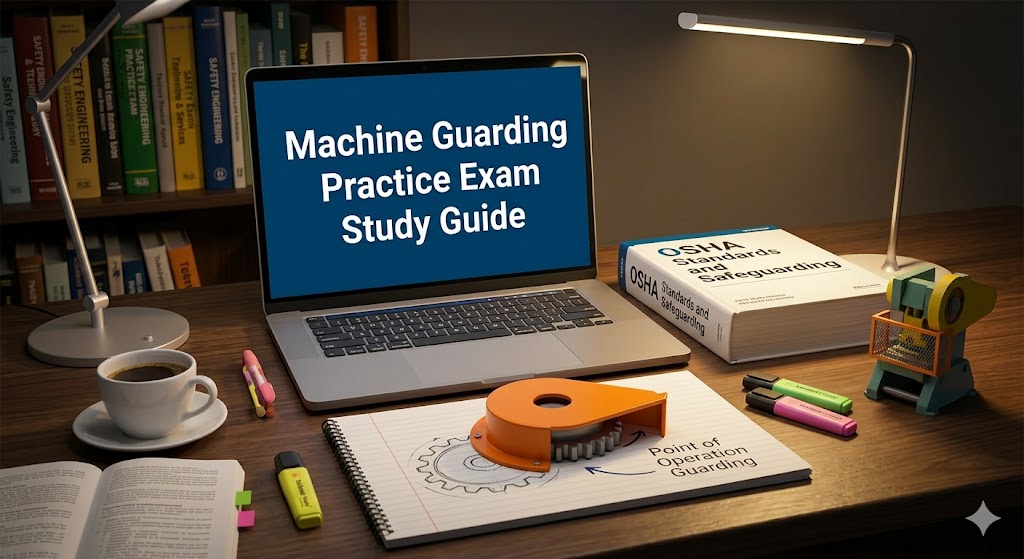
Additional Information
What the Course Entails and Exam Details
This examination does not exist in a vacuum; it typically
validates knowledge gained through a comprehensive safety training course, such
as those modeled after OSHA’s Machinery and Machine Guarding Standards (OSHA
#2045).
The core syllabus generally covers the following vital
areas:
Hazard Recognition: Learning to identify the mechanical
hazards associated with common machine processes, motions, and points of
operation.
OSHA Standards Compliance: A deep dive into standard 29
CFR 1910.212 (General Requirements for All Machines) and specific regulations
for power presses, woodworking machinery, and abrasive wheels.
Methods of Safeguarding: Understanding the
"Hierarchy of Controls" as it applies to machinery. You will learn
about fixed, interlocked, and adjustable guards, as well as safety devices such
as presence-sensing light curtains, two-hand controls, and pullback restraints.
Point of Operation: Specialized focus on the area where
work is performed on the material, including the necessary guards to prevent
operator hands from entering the danger zone.
Power Transmission Apparatus: Safeguarding methods for
the belts, pulleys, chains, and gears that transmit energy.
Complementary Safety Procedures: Recognizing how
Lockout/Tagout (LOTO) and proper Personal Protective Equipment (PPE) interact
with physical guarding systems.
What to Expect in the Final Exam
While the exact format can vary based on the specific
issuing body, standard industry safety exams generally share these
characteristics:
Format: Most final examinations are administered as
computer-based testing (CBT), consisting of multiple-choice and true/false
questions. Many modern exams incorporate scenario-based questions where you
must identify the appropriate guarding solution for a depicted situation.
Passing Score Requirements: Candidates are typically
required to achieve a score between 70% and 80% to pass.
Time Limits: You are generally allotted between 1 and 2
hours to complete the test, depending on the complexity of the exam.
Specific Rules: The exam is usually closed-book. You may
need to present a valid photo ID before starting. Online proctoring may be used
for remote examinations to ensure integrity.
How to Study and
Exam Centers
Effective preparation is the key to confidence. Here are
actionable strategies to ensure you are ready:
Take Advantage of Practice Tests: Utilize your Machine
Guarding Practice Exam repeatedly. Do not just focus on the correct answers;
understand why the other options are incorrect and the safety principle behind
the right one.
Review Regulatory Documentation: Access and study the
official OSHA documentation for standard 1910 Subpart O. Familiarity with the
official language of the regulation can help clarify tricky exam questions.
Practice Workplace Scenario Assessment: Apply your
learning to your own workplace. Visually inspect the machinery you work around
and determine if it meets the safeguarding principles you are studying.
Join a Study Group: Collaborative learning can help
reinforce concepts and offer new perspectives on hazard recognition.
Where and How to Take the Exam
The associated certification exam is typically taken
through authorized organizations rather than public testing centers like
Pearson VUE, although some safety certifications do use them.
You will likely take your exam through one of these
channels:
Authorized OSHA Training Institutes (OTI) Education
Centers: If you are taking the OSHA #2045 course, the exam is included in the
program.
Company-Mandated Training Portals: Many large
manufacturing companies host their own certified safety training and examine
internally through secure online portals.
Authorized Online Safety Schools: Several accredited
third-party organizations are authorized to provide both the training and the
final proctored examination online.
Job Opportunities
from the Course
A certification validated by a Machine Guarding exam
opens doors within the manufacturing, construction, and compliance sectors.
Here are specific career paths where this knowledge is highly valued:
Industrial Safety Officer: Responsible for implementing
safety programs and ensuring equipment compliance across a facility.
EHS Coordinator/Specialist: Manages environmental health
and safety data, compliance, and auditing for an organization.
Maintenance Supervisor: Oversees the repair and
installation of machinery, including the essential re-installation of
safeguards after servicing.
Plant Manager: Directs entire plant operations, with
total responsibility for operational safety and regulatory compliance.
Risk Management Consultant: Advises companies on
liability and insurance risks related to industrial operations.
Machine Operator Trainer: Develops and delivers training
protocols on safe operating procedures and safeguarding.
Workplace Compliance Inspector: Audits industrial
facilities for government agencies to enforce safety standards.
Frequently Asked Questions
Reviews
5.0
Based on 0 reviews
Leave a Review
No reviews yet. Be the first to review!