
Machinist Apprentice Level One Practice Test
$69.00
- Buy to unlock unlimited access to all Quiz questions and Answers in this Quiz.
- After purchase you can print a PDF of the whole quiz at any point. The PDF will contain the questions and the correct answers.
About this Exam
Welcome to your first major stepping stone in the world of
precision manufacturing. The Machinist Apprentice Level One Certification is a
foundational credential designed to validate the core knowledge and basic
practical skills required of entry-level machinists.
This exam is designed for individuals who have completed the
first phase of their apprenticeship technical training or possess equivalent
pre-apprenticeship shop experience. It acts as a gateway, proving you possess
the essential safety understanding, mathematical ability, and familiarity with
machinery to advance into more complex machining operations. If you are
passionate about building things, solving problems, and working with your hands
in a high-tech environment, preparing for this test is your crucial first step
toward a rewarding, long-term career.
Ready to test your knowledge?
Buy Now to Access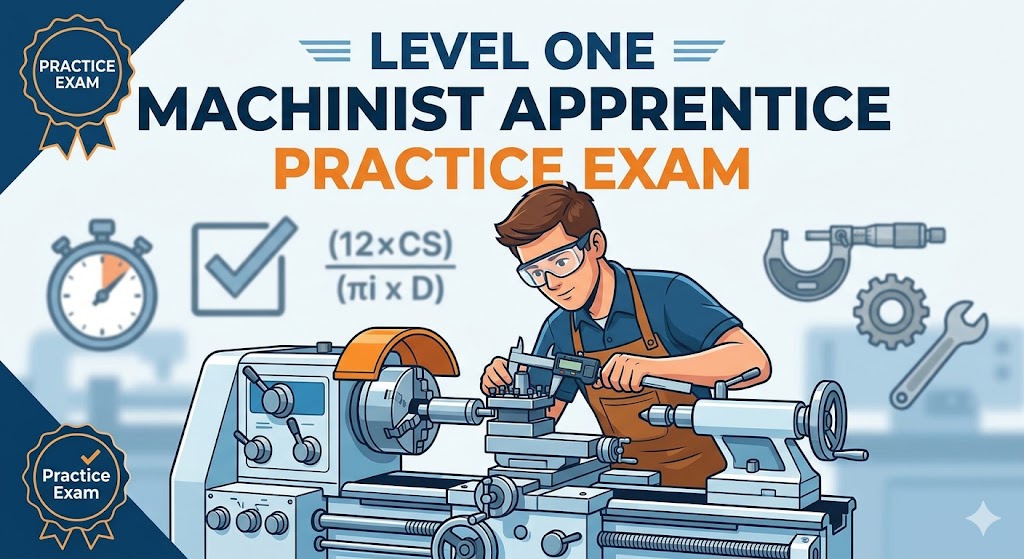
Additional Information
What the Course
Entails and Exam Details
This study guide focuses on the curriculum typical of a
comprehensive Machinist Apprentice Level One program. The training covers the
absolute essentials of machine shop theory and basic application. You are not
expected to be a master yet, but you must prove you know the foundational
rules. The core competencies covered in this course—which this practice exam
will test—include four primary domains:
First, Occupational Health and Safety is paramount.
You will learn safe working practices around industrial machinery, fire
protection, hazardous material handling (WHMIS/OSHA standards), and the proper
use of personal protective equipment (PPE). You must understand your
responsibilities regarding a safe workshop environment.
Second, the curriculum focuses on Trade Mathematics and
Science. This goes beyond basic arithmetic to include the application of
algebra, geometry, and trigonometry to solve shop problems. You will learn to
calculate speeds and feeds, solve for tapers using trigonometry, and manage SI
(metric) and imperial (inch) unit conversions precisely.
Third, you will master Measurement and Interpretation.
This involves two crucial skills: the ability to read and interpret engineering
drawings (blueprints) using standard dimensioning methods, and the absolute
mastery of precision measuring instruments. You must become proficient with
micrometers, calipers, vernier scales, and gauges, knowing exactly when to use
each to ensure tolerance compliance.
Finally, you will be introduced to Basic Machinery and
Tools. This section covers the theory, setup, and operation of basic shop
equipment, including power saws, drilling machines, off-hand grinders, and a
significant focus on manual lathe operations, such as turning, facing, and
basic threading.
What to Expect in the Final Exam
While actual exam specifications can vary slightly by
jurisdiction (e.g., specific Canadian province standards, American
union-specific tests, or company-specific assessments), the structure of the
theory exam generally follows a recognized pattern.
First, The Format. The Level One final exam is
typically a multiple-choice format, often administered digitally but sometimes
offered in paper format. The number of questions usually ranges from 100 to
120. These are not just memory recall questions; they require you to apply
math, interpret blueprints on screen, and solve common machining scenarios.
Second, The Practical Component. Please note: A full
Level One certification usually requires the successful completion of both
a theory exam and a practical (hands-on) competence assessment within the shop
environment. This online study guide focuses strictly on preparing you for the Theory
Exam portion. You should speak with your apprentice coordinator regarding
the specific requirements and scheduling of your practical assessment.
Third, Time Limits and Passing Score. The theory exam
is often timed, usually giving you three to four hours to complete all
questions. You must manage your time carefully. The standard passing grade for
trade exams is frequently 70% or higher. It is essential to achieve a high
score to demonstrate your readiness for advanced Level Two traini
How to Study and
Exam Centers
Effective preparation is the difference between passing and
excelling. To optimize your study time, adopt a structured approach.
Active Study Strategies: Start by reviewing your
textbook and course notes systematically. Rather than just reading, use active
recall: summarize each chapter in your own words, draw out machine setup
diagrams from memory, and memorize your formulas (especially speed/feed
calculations and trigonometry). Your trade math skills must be fast and
accurate on test day.
Utilize Practice Tests: This is the single most
effective way to prepare for a multiple-choice exam. Take the Level One
Machinist Apprentice Practice Test multiple times. Do not just focus on getting
the right answer; focus on why the other answers are wrong. Use the
results to identify your weakest subjects—whether it’s reading a vernier scale
or solving for a taper—and dedicate extra study time to those specific areas.
Exam Center Logistics: Where you take the final exam
depends entirely on your apprenticeship sponsor or jurisdiction.
For many structured programs, the final theory exam is taken
at authorized educational institutions, such as your local technical
college or trade school, upon completion of your required training block.
Alternatively, some certifications utilize standardized
physical testing centers. For example, some companies or unions use authorized
physical testing centers that may use proctored software, while other
jurisdictions utilize standardized centers like Pearson VUE. Some
examinations may be offered via secure online proctoring portals where
you take the exam from home under webcam supervision.
It is absolutely crucial that you confirm the exact testing
method and location with your apprenticeship training officer or instructor
several weeks before you intend to write the exam.
Job Opportunities
from the Course
Successfully completing your Level One technical training
and passing this foundational exam proves to employers that you have committed
to the trade and possess the vital skills needed to contribute in a production
environment.
While you are still an apprentice, achieving this level
unlocks the next stage of your career and allows you to continue working while
learning. The training you receive also makes you employable in several related
capacities in the manufacturing sector. This credential directly leads to or
supports career paths such as:
- Machinist
Apprentice (Continuing to Level Two)
- Manual
Machinist (Entry-Level)
- CNC
Machine Operator
- Maintenance
Machinist (Apprentice)
- Production
Machine Setter
- Machine
Assembler and Fitter
- Production
Technician
- Quality
Control Inspector (Entry-Level)
Frequently Asked Questions
Reviews
5.0
Based on 0 reviews
Leave a Review
No reviews yet. Be the first to review!