
Machinist’s Mate (MM) "A" School Test 3 Practice
$69.00
- Buy to unlock unlimited access to all Quiz questions and Answers in this Quiz.
- After purchase you can print a PDF of the whole quiz at any point. The PDF will contain the questions and the correct answers.
About this Exam
The Machinist’s Mate (MM) "A" School Test 3 is a
vital academic assessment for United States Navy sailors attending initial
technical training. This specific exam is designed to measure a sailor’s
knowledge of complex engineering systems that are critical to the operation of
naval vessels. Sailors preparing for this test have already completed basic
engineering principles and are moving toward specialized knowledge required for
the Machinist’s Mate rating. Successful completion of this test is necessary to
advance in the course and ultimately graduate, earning the MM rating and the
authority to operate and maintain vital shipboard machinery.
Ready to test your knowledge?
Buy Now to Access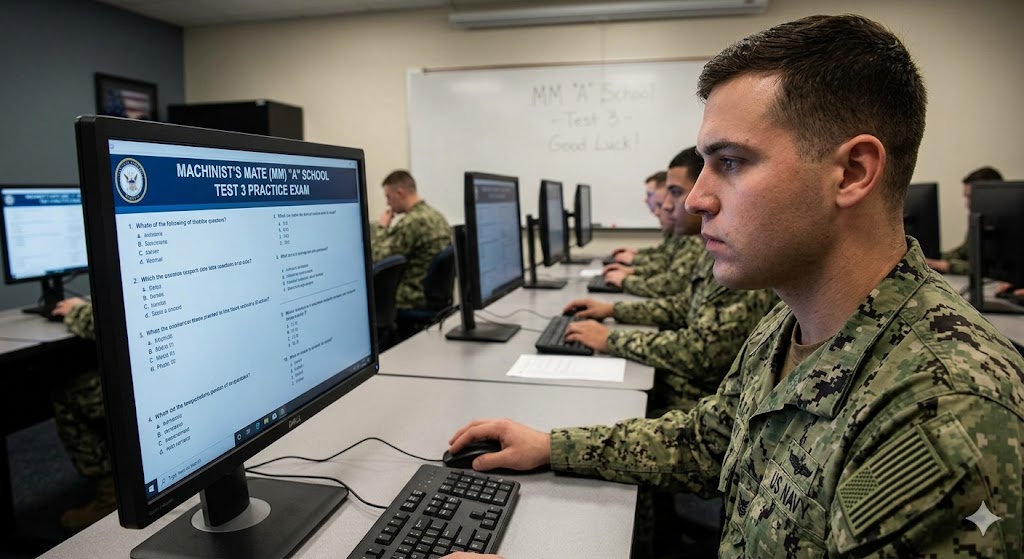
Additional Information
What the Course Entails and Exam Details
This examination focuses on the application of thermodynamic
and mechanical principles. Students are tested on their ability to understand
and diagnose systems crucial for propulsion and auxiliary support. While
earlier tests focus on basic concepts, Test 3 generally moves into more complex
applications.
The exam covers systems related to the steam cycle (for
relevant platforms), including boilers and turbines, as well as core shipboard
utility systems. A major focus is placed on the understanding of various types
of valves, including their construction, function, and correct alignment
procedures for different operations. Sailors must also understand fluid flow,
pressure dynamics, and temperature control within these systems. Pump systems,
including centripetal and positive displacement pumps, and their role in fluid
transfer and cooling are also typically a strong focus, along with basic
refrigeration cycles and auxiliary machinery operations.
What to Expect in the Final Exam
The MM "A" School Test 3 is a challenging,
standard Navy examination that requires a thorough grasp of the material. The
exam is administered in a computer-based format and is primarily
multiple-choice, focusing on fact recall, conceptual understanding, and
practical application.
Sailors are often required to identify components, interpret
system diagrams (schematics), and determine the correct troubleshooting steps
or standard operating procedures. The passing score is rigorous, requiring
sailors to achieve at least a 75% or 80% (this threshold can sometimes vary
based on the specific curriculum version), reflecting the high standards
expected in Navy engineering. A designated time limit (often two to four hours)
is strictly enforced, requiring test-takers to be efficient and decisive in
their responses. All authorized reference materials, if any, are strictly
controlled during the exam session.
How to Study and Exam Centers
Effective preparation for this exam requires a disciplined
and structured study plan. Sailors are strongly encouraged to utilize all
resources provided by the "A" School instructors, especially
"The Guide," which serves as a central study reference. Active review
of training manuals (such as NAVEDTRA series) and all classroom lecture
materials is essential.
Form study groups with classmates, as discussing complex
systems can clarify confusion. Create detailed flashcards for all systems,
components, types of valves, and operational terminology. Reviewing past
practical labs and hands-on exercises is particularly helpful for understanding
system interdependencies. Utilize any provided practice tests or question banks
to simulate the exam experience. This examination is not taken via commercial
centers; it is administered exclusively at the Naval Technical Training Center
(NTTC) at Naval Station Great Lakes as a direct component of the training
curriculum.
Job Opportunities
from the Course
Successfully completing this course and graduating from MM
"A" School opens a clear and rewarding career path within the Navy.
Graduates are assigned as Machinist's Mates (MM) to surface ships or
submarines, depending on their track and ultimate command. Their training
unlocks specific roles and responsibilities in areas critical to naval
engineering.
- Engineering
Plant Operator: Responsible for monitoring and controlling propulsion
and auxiliary systems during watch-standing.
- Propulsion
System Maintainer: Focuses on the preventative and corrective
maintenance of steam turbines, gas turbines, or propulsion machinery.
- Auxiliary
Systems Technician: Manages and repairs crucial ship systems such as
air conditioning, refrigeration, plumbing, and compressed air.
- Nuclear
Field Machinist's Mate: Mates who enter the Nuclear Power program
operate and maintain the complex mechanical systems associated with
nuclear propulsion reactors.
- Maintenance
Supervisor: As sailors advance in rank, they move into senior
supervisory roles, planning and overseeing major maintenance cycles.
- Technical
Instructor: Experienced Mates may be assigned to train new sailors
back at "A" School or at regional training commands.
Frequently Asked Questions
Reviews
5.0
Based on 0 reviews
Leave a Review
No reviews yet. Be the first to review!