
Magnetic Particle Inspection Level 1 Practice Exam
$69.00
- Buy to unlock unlimited access to all Quiz questions and Answers in this Quiz.
- After purchase you can print a PDF of the whole quiz at any point. The PDF will contain the questions and the correct answers.
About this Exam
Magnetic Particle Inspection (MPI) is a crucial Non-Destructive Testing (NDT) method used to detect surface and near-surface flaws in ferromagnetic materials. This certification is essential for quality control in industries like aerospace, automotive, oil and gas, and manufacturing. The Magnetic Particle Inspection Level 1 certification is the foundational stepping stone for NDT technicians. It is designed for entry-level personnel who will perform calibrations and specific inspections under the strict supervision of Level 2 or Level 3 certified individuals. This certification validates your understanding of basic MPI principles and your ability to carry out procedures correctly.
Ready to test your knowledge?
Buy Now to Access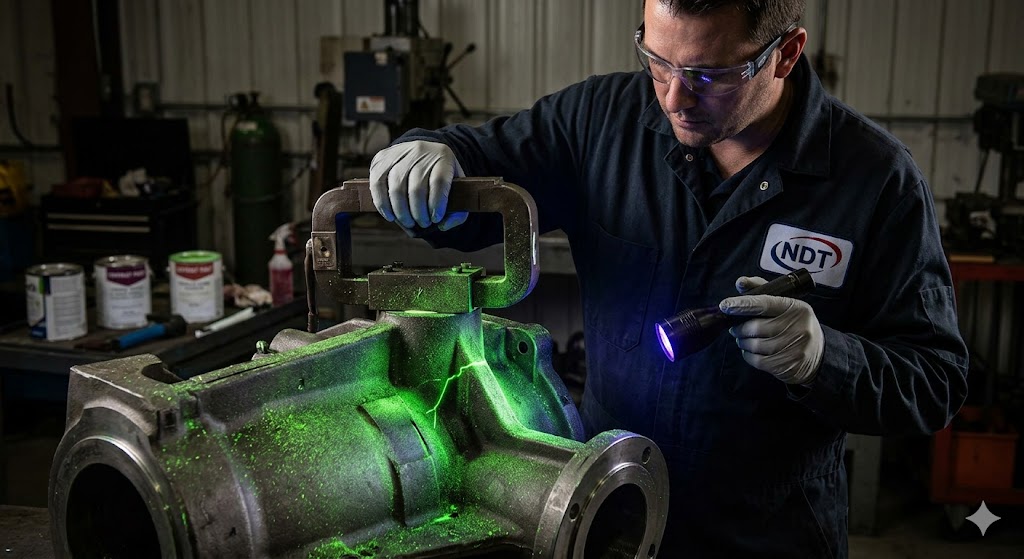
Additional Information
What the Course
Entails and Exam Details
To prepare for this practice exam, it's essential to
understand the core syllabus covered in a Level 1 training program. You can
expect questions focusing on the fundamental concepts of magnetic fields, their
properties, and how they interact with flaws. The course and the practice exam
cover the selection and use of different types of MPI equipment, such as
electromagnetic yokes, prods, coils, and benches. You will be tested on your
knowledge of the various types of magnetic particles (dry, wet, visible, fluorescent)
and their applications, as well as surface preparation requirements.
Furthermore, you must understand the proper magnetization techniques, including
circular and longitudinal magnetization, and the correct sequence of inspection
operations.
What to Expect in
the Final Exam
The actual qualification exam for MPI Level 1
certification typically consists of three parts. First, there is a General
Written Examination, which includes multiple-choice questions covering the
basic theory and principles of the magnetic particle testing method. Second is
the Specific Written Examination, which focuses on the specific codes,
standards, and procedures applicable to the industry or company you will be
working for. Lastly, a Practical Examination is required, where you must
demonstrate your ability to set up equipment, perform an inspection on provided
samples, interpret any indications found, and document the results. You will
typically have a specific time limit for each section, and a passing score of
at least 70% is usually required on each individual part, often with a higher
composite score required across all sections.
How to Study and
Exam Centers
Effective study strategies involve a combination of
theoretical learning and hands-on practice. Thoroughly review your Level 1
training manuals and class notes, paying close attention to definitions,
equipment operating principles, and safety procedures. Utilize practice exams,
like this one, to simulate the actual test environment, identify areas where
you need further study, and get comfortable with the types of multiple-choice
questions asked. If possible, practice setting up and using MPI equipment under
the guidance of a mentor.
The written portions of the MPI Level 1 exam are often
administered at authorized testing centers. These may include specific NDT
training schools, professional society local sections, or dedicated
computer-based testing facilities like Pearson VUE, depending on the certifying
body (e.g., ASNT, AWS). The practical exam is typically conducted in-person at
an authorized facility with the necessary equipment and samples. Contact the
organization handling your certification process to find the specific approved
locations and schedule your exams.
Job Opportunities from the Course
Obtaining your Magnetic Particle Inspection Level 1
certification opens the door to several entry-level career paths within the
expanding field of Non-Destructive Testing. This qualification is highly sought
after by employers across a wide range of industries.
The specific job titles and career paths available
include:
- NDT
Technician Trainee
- Quality
Control Inspector
- Magnetic
Particle Inspector
- Maintenance
Inspector (NDT)
- Manufacturing
Inspector
- Aviation
Maintenance Technician (NDT Specialty)
Frequently Asked Questions
Reviews
5.0
Based on 0 reviews
Leave a Review
No reviews yet. Be the first to review!