
Magnetic Particle Inspection Level 2 Practice Exam
$69.00
- Buy to unlock unlimited access to all Quiz questions and Answers in this Quiz.
- After purchase you can print a PDF of the whole quiz at any point. The PDF will contain the questions and the correct answers.
About this Exam
Magnetic Particle Inspection (MPI) Level 2 is a crucial
certification in the world of Non-Destructive Testing (NDT). It signifies
advanced knowledge and practical skill in using magnetic fields and iron
particles to detect discontinuities on or near the surface of ferromagnetic
materials. This certification is specifically designed for technical
professionals who wish to step beyond initial Level 1 tasks and assume
responsibilities for equipment calibration, procedural writing, interpretation
of indications, and, crucially, the training and supervision of Level 1
personnel. Earning this credential is a key milestone for anyone aiming for a
leadership or QA role in industries that rely on structural integrity, such as
aerospace, automotive, manufacturing, and oil & gas.
Ready to test your knowledge?
Buy Now to Access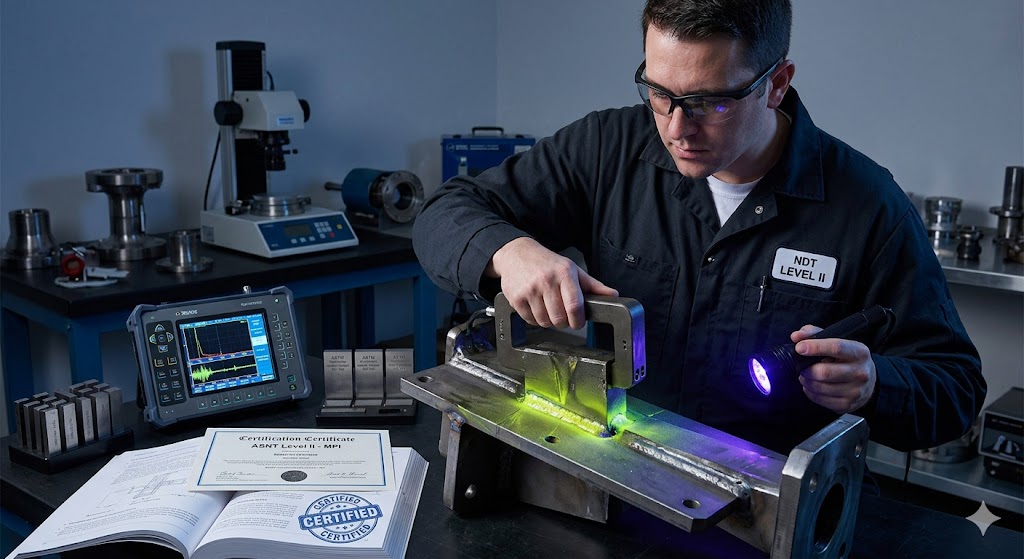
Additional Information
A comprehensive MPI Level 2 preparation course deepens your
foundational knowledge. You will master the underlying principles of magnetism
and magnetic fields, advancing well beyond simple pole identification. The
curriculum covers the precise selection of magnetization techniques (e.g.,
yoke, prods, coils) for various geometries. You will learn to perform advanced
equipment calibration and verification tests. Crucially, Level 2 training
emphasizes the interpretation and evaluation of results against specific
industry codes and standards (like ASNT SNT-TC-1A, ISO 9712, or specific
military specs). Furthermore, the course will prepare you to write, modify, and
validate the MPI procedures that Level 1 operators must follow.
The comprehensive Level 2 examination is a rigorous process,
typical in NDT certification. It consists of multiple parts. You will face
distinct general and specific written exams, typically composed of
multiple-choice questions. The "General" exam assesses your
foundational understanding of MPI theory, safety, and physics, drawing from
Level 1 concepts but at a deeper level. The "Specific" exam focuses
on application: referencing specific procedures, equipment maintenance, and,
most importantly, interpreting results using relevant industry standards and
specifications (such as ASME, ASTM, or AWS). A separate practical examination
is often the most critical component. In this phase, you must demonstrate
proficiency by performing an MPI inspection on real test samples, identifying
and classifying defects correctly, and writing a complete, accurate test
report, all while adhering to a strict procedure. To pass, candidates usually
require a minimum average score of 70% or 80?ross all parts, with no single
component score falling below a defined threshold (e.g., 70%). Time limits will
apply to each section, demanding efficient application of knowledge.
Effective preparation for this exam requires a multi-pronged
approach. Thoroughly review all course materials, relevant industry codes, and
reference standards (such as the ASNT study guides). Create extensive
flashcards for terminology, formulas, and equipment details. Actively seeking
hands-on practice is non-negotiable for the practical component. Rehearse the
entire inspection process, focusing on equipment setup, magnetization
techniques, particle application, and, critically, practice interpreting and
documenting defects under supervision. Prioritize taking high-quality MPI Level
2 practice exams, as these will simulate the exam environment and highlight
areas needing improvement. The real value of a practice exam is not just the
score but the review of incorrect answers.
Regarding exam centers, theoretical components
(multiple-choice) may be administered via specialized online testing portals or
at computerized testing centers, including widely available networks like
Pearson VUE, depending on the certifying body (e.g., ASNT Central Certification
Program). The practical examination, however, almost always requires attendance
at a specific, authorized physical testing center, such as an NDT school,
training institute, or ASNT headquarters/regional location, which is equipped
with the necessary standardized MPI equipment and test samples.
Earning your Magnetic Particle Inspection Level 2
certification unlocks significant career opportunities across diverse
industrial sectors. Specific job titles and roles made accessible by this
credential include:
- NDT
(Non-Destructive Testing) Level II Technician
- Magnetic
Particle Testing (MT) Inspector
- Quality
Control (QC) Inspector
- Quality
Assurance (QA) Analyst
- NDE
(Non-Destructive Examination) Coordinator
- NDT
Level II Supervisor (of Level I personnel)
- Maintenance
Technician (with MT specialization)
- NDT
Field Service Technician
- Aerospace
NDT Technician (specializing in MPI for engine parts or airframes)
- API
(American Petroleum Institute) Authorized Inspector (where MT is a
required method for pressure vessels/piping)
- NACE-Certified
Coating Inspector (MT often pre-requisite knowledge)
Frequently Asked Questions
Reviews
5.0
Based on 0 reviews
Leave a Review
No reviews yet. Be the first to review!