
Magnetic Resonance Imaging (MRI) Practice Test
$69.00
- Buy to unlock unlimited access to all Quiz questions and Answers in this Quiz.
- After purchase you can print a PDF of the whole quiz at any point. The PDF will contain the questions and the correct answers.
About this Exam
Magnetic Resonance Imaging (MRI) is a revolutionary medical
imaging technique. It uses powerful magnetic fields and radio waves to create
detailed pictures of the body's organs and tissues. Aspiring healthcare
professionals who wish to become certified MRI technologists must demonstrate
their proficiency through rigorous examination. This practice test is designed
as a crucial tool for those students, offering a realistic preview of the
actual certification exams. It allows candidates to assess their knowledge gaps
and build confidence before the big day. Achieving certification signifies
readiness to operate complex MRI equipment safely and effectively.
Ready to test your knowledge?
Buy Now to Access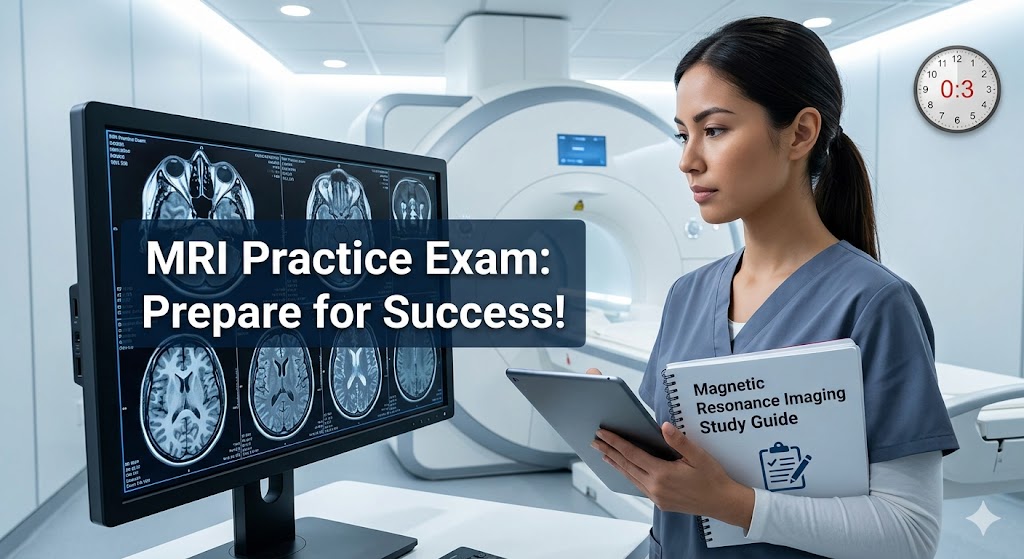
Additional Information
What the Course Entails and Exam Details
The journey to becoming an MRI technologist involves
comprehensive education covering several key domains. This study guide and the
associated practice test focus on these core areas. Students will delve into
patient care and safety, ensuring proper screening for metallic implants and
managing patient comfort. MR physics and instrumentation are central topics,
exploring magnet types, coils, radiofrequency pulses, and spatial encoding. A
deep understanding of pulse sequences, image contrast, and artifacts is
essential for diagnostic imaging. Beyond physics, candidates must master
imaging procedures for various body regions. Data acquisition and processing,
as well as image quality control, are also vital components. This thorough
curriculum prepares individuals for the multi-faceted challenges of real-world
practice.
What to Expect in the Final Exam
The actual MRI certification exam is typically a challenging
assessment. It primarily consists of multiple-choice questions designed to
evaluate both theoretical knowledge and practical application. Candidates can
expect between 150 and 200 questions within a set time limit, often around
three to four hours. The exact number of questions and time allocation may vary
depending on the specific certifying organization. Passing scores are usually
numerically based, often as scaled scores, with specific thresholds set by each
body. Understanding these parameters is crucial for managing your time
effectively during the test. Specific rules regarding identification,
prohibited items, and testing environment will be strictly enforced by the
testing center. Diligent preparation using this practice test will help you
navigate these elements smoothly.
How to Study and
Exam Centers
Effective study requires a strategic approach. Begin by
comprehensively reviewing textbooks, online resources, and lecture materials
across all core topics. Utilize this practice test to simulate actual exam
conditions and identify areas where you need more focus. Create detailed study
schedules and stick to them consistently. Consider forming study groups to
discuss complex concepts and share insights. Active learning, such as teaching
concepts to others or using flashcards, can significantly enhance retention.
For the final certification exam, most candidates will need to schedule an
appointment at an authorized testing center. Pearson VUE is a common provider
for these high-stakes medical examinations, with numerous locations globally.
Some specialized exams or preparatory tests might offer online options, but
clinical certifications typically require in-person attendance at secure
centers. Always check with your specific certification body for detailed
instructions on scheduling and location availability.
Job Opportunities
from the Course
Obtaining MRI certification opens doors to exciting and
rewarding career paths. Successfully navigating this practice test is a
significant step toward unlocking these opportunities. Certified individuals
are well-positioned for the following roles:
- Magnetic
Resonance Imaging (MRI) Technologist: The primary role, operating scanners
and caring for patients.
- Lead
MRI Technologist: A supervisory position overseeing other techs and
ensuring department efficiency.
- Clinical
Applications Specialist: Working for equipment manufacturers to train
others on MRI systems.
- MRI
Educator or Instructor: Teaching aspiring students in academic settings.
- Travel
MRI Technologist: Enjoying flexibility and exploring different healthcare
facilities.
- MRI
Research Coordinator/Technologist: Contributing to advancements in medical
imaging through research studies.
Frequently Asked Questions
Reviews
5.0
Based on 0 reviews
Leave a Review
No reviews yet. Be the first to review!