
Magnetic Variation and Aviation Navigation Systems Practice Test
$69.00
- Buy to unlock unlimited access to all Quiz questions and Answers in this Quiz.
- After purchase you can print a PDF of the whole quiz at any point. The PDF will contain the questions and the correct answers.
About this Exam
This comprehensive [Magnetic Variation and Aviation
Navigation Systems Practice Test] study guide article is designed for aspiring
pilots, navigators, air traffic controllers, and aviation technology
enthusiasts who are preparing for exams covering the critical principles of
celestial and electronic aircraft navigation. Whether you are aiming for a
pilot's license, an avionics certification, or a career in flight planning, a
deep understanding of magnetic variation and modern navigation systems is essential
for safe and efficient flight operations. This resource provides a targeted
overview and essential preparation strategies for successfully navigating your
relevant certification tests. Proper spacing is applied throughout this article
for easy reading and transfer.
Ready to test your knowledge?
Buy Now to Access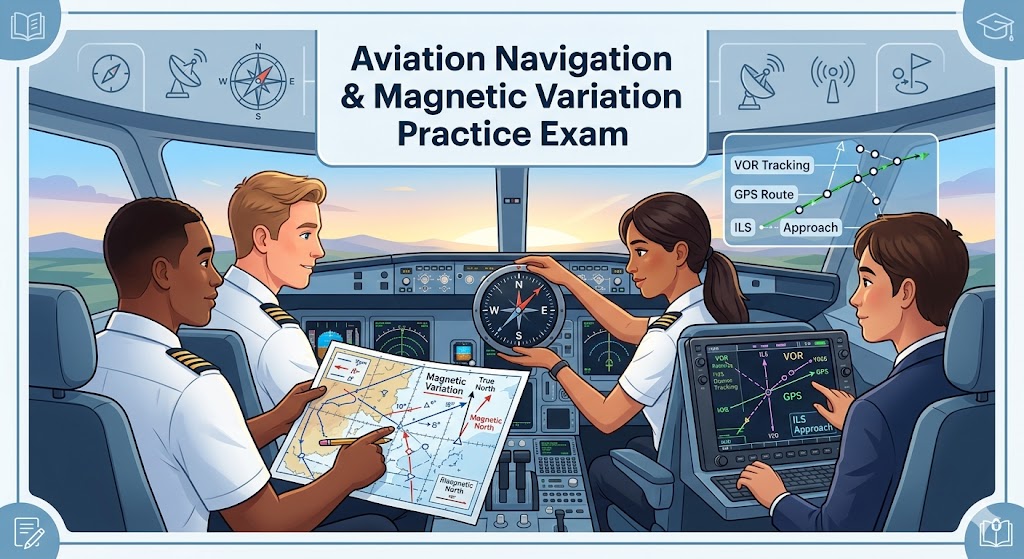
Additional Information
What the Course
Entails and Exam Details
A robust aviation navigation course, and any
corresponding practice test, comprehensively covers both fundamental physical
principles and advanced electronic systems. Students should expect in-depth
study in the following areas:
- Magnetic
Principles: Understanding the differences between true north (geographic
north), magnetic north, and compass north is crucial. Students will learn
to calculate and apply magnetic variation (or declination) – the angle
between true and magnetic north at any given location. Topics include
using variations and deviations from compass errors to accurately
determine a course. Calculation methods, including the pneumonic
"variation east, magnetic least; variation west, magnetic best"
(adjusting from magnetic to true or vice versa), will be practiced. Dip
errors, acceleration errors, and turning errors specific to magnetic
compasses are also included.
- Electronic
Navigation Systems: The bulk of modern navigation relies on electronic
systems. Your preparation should cover:
- VOR
(VHF Omnidirectional Range): Ground-based radio beacons transmitting
omnidirectional signals. Topics include radial interception, VOR
tracking, equipment operation, and understanding indications on VOR
receivers.
- NDB
(Non-Directional Beacon): Older but still relevant ground-based
transmitters. Students learn about homing, tracking with an ADF
(Automatic Direction Finder), and inherent NDB errors.
- DME
(Distance Measuring Equipment): Understanding slant-range distance
calculations in conjunction with VORs or as standalone systems.
- ILS
(Instrument Landing System): Detailed study of localizer (horizontal
guidance), glideslope (vertical guidance), marker beacons, and approach
procedures using ILS indications.
- GPS/GNSS
(Global Positioning/Navigation Satellite System): Comprehensive
understanding of satellite navigation principles, receiver operation,
integrity monitoring (like RAIM), waypoints, and operational
considerations. Both domestic and global systems (like GPS, Galileo,
GLONASS) and relevant regulations are typically covered.
- Map
Reading & Charts: Interpretation of aeronautical charts (Sectional,
VFR Terminal, IFR Enroute), understanding symbols, reading terrain
features, calculating distances, headings, and ground speeds. The use of
traditional tools like the E6B flight computer for dead reckoning
calculations often accompanies this section.
What to Expect in the Final Exam
While the exact format can vary slightly depending on the
specific certification authority (e.g., FAA in the US, EASA in Europe, CAAC in
China), the [Magnetic Variation and Aviation Navigation Systems Practice Test]
and general aviation knowledge exams typically follow a standard proctored
format:
- Multiple
Choice Questions: The overwhelming majority of knowledge-based questions
will be in a multiple-choice format, presenting a question or scenario
with several potential answers, only one of which is correct. These test
both factual recall and the application of principles to practical
navigation scenarios.
- Timed
Examination: You will be given a specific time limit to complete the
entire exam. Time management is crucial, as you must allocate sufficient
time for understanding questions and calculations. Example durations could
be 60-90 minutes for smaller modules or several hours for comprehensive
pilot written tests, containing 60-100 or more questions in total,
spanning multiple subjects. A separate, dedicated navigation module might
be around 1-2 hours for 30-50 questions.
- Passing
Score: The required passing score is generally set around 70-80% correct
answers. It is imperative to aim higher during your practice to account
for exam pressure and ensure solid understanding.
- Practical
& Applied Scenarios: Be prepared for questions that involve
calculations using magnetic variation and deviation, plotting points on a
provided map or chart extract, interpreting VOR or GPS display readouts,
and solving navigation problems using basic dead reckoning.
- Proctored
Environment: Final exams are taken in controlled environments. This
includes certified computer-based testing centers within general airport
facilities or through authorized testing networks (for example, locations
similar to standard computerized testing centers found globally, including
those like Pearson VUE or other large network providers), or proctored
online setups, where you will be monitored to prevent academic dishonesty.
Electronic devices and unauthorized aids are strictly prohibited. You will
likely be provided with official chart extracts, calculation sheets, and
potentially a basic calculator for specific questions. You must check with
your specific authority for their approved centers and procedures.
How to Study and
Exam Centers
Effective preparation for the [Magnetic Variation and
Aviation Navigation Systems Practice Test] requires structured study and
consistent practice. Follow these strategies:
- Utilize
Comprehensive Study Materials: Invest in high-quality textbooks
specifically tailored to aviation navigation, general pilot knowledge
handbooks, and approved study guides. Seek out current editions as
regulations and electronic systems evolve.
- Interactive
Online Courses: Many authorized flight schools and private educational
companies offer structured online courses that cover all navigation topics
visually and with interactive elements. These can be particularly helpful
for understanding electronic systems and plotting procedures.
- Dedicatted
Practice Tests: This is crucial. Actively seek out and regularly take
comprehensive [Magnetic Variation and Aviation Navigation Systems Practice
Test] simulations. Analyze every incorrect answer to understand the
reasoning behind the correct response and pinpoint your weak areas. Many
reputable providers offer online question banks specifically curated for
various aviation certifications. These tools often simulate the actual
exam interface and timing, providing invaluable test-taking experience.
- Practice
Calculations & Plotting: Spend significant time performing magnetic
variation calculations (converting between true, magnetic, and compass
headings) and plotting courses/distances on actual or practice charts.
Learn to efficiently use traditional navigation tools like a protractor,
ruler, and an E6B flight computer (both mechanical and potentially digital
versions if allowed).
- Visualize
the Concepts: Use diagrams, simulators, and visual aids to help you truly
grasp how VOR radials emanate, how ILS signals are intercepted, and how
GPS waypoints function. Desktop flight simulators can be excellent for
reinforcing electronic navigation skills in a practical context.
- Seek
Instructon: If you encounter challenging concepts, don't hesitate to
consult with an experienced flight instructor or knowledge instructor.
Personal guidance can clarify complex topics efficiently.
Where to Take the Exam: The [Magnetic Variation and
Aviation Navigation Systems Practice Test] itself is often a component or
precursor to official knowledge exams required by aviation authorities or
specific institutions. For final official exams, you can typically take them at
the following types of locations:
- Physical
Testing Centers: Certified testing locations, such as those within general
airport facilities or through authorized testing networks (for example,
locations similar to standard computerized testing centers found globally,
including those like Pearson VUE or other large network providers),
administer computer-based exams.
- Authorized
Flight Schools: Many certified flight schools are also approved testing
centers for knowledge exams. They can guide you through the registration
and testing process.
- Instituion-Specific
Centers: Certain organizations or educational institutions may have their
own authorized centers for specific internal or industry-recognized
certifications. Ensure you verify with your specific authority which
centers are approved.
Job Opportunities
from the Course
Successfully mastering the concepts in a [Magnetic
Variation and Aviation Navigation Systems Practice Test] and achieving the
corresponding certifications opens doors to a diverse range of exciting careers
in the aviation industry. Here is a clear list of specific job titles and
career paths unlocked by this knowledge:
- Pilot
(at all levels): From Private Pilot (PPL) to Commercial Pilot (CPL) and
Airline Transport Pilot (ATP), a comprehensive grasp of navigation is
foundational. You will navigate small aircraft visually or large
commercial airliners across continents and oceans.
- Flight
Instructor (CFI/CFII): Shape the next generation of aviators by teaching
fundamental and advanced navigation techniques, both ground-based and in
the aircraft.
- Air
Traffic Controller (ATC): Though not pilots, controllers must intricately
understand navigation procedures, VOR/GPS routing, and approach procedures
to safely guide and separate aircraft in complex airspace.
- Aircraft
Dispatcher: Responsible for planning flight paths, calculating fuel, and
ensuring safe operations, dispatchers require expert-level understanding
of routes, charts, and relevant navigation systems.
- Avionics
Technician: Install, maintain, and troubleshoot the intricate electronic
navigation systems (GPS, VOR, ILS) critical to modern aircraft, requiring
both physical skill and theoretical knowledge of how they operate.
- Aerial
Surveyor/Photographer: Navigate precise flight lines using advanced
systems to capture data or imagery.
- Aviation
Operations Specialist: Various ground-based roles in flight planning,
ground support, and airspace management rely heavily on navigational data
and understanding.
- Unmanned
Aircraft Systems (UAS) Operator / Drone Pilot (Commercial): While not
traditional cockpits, commercial drone pilots must adhere to airspace
regulations and frequently utilize advanced navigation systems for
specific missions, making navigation principles increasingly relevant.
Frequently Asked Questions
Reviews
5.0
Based on 0 reviews
Leave a Review
No reviews yet. Be the first to review!