
Maine Fuel Code Journeyman Practice Exam
$69.00
- Buy to unlock unlimited access to all Quiz questions and Answers in this Quiz.
- After purchase you can print a PDF of the whole quiz at any point. The PDF will contain the questions and the correct answers.
About this Exam
The Maine Fuel Code Journeyman exam is a crucial step for individuals aiming to become licensed to install, service, and repair natural gas and propane systems within the state. This certification signifies that you possess the necessary technical knowledge and understanding of safety codes to work independently and supervise apprentices. It is designed for tradespeople who have completed the required hours of documented practical experience and classroom instruction, verifying their readiness to uphold the rigorous standards set by the Maine Fuel Board and the Department of Professional and Financial Regulation
Ready to test your knowledge?
Buy Now to Access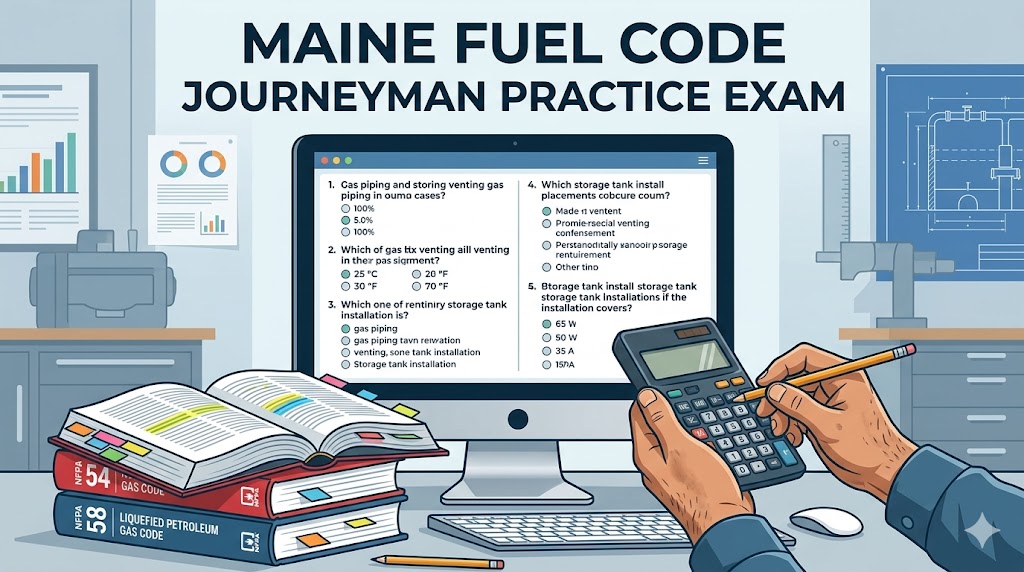
Additional Information
What the Course
Entails and Exam Details
Preparation for this exam demands a thorough understanding
of standard national codes and Maine’s specific modifications. The core
syllabus includes, but is not limited to: comprehensive knowledge of NFPA 54
(National Fuel Gas Code), encompassing gas piping system design, materials, and
installation; proper appliance installation and venting procedures; combustion
air requirements; and pressure testing protocols. It also heavily covers NFPA
58 (Liquefied Petroleum Gas Code), detailing storage, handling, and
transportation of LP-gas, as well as the design and installation of LP-gas
systems and equipment. Candidates must also be familiar with the relevant
sections of the Maine Revised Statutes and the specific rules and amendments
promulgated by the Maine Fuel Board, which govern licensing, permits,
inspections, and enforcement.
What to Expect in the Final Exam
The actual Maine Fuel Code Journeyman examination is
typically a computer-based, multiple-choice assessment. While the specific
number of questions and time limit can vary slightly, candidates should prepare
for a comprehensive test, often lasting between two and three hours. The
passing score is generally set at 70% or higher. The questions are designed to
evaluate not just rote memorization but also the practical application of code
requirements to real-world scenarios. This is often an "open book"
exam, but candidates are typically only permitted to use specific, approved
editions of the NFPA 54 and NFPA 58 code books, which must be free of personal
notes or loose papers.
How to Study and
Exam Centers
Effective study begins with obtaining the correct, current
editions of NFPA 54 and NFPA 58 as adopted by the State of Maine. Do not rely
on outdated versions. Actively use these codes, tabbing key sections and
practicing locating information quickly, as speed is crucial during the exam.
Investing in a dedicated practice exam, like this one, allows you to simulate
the testing environment, identify knowledge gaps, and understand the phrasing
of code-based questions. Additionally, consider enrolling in code-specific
review courses offered by authorized Maine trade schools or industry
associations. The exam itself is administered at specific testing centers,
often facilitated through a third-party vendor like Pearson VUE, or at
designated State of Maine locations. Candidates must register and schedule
their exam in advance, typically after their license application and experience
documentation have been approved by the Maine Fuel Board.
Job Opportunities from the Course
Obtaining your Journeyman license in Maine opens numerous
stable and rewarding career paths in the skilled trades. This certification
signifies compliance and expertise, unlocking positions with competitive
salaries and opportunities for advancement. Some of the primary job titles and
roles available include: Licensed Journeyman Gas Technician; Propane and
Natural Gas Appliance Installer; HVAC (Heating, Ventilation, and Air
Conditioning) Service Technician with a Fuel Gas Endorsement; Industrial Gas
Piping Specialist; and Fuel System Inspector. For those with entrepreneurial
ambition, a Journeyman license is also a necessary stepping stone towards
becoming a licensed Master, which allows for operating your own independent
fuel gas contracting business in the State of Maine.
Frequently Asked Questions
Reviews
5.0
Based on 0 reviews
Leave a Review
No reviews yet. Be the first to review!