
Maine Maritime USCG Firefighting Practice Test
$69.00
- Buy to unlock unlimited access to all Quiz questions and Answers in this Quiz.
- After purchase you can print a PDF of the whole quiz at any point. The PDF will contain the questions and the correct answers.
About this Exam
The Maine Maritime USCG Firefighting certification is a
critical credential for anyone aspiring to a career on the water. This
comprehensive training program is designed specifically for merchant mariners,
cadets, and officers who must be prepared to respond effectively to fire
emergencies at sea.
Safety is the paramount concern in the maritime industry, and fire is one of the greatest threats to a vessel and its crew. This course ensures that mariners possess the knowledge, skills, and confidence to utilize firefighting equipment and execute emergency procedures. Passing the USCG firefighting exam is often a mandatory requirement for obtaining various merchant mariner credentials and STCW endorsements, marking it as a foundational step in professional maritime development
Ready to test your knowledge?
Buy Now to Access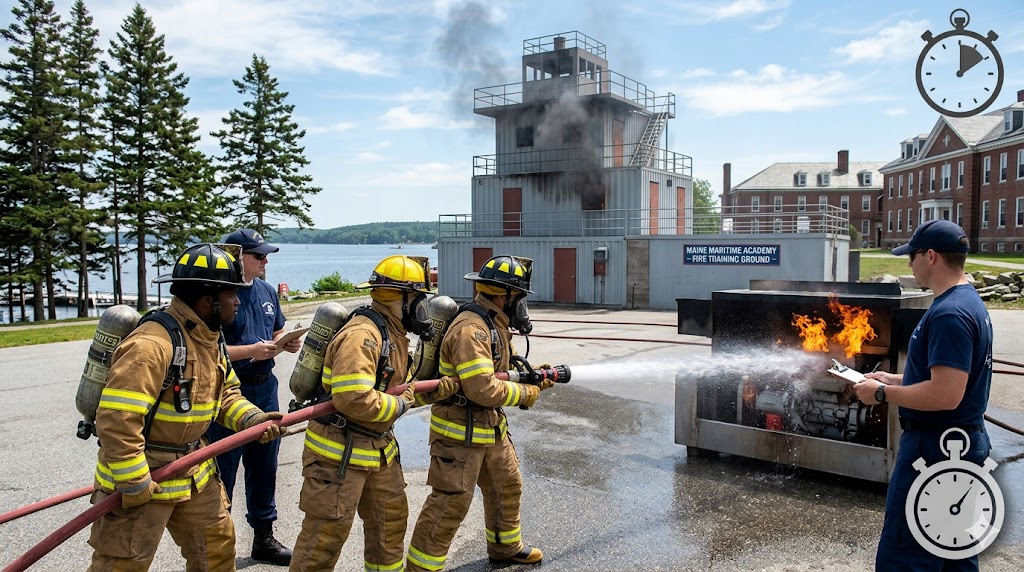
Additional Information
What the Course Entails and Exam Details
This rigorous course blends theoretical classroom
instruction with intensive practical hands-on training. The syllabus is
meticulously structured to meet United States Coast Guard (USCG) and
International Maritime Organization (IMO) standards for safety at sea.
Key topics covered during the training include the chemistry
of fire (the fire triangle and tetrahedron), classes of fire (A, B, C, D, and
K), and proper extinguishing agents for each type. Students gain critical
knowledge regarding the construction and organization of fire teams on board
ships, emergency procedures, and fire prevention strategies. The practical
components involve the correct inspection, maintenance, and use of portable
fire extinguishers, wearing and operating Self-Contained Breathing Apparatus
(SCBA), and working with fire hoses, nozzles, and various fixed fire
suppression systems.
What to Expect in
the Final Exam
To secure certification, candidates must successfully
complete two distinct components of the final examination: a written assessment
and a physical practical evaluation.
The written exam consists of multiple-choice questions
curated directly from the USCG question bank, focusing on fire theory,
equipment management, and safety protocols. Candidates generally need to
achieve a score of at least 70% to pass the theoretical portion.
The practical evaluation is equally critical. Students are
required to demonstrate proficiency in core physical skills, including properly
donning an SCBA under timed conditions, navigating through smoke-filled
environments, and actively deploying fire hoses and extinguishing agents during
controlled live-fire drills. This portion is strictly a Pass/Fail assessment
based on the safe and correct execution of procedures. Strict safety gear (Full
Bunker Gear) and adherence to commands are required throughout the entire
examination.
How to Study and Exam Centers
Effective preparation requires a balance between reviewing
course material and familiarizing yourself with the USCG question formats.
We highly recommend utilizing a dedicated Maine Maritime
USCG Firefighting Practice Test as your primary study tool. These practice
exams simulate the real testing environment, helping you build stamina, improve
time management, and identify specific knowledge gaps. Focus on understanding why
a particular answer is correct, rather than just memorizing responses. Pay
close attention to classifications of fires and the specific agents used to
combat them, as these are frequent testing points.
The Maine Maritime USCG Firefighting course and the
associated examinations are typically administered on-site at Maine Maritime
Academy in Castine, Maine. The facility provides specialized maritime
simulation environments and fire training grounds necessary for the practical
component. Candidates must register for the course through the Maine Maritime
Center for Professional Mariner Development. While the written portion uses
USCG approved materials, this specific certification requires the in-person practical
component at an authorized training facility and cannot be taken solely online
or at a Pearson VUE center.
Job Opportunities from the Course
Obtaining this certification is crucial for unlocking
employment in the maritime sector, as most employers require basic safety
training, including firefighting, before employment. Here are some of the
specific job titles and career paths this qualification supports:
- Able
Seaman (AB)
- Ordinary
Seaman (OS)
- Deck
Officer (Third Mate, Second Mate)
- Marine
Engineering Officer
- QMED
(Qualified Member of the Engine Department)
- Tugboat
Deckhand and Captain
- Cruise
Ship Crew Member (Safety personnel)
- Commercial
Fisherman
- Supply
Vessel Crew member
- Port
Operations Specialist
- Offshore
Wind Industry Technician
Frequently Asked Questions
Reviews
5.0
Based on 0 reviews
Leave a Review
No reviews yet. Be the first to review!