
Maine Pesticide Practice Test
$69.00
- Buy to unlock unlimited access to all Quiz questions and Answers in this Quiz.
- After purchase you can print a PDF of the whole quiz at any point. The PDF will contain the questions and the correct answers.
About this Exam
The Maine Pesticide Applicator certification is a mandatory
qualification for individuals who safely and legally apply pesticides within
the state of Maine. This includes commercial applicators who work for pest
control companies, private applicators such as farmers and greenhouse
operators, and government employees engaged in vector control or land
management. This program is designed to protect public health and the state's
natural resources by ensuring that everyone handling these products has a comprehensive
understanding of their safe and effective use. By achieving certification, you
demonstrate to the Maine Board of Pesticides Control (BPC) that you possess the
necessary knowledge and skills to minimize risks and perform your duties
responsibly.
Ready to test your knowledge?
Buy Now to Access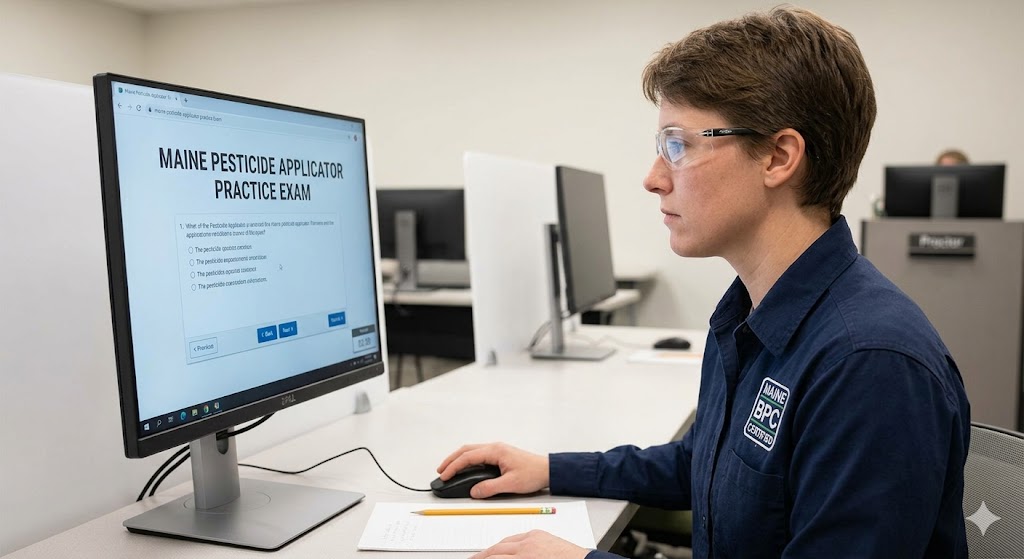
Additional Information
What the Course Entails and Exam Details
This course, or more accurately, the curriculum required for licensing, covers a foundational and an applicable component. All potential applicators must master the core curriculum, which is tested in the Core Exam. This critical first test includes topics such as pesticide laws and regulations, detailed label interpretation, personal protective equipment (PPE), routes of exposure and first aid, environmental impacts including water contamination, application techniques and equipment, pesticide formulations, and the principles of Integrated Pest Management (IPM).
Furthermore, individuals seeking a Commercial or Private license must also study for a specific Category Exam or Commodity Exam, which delves deeper into the pest management practices, equipment calibration, and safety procedures particular to their chosen industry, whether that's structural pest control, turf management, forestry, or the production of specific agricultural commodities. The course of study is largely self-guided using official study manuals.
What to Expect in the Final Exam
The path to licensure requires passing a series of closed-book, written examinations. You should expect the main Core Exam to be a multiple-choice test consisting of questions designed to evaluate your comprehensive knowledge of safe pesticide handling.
A passing score of 80% is required to pass the Core Exam. For Commercial and Private licensure, candidates must pass both the Core Exam and their respective Category or Commodity Exam within one year of their first attempt. If this is not achieved, they must retake all required exams. Examinations for commercial applicators are generally held weekly at the Maine Board of Pesticides Control offices in Augusta or on a monthly basis in Presque Isle, while private and basic exams may also be administered through various University of Maine Cooperative Extension (UMCE) county offices by appointment. The test assesses practical understanding, including label interpretation and equipment selection.
How to Study and Exam Centers
Effective preparation is key to success on the Maine pesticide applicator exams. The official self-study manuals are the primary resource and can be purchased through the University of Maine Cooperative Extension's Pest Management Office. To ensure a passing score, you should not only read the manuals thoroughly but also utilize online resources, including official practice questions and explanatory rationales. Practice reading and interpreting actual pesticide labels, as this is a heavily weighted section. Create flashcards for critical definitions, laws, and PPE guidelines.
To schedule your exam, you must contact the Maine Board of Pesticides Control (BPC) or, for private/basic exams, a county Cooperative Extension office. These are the authorized testing centers in Maine. Scheduling must be done in advance. Remember to allow adequate time for processing your exam application and for the study manuals to arrive, especially during peak seasons in early spring.
Job Opportunities from the Course
Earning a Maine Pesticide Applicator license unlocks a significant range of career opportunities across various sectors in the state. Possessing this certification is often a key differentiator for employers looking to hire responsible and skilled professionals.
Potential job titles and career paths this certification can lead to include:
• Pest Control Technician (Structural or Residential)
• Commercial Lawn Care Applicator
• Landscape Maintenance Technician
• Golf Course Turf Manager
• Agricultural Crop Applicator (Private or Commercial)
• Greenhouse and Nursery Manager
• Orchardist
• Forestry Pest Manager
• Government Vector Control/Mosquito Abatement Officer
• Public Health Pesticide Applicator
• Vegetation Management Specialist (for right-of-ways)
Frequently Asked Questions
Reviews
5.0
Based on 0 reviews
Leave a Review
No reviews yet. Be the first to review!