
Maine Phase 2 Policing Guide Practice Test
$69.00
- Buy to unlock unlimited access to all Quiz questions and Answers in this Quiz.
- After purchase you can print a PDF of the whole quiz at any point. The PDF will contain the questions and the correct answers.
About this Exam
The Maine Phase 2 Policing assessment represents a
critical milestone for aspiring law enforcement officers in the state.
This phase typically follows successful completion of the
Phase 1 (pre-service) training and focuses on the practical application of
legal knowledge and tactical skills required by the Maine Criminal Justice
Academy (MCJA).
This study guide and practice test are specifically
designed for candidates who are preparing to transition into probationary
officer roles or full-time academy training, ensuring they have mastered the
core competencies necessary to safely and effectively serve the communities of
Maine.
Ready to test your knowledge?
Buy Now to Access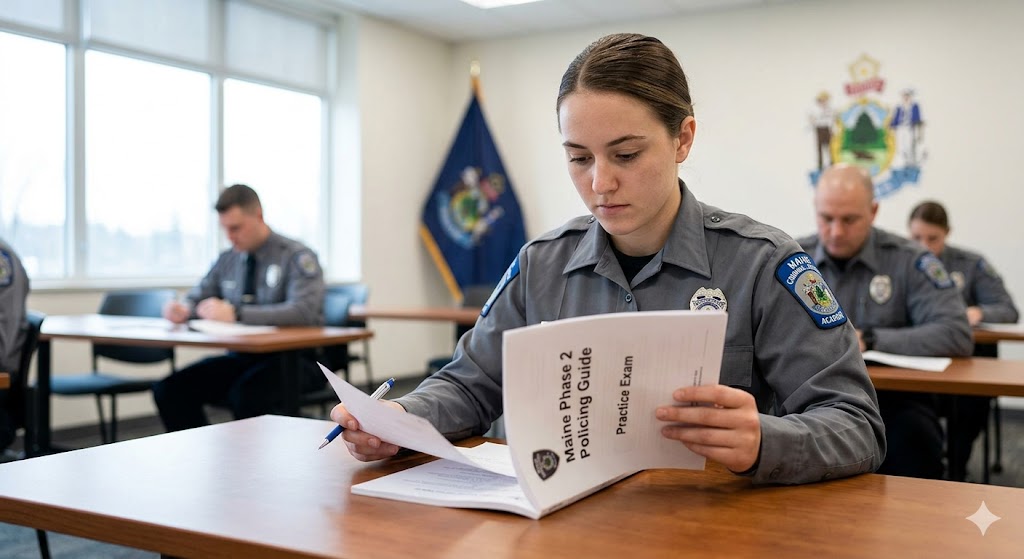
Additional Information
What the Course
Entails and Exam Details
The Phase 2 curriculum builds significantly on the
foundational legal concepts introduced in Phase 1, shifting focus from theory
to applied practice.
Candidates must master a diverse and rigorous syllabus
prescribed by the MCJA.
Key focus areas typically include advanced concepts in
Maine Criminal Law, including specific state statutes, and extensive training
on Civil Liability for officers.
Furthermore, significant emphasis is placed on applied
Police Procedures, specifically in critical and high-risk scenarios.
Participants receive specialized training in Emergency
Vehicle Operations, Mechanics of Arrest, and Defensive Tactics.
Communication skills, including detailed report writing
and effective public interaction, are also critical components that are heavily
emphasized and evaluated during this phase.
What to Expect in the Final Exam
The Maine Phase 2 final assessment is comprehensive and
demanding, serving as the gateway to certification and full duty.
It usually consists of a combination of evaluation
methods designed to test both mental acuity and physical proficiency.
Candidates should expect a rigorous written examination,
typically featuring complex, scenario-based multiple-choice questions that test
legal knowledge and decision-making under simulated pressure.
Additionally, a comprehensive practical skills assessment
is required, where candidates must demonstrate proficiency in arrest
techniques, defensive tactics, and potentially vehicle operations.
While specific requirements can vary slightly by
graduating class and updated academy protocols, a high passing standard (often
a minimum of 75% or 80%) is strictly required for both the written and
practical components.
Strict time limits apply to both sections, demanding
quick, accurate legal and tactical reasoning.
How to Study and
Exam Centers
Preparation for Phase 2 demands a dedicated combination
of legal study and physical skill repetition.
First, fully master the official source material provided
by the Maine Criminal Justice Academy or your sponsoring law enforcement
agency.
Utilize flashcards for complex legal terminology and
definitions of key Maine criminal statutes.
Scenario-based training with experienced officers or
instructors is essential for the practical components.
Actively engaging in mock arrests, practicing defensive
tactics, and reviewing high-stress decision-making trees is crucial for
success.
Utilizing a dedicated "Maine Phase 2 Policing Guide
Practice Exam" is highly recommended to simulate the intense written
testing environment and identify specific weak points in your legal or
procedural understanding.
The final examinations are typically administered
directly at the Maine Criminal Justice Academy facility in Vassalboro or
through authorized regional training centers located throughout Maine.
Frequently Asked Questions
Reviews
5.0
Based on 0 reviews
Leave a Review
No reviews yet. Be the first to review!