
Maintenance and Material Management (3-M) 304 Practice Exam
$69.00
- Buy to unlock unlimited access to all Quiz questions and Answers in this Quiz.
- After purchase you can print a PDF of the whole quiz at any point. The PDF will contain the questions and the correct answers.
About this Exam
The Maintenance and Material Management (3-M) 304
qualification is a pivotal certification within the United States Navy's
standard maintenance system. It is designed for personnel moving into
supervisory and management roles, such as Work Center Supervisors and Division
Officers, who are responsible for the effective implementation and oversight of
shipboard maintenance programs. The primary purpose of the 3-M system is to
ensure maximum equipment and system operational readiness. Achieving the 304
qualification demonstrates a Sailor's proficiency in managing the tools,
documentation, and personnel required to keep a vessel mission-ready.
Ready to test your knowledge?
Buy Now to Access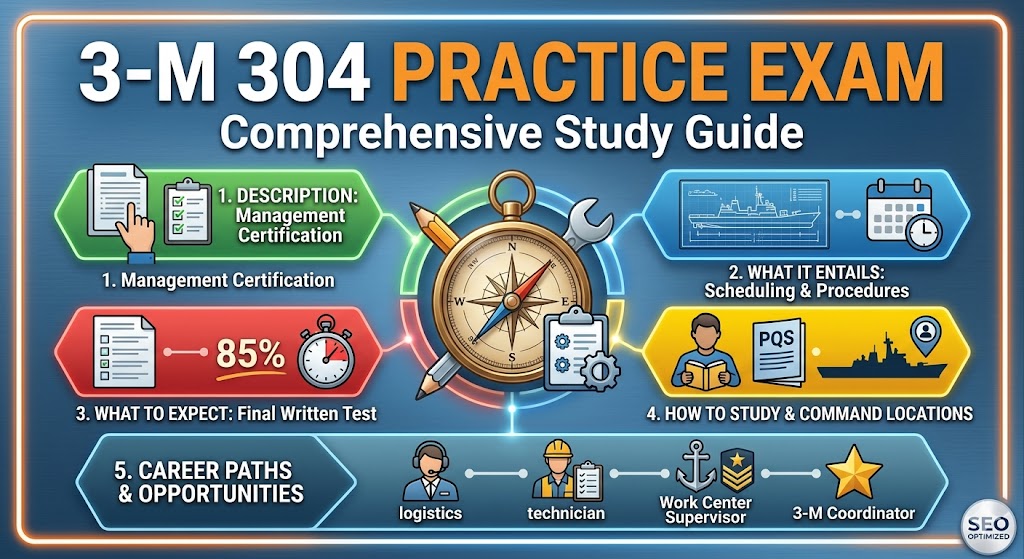
Additional Information
What the Course Entails and Exam Details
The 3-M 304 course, typically completed as part of a Personal Qualification Standard (PQS), covers a comprehensive array of technical and administrative procedures essential to Navy maintenance. Key topics and skills include, but are not limited to: understanding and processing Feedback Reports (FBR) to correct maintenance documentation; managing Job Control Numbers (JCN) for maintenance tracking; interpreting Advance Change Notices (ACN) and validating Maintenance Index Pages (MIP) and Maintenance Requirement Cards (MRC); utilizing the Consolidated Ship’s Maintenance Project (CSMP) to view equipment material conditions; administering the Inactive Equipment Maintenance (IEM) program; conducting and documenting various types of maintenance spot checks; and effectively operating current 3-M software systems like SKED 3.2 for scheduling and accountability. The qualification process involves both self-study of the PQS and practical, hands-on application of these skills under the guidance of qualified personnel.
What to Expect in the Final Exam
The 3-M 304 final exam is typically a written test administered internally within a Sailor’s assigned command by the command's designated 3-M Coordinator (3MC). While specific formats may vary, it commonly features multiple-choice and true/false questions designed to assess the candidate's understanding of the theoretical concepts and administrative processes. The exam represents a significant challenge, requiring a passing score of 85 percent or higher to qualify. Candidates must demonstrate not only knowledge of terms but also the ability to apply 3-M rules to practical scenarios. If a candidate does not pass, they will undergo remediation, often with a 3-M Assistant (3MA), before being allowed to reschedule a retake, typically no earlier than one week after the failed attempt. Satisfactory completion of all associated practical PQS line items and spot checks is a prerequisite for taking the written exam.
How to Study and Exam Centers
Preparation for the 3-M 304 qualification requires a proactive and dedicated approach. Your primary study resource is the PQS itself. Ensure you have the most current version and diligently work through each line item, seeking signatures only after you have truly mastered the task or concept. Utilize the 3-M systems active on your ship, such as SKED, to practice scheduling, documenting, and searching for information. Seek out experienced Work Center Supervisors or 3-M Coordinators for mentorship and to perform practice spot checks. Many Navy commands offer additional training resources, study groups, or remediation with a 3MA, which are invaluable for reinforcing your knowledge. Since the exam is administered internally by your command's 3MC, there is no external exam center or online portal for the final test; the physical location will be within your command or on your vessel as directed by your 3-M leadership.
Job Opportunities from the Course
Successfully achieving the 3-M 304 qualification is a vital step in career advancement for Navy personnel, especially those in engineering and combat systems ratings. It is an indispensable credential for those aspiring to, or currently serving in, key leadership and maintenance management roles. This certification unlocks and is often required for specific job titles and career paths, including:
• 3-M Coordinator (3MC): A critical command-level role overseeing the entire 3-M program.
• 3-M Assistant (3MA): Providing key departmental or divisional support for the 3-M program.
• Work Center Supervisor (WCS): The leader responsible for a specific shop's maintenance accomplishment.
• Division Officer (DIVO): Officers with significant 3-M program oversight and approval authorities.
• Navy 3-M Technician: Civilian and contractor roles supporting fleet maintenance.
• Maintenance & Material Management Logistics Trainer: Educating both military and civilian personnel on the 3-M system.
• Maintenance Analyst/Data Entry Support: Roles involving the tracking and analysis of maintenance data for continuous improvement.
Frequently Asked Questions
Reviews
5.0
Based on 0 reviews
Leave a Review
No reviews yet. Be the first to review!