
Mandible, TMJ, Bone Modeling Practice Test
$69.00
- Buy to unlock unlimited access to all Quiz questions and Answers in this Quiz.
- After purchase you can print a PDF of the whole quiz at any point. The PDF will contain the questions and the correct answers.
About this Exam
This practice test is an essential resource for students preparing for examinations in dental anatomy, physiology, and skeletal biology. It is specifically designed for individuals pursuing certifications or degrees in dental hygiene, dental assisting, pre-dental studies, pre-medical courses, or advanced anatomical sciences. This test provides a complete overview of critical concepts related to the human jaw and jaw joint (TMJ), and the essential physiological process of bone modeling. It serves as a vital self-assessment tool to build confidence and identify knowledge gaps before sitting for a high-stakes certification or final examination.
Ready to test your knowledge?
Buy Now to Access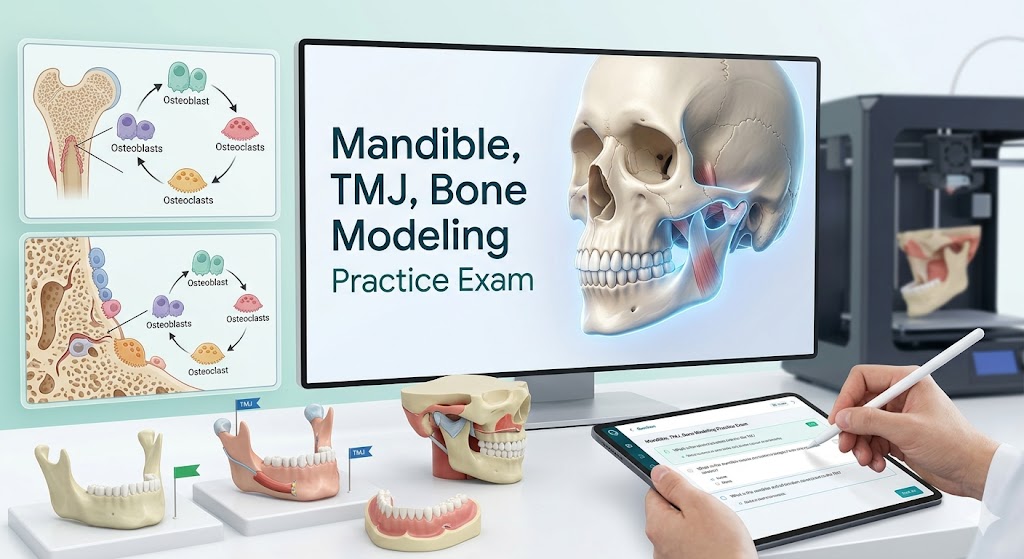
Additional Information
What the Course
Entails and Exam Details
The corresponding course or curriculum that this practice
test supports focuses on the intricate details of craniofacial anatomy and
basic bone physiology. This test provides a simulated experience covering these
key areas:
- Gross
Anatomy of the Mandible: Comprehensive knowledge of landmarks (such as
the ramus, body, condyle, coronoid process, angle), foramina, and
attachment points for muscles of mastication.
- The
Temporomandibular Joint (TMJ): Understanding the unique structure of
this joint, including the articular disc, ligaments (capsular, lateral,
etc.), the mandibular fossa, and the associated musculature. Candidates
must also grasp the biomechanics of opening, closing, protrusion, and lateral
movements.
- Bone
Modeling and Remodeling Processes: Mastery of the roles of
osteoblasts, osteoclasts, and osteocytes. This section covers the basic
multicellular unit (BMU), the sequence of bone modeling, and how the body
maintains skeletal integrity, including hormonal and mechanical
influences.
- Clinical
Relevance: Application of knowledge to real-world scenarios, such as
understanding TMJ disorder (TMD), bone healing after extractions or
fractures, and orthodontic tooth movement.
What to Expect in the Final Exam
This practice test is structured to mirror the format of
standard certification or academic exams. While the final exam structure will
depend on the certifying body, candidates should typically expect:
- Format:
A predominant amount of multiple-choice questions (e.g., 60–100
questions). Some certifications may include matching exercises or
practical component identifications, where candidates must identify
structures from anatomical diagrams or photographs.
- Passing
Score Requirements: Passing scores generally fall between 70% and 80%.
Mastering this practice test is a strong indicator of achieving a high
score on the final exam.
- Time
Limits: Candidates are usually given 90 to 120 minutes to complete the
test. Strategic practice helps improve speed and accuracy.
- Specific
Rules: Final exams often require proctoring (either at a physical
testing center or online), prohibiting the use of notes or external aids.
Familiarize yourself with all candidate rules before testing.
- How to Study and Exam Centers
To succeed on this exam, candidates should adopt a
comprehensive, multi-faceted study approach that focuses on both rote recall
and conceptual understanding.
Recommended Study Strategies:
- Utilize
Anatomical Models: Spend time working with physical or high-quality 3D
digital models of the human skull and mandible to understand spatial
relationships.
- Create
Flashcards: Make digital or physical flashcards for complex anatomical
names, the six stages of bone remodeling, and definitions of terms like
BMU and articular disc.
- Group
Study: Collaborate with peers to explain complex physiological
concepts, like the mechanism of bone resorption by osteoclasts, to one
another.
- Textbook
and Video Review: Cross-reference practice test questions with a
standard textbook on dental anatomy and watch videos on TMJ mechanics to
reinforce learning.
How to Take the Final Exam: The actual examination is
typically administered through standardized procedures set by educational
institutions or certification boards.
- Specific
Physical Testing Centers or Authorized Schools: Most programs require
candidates to sit for the final exam at authorized testing facilities,
such as the dental school where they are enrolled, or accredited
professional testing centers.
- Pearson
VUE: For certain regional or national certifications, like some dental
assisting board exams, testing may be available through global
computer-based testing services like Pearson VUE. Candidates should check
their certifying body's handbook for specific locations and enrollment
processes.
Job Opportunities from the Course
Achieving proficiency in mandible, TMJ, and bone modeling
anatomy is a foundational requirement for numerous essential careers within
healthcare and the dental sciences. This coursework directly supports the
prerequisite knowledge for the following career paths:
- Dental
Assistant: Understanding mandibular anatomy is essential for taking
effective x-rays, assisting in extractions, and educating patients.
- Dental
Hygienist: Proficiency in TMJ function is vital for patient
assessment, managing TMD, and providing comprehensive oral care.
- Dental
Technologist / Laboratory Technician: Knowledge of jaw movement and
anatomy is key to fabricating correct dental prosthetics.
- Surgical
Technologist: Vital anatomical knowledge for supporting maxillo-facial
or oral surgeries.
- Pre-Dental
/ Pre-Medical Student: This serves as critical foundational science
preparation for entrance exams and upper-level anatomical studies.
- Medical
/ Dental Illustrator: Expertise in this specialized anatomy is
required for creating educational materials.
- Orthodontic
Assistant: Understanding bone modeling is fundamental to grasping how
orthodontic appliances move teeth.
- Physical
Therapy Assistant: Opportunities exist to specialize in helping
patients manage TMJ disorders and craniofacial pain through focused
rehabilitation.
Frequently Asked Questions
Reviews
5.0
Based on 0 reviews
Leave a Review
No reviews yet. Be the first to review!