
Maricopa County Process Server Practice Exam
$69.00
- Buy to unlock unlimited access to all Quiz questions and Answers in this Quiz.
- After purchase you can print a PDF of the whole quiz at any point. The PDF will contain the questions and the correct answers.
About this Exam
Embarking on a career as a Certified Private Process Server
in Maricopa County is an excellent way to enter the dynamic world of the
Arizona legal system. A Process Server holds a critical position, acting as a
vital link in the chain of justice. Their primary responsibility is to deliver
essential legal documents—such as summonses, complaints, and subpoenas—to the
correct individuals.
This ensures all parties are properly and formally notified
of a legal action, upholding their fundamental rights to due process. This path
is perfectly designed for detail-oriented individuals seeking an independent
and impactful career within the legal sector. By successfully navigating the
certification process, you become an integral part of maintaining the fairness
and integrity of our court systems.
Ready to test your knowledge?
Buy Now to Access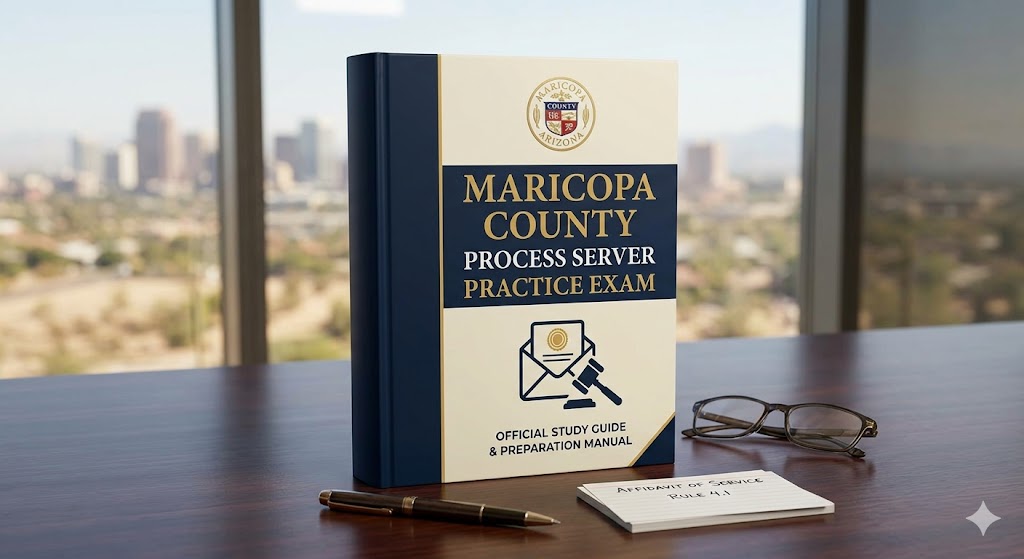
Additional Information
What the Course Entails and Exam Details
While the state of Arizona does not mandate a singular, structured "course" to become a Process Server, the required body of knowledge is extensive. The certification examination is designed to test your mastery of the rules, statutes, and ethical standards that govern legal notification.
The core syllabus covers critical areas including the Arizona Rules of Civil Procedure, specifically Rule 4 and Rule 4.1, which dictate the acceptable methods for service of process. You must also study the relevant sections of the Arizona Revised Statutes, notably Title 11. Other vital topics include proof of service requirements, professional conduct, ethics, and the obligations of continuing education needed to maintain your three-year certification. Official study materials are often provided by the Maricopa County Superior Court.
What to Expect in the Final Exam
The final exam is a formal, timed assessment. While the specific format can be determined by the presiding judge of each county, the Initial Certification Examination generally consists of a comprehensive series of multiple-choice and/or true/false questions. These questions are designed to simulate real-world scenarios and test your direct understanding of Arizona's legal rules.
In many Arizona counties, you must achieve a rigorous passing score—often 85% or higher—to demonstrate competence. Applicants typically have a generous time limit, such as 90 minutes, to complete the exam. It is essential to be punctual, provide proper identification, and adhere strictly to the testing protocol set by the court clerk to ensure a smooth and successful testing experience.
How to Study and Exam Centers
Preparation is paramount. The single best study strategy is to thoroughly digest the official study guide and training materials provided directly by the Maricopa County Superior Court Process Server Program. We strongly encourage you to supplement this with the free training manual and study guide offered by the Arizona Process Servers Association (APSA).
Engaging with a "Maricopa County Process Server Practice Exam" is a highly effective way to familiarize yourself with the question style and manage your time effectively. For exam logistics, applicants in Maricopa County must contact and file their initial application with the Maricopa County Superior Court directly at (602) 506-3204. They will provide the precise location for in-person testing, which is typically held within a specialized testing area at the court itself. Always verify with the court if any online testing portal options are available.
Job Opportunities from the Course
Earning your certification as a Process Server in Maricopa County unlocks a variety of career opportunities, ranging from self-employed contracts to stable, in-house positions. Here is a list of job titles and career paths this certification enables:
• Certified Private Process Server (Independent Contractor)
• Legal Courier and Delivery Specialist
• Process Server Manager within a dedicated firm
• Legal Support Manager overseeing a process serving division
• Legal Assistant specializing in litigation support
• Paralegal with focused expertise in family or civil law
• Bailiff/Process Server (for specialized or tribal jurisdictions)
• Surveillance and Field Investigator (often a combined role)
Frequently Asked Questions
Reviews
5.0
Based on 0 reviews
Leave a Review
No reviews yet. Be the first to review!