
Marine Corps Combat Fitness Test (CFT) Practice Test
$69.00
- Buy to unlock unlimited access to all Quiz questions and Answers in this Quiz.
- After purchase you can print a PDF of the whole quiz at any point. The PDF will contain the questions and the correct answers.
About this Exam
The United States Marine Corps Combat Fitness Test (CFT) is a mandatory, annual physical performance assessment designed to evaluate a Marine's readiness for the physical rigors of contemporary combat operations. It complements the standard Physical Fitness Test (PFT) by focusing on functional, combat-relevant tasks rather than pure distance running and bodyweight exercises. All active-duty and reserve Marines, regardless of their Military Occupational Specialty (MOS), age, or rank, must take and pass the CFT. The test is specifically designed to measure a broad spectrum of physical attributes needed in a combat environment, including anaerobic capacity, upper body and core strength, agility, and overall explosive power. It is taken during the latter half of the calendar year, between July 1 and December 31
Ready to test your knowledge?
Buy Now to Access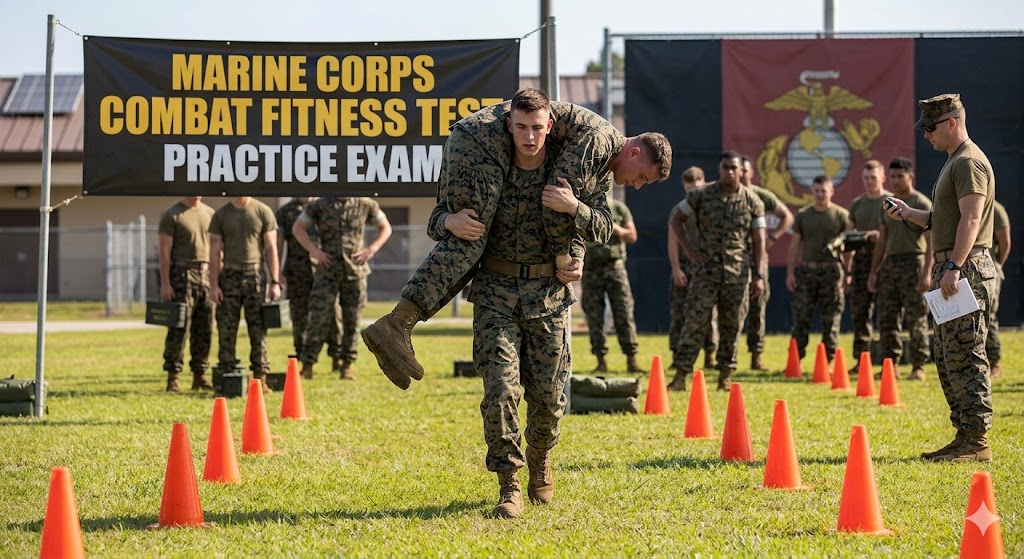
Additional Information
What the Course Entails and Exam Details
The CFT consists of three timed events executed in sequence
with defined rest periods. Marines perform the test in their standard combat
utility uniform—known as "MARPAT" (Marine Corps Pattern) trousers and
blouse—and combat boots. This equipment requirement is crucial, as it simulates
the load and restrictive nature of actual operational attire.
The core topics, or events, are:
Movement to Contact (MTC):
A timed 880-yard sprint. This event assesses a Marine's ability to move quickly
over distance under pressure, simulating an approach to a combat zone.
Ammunition Lift (AL): This
event tests upper body strength and muscular endurance. Marines must lift a
standard 30-pound M2A1 ammunition can from ground level to a full overhead
lockout as many times as possible within two minutes. Proper form requires a
complete lockout of the elbows and the can returning to a minimum level below
the chin.
Maneuver Under Fire (MANUF):
This is a complex, 300-yard shuttle run that incorporates a series of
combat-related tasks. It includes a 10-yard sprint, a 15-yard low crawl, a high
crawl, dragging a casualty, carrying a casualty (fireman's carry), a 75-yard
sprint while carrying two 30-pound ammo cans through an agility course of
cones, a simulated grenade throw into a marked circle, five pushups, and a
final sprint with the ammo cans to the finish line.
What to Expect in the Final Exam
You must expect a demanding physical challenge where time
and proper execution are critical. The CFT is a purely practical, pass/fail
exam based on numerical scoring. The maximum possible score is 300 points, with
100 points attainable for each of the three events. Scoring scales are adjusted
for age brackets and gender to ensure fairness while maintaining rigorous
standards.
To pass the CFT, a Marine must achieve a minimum score in each
of the three events and a minimum total combined score. Performance is
categorized into three classifications: 1st Class (highest), 2nd Class, and 3rd
Class. A 3rd Class score is the minimum required to pass.
Your final score is directly tied to your career
progression; 1st Class scores are essential for remaining competitive for
promotion, special duty assignments, and retention within the Marine Corps.
Failure to pass the CFT is a serious administrative issue that can result in
adverse fitness reports and hinder or end a Marine's career.
How to Study and
Exam Centers
Preparation for the CFT requires a training regimen that
mirrors the demands of the events. Since the test is physical, there is no
written content to study; your preparation must be done on the track and in the
gym. Actionable study strategies include:
Interval Training: To
prepare for the Movement to Contact and the sprints in the Maneuver Under Fire,
incorporate high-intensity interval training (HIIT). Work on 400-meter and
800-meter repeats to build anaerobic capacity.
Functional Strength Training:
For the Ammunition Lift, focus on overhead pressing, push presses, and muscular
endurance for the shoulders and core. Practice lifting a weight similar to the
30-pound ammo can for a full two minutes.
Specific MANUF Drills: You
must practice the sequence of the Maneuver Under Fire to build efficiency. Find
a field and set up a course with cones to practice the agility run, casualty
drag, fireman's carry, and grenade throw technique under fatigue.
Train in Uniform: A
critical mistake is training only in gym gear. Conduct regular,
mock CFTs in full utilities and
boots to accustom your body to the added heat and restriction.
The Combat Fitness Test is administered at official Marine
Corps installations worldwide. Testing is typically organized at the unit level
and conducted by certified Force Fitness Instructors (FFIs) or designated
Command Physical Training Representatives (CPTRs) who are trained to enforce
standard form and timing.
Job Opportunities
from the Course
Passing the Marine Corps Combat Fitness Test does not
"unlock" new jobs outside the military, but it is an absolute
requirement for maintaining and advancing a career within the US
Marine Corps. It validates that a Marine is operationally ready to fulfill
their duties. Successfully passing the CFT maintains eligibility for:
- All
Military Occupational Specialties (MOS) from Infantry to Intelligence.
- Selection
for leadership and NCO (Non-Commissioned Officer) promotion.
- Special
assignments and schools, including Drill Instructor, Recruiter, Marine
Security Guard, and MARSOC (Marine Forces Special Operations Command)
selection.
- Commissioning
programs for enlisted Marines to become officers.
- Regular
re-enlistment and continuation of service in the Marine Corps.
Frequently Asked Questions
Reviews
5.0
Based on 0 reviews
Leave a Review
No reviews yet. Be the first to review!